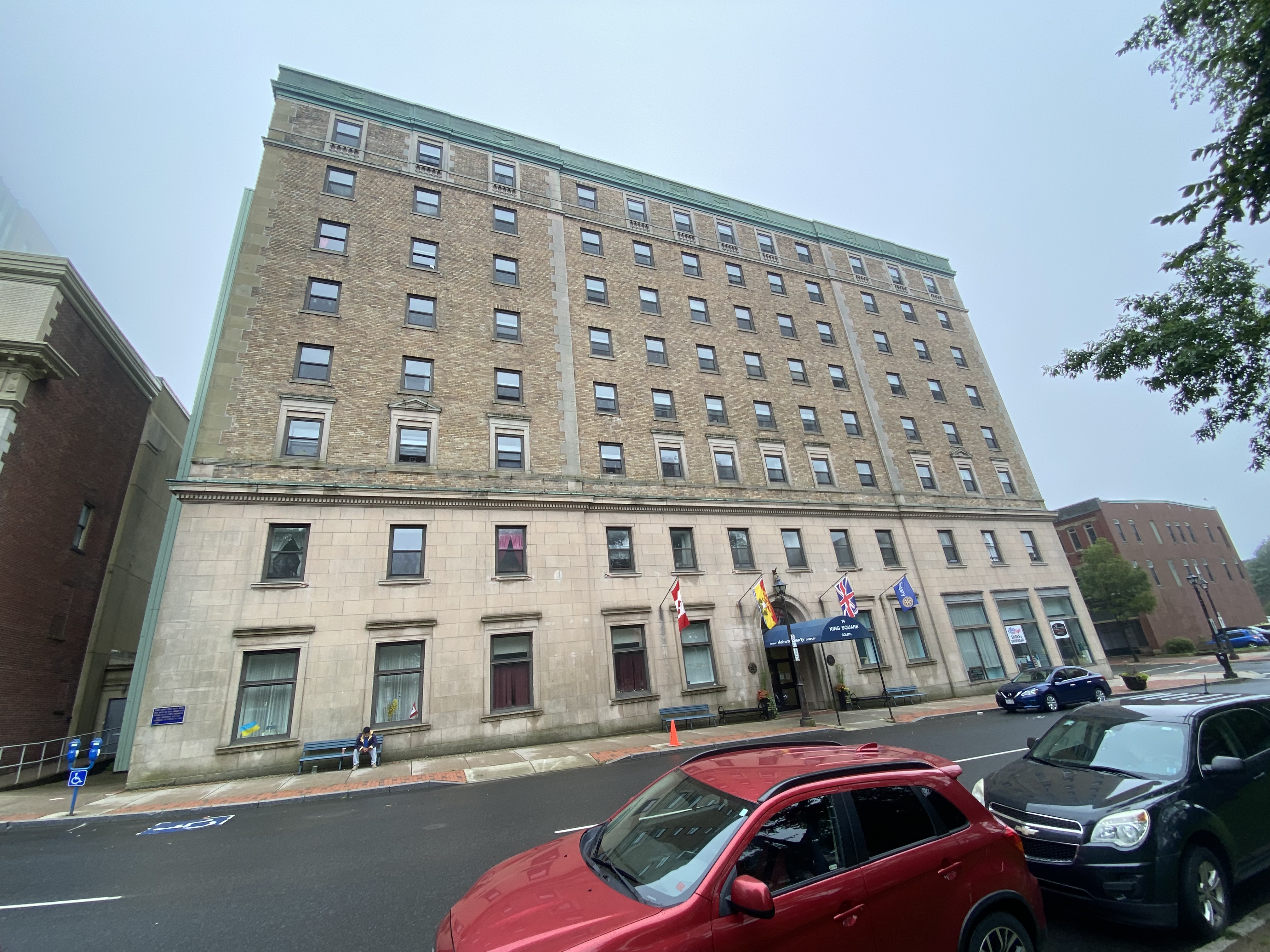
Admiral Beatty Hotel
On the morning of May 20, 1932, Amelia Earhart sat in the Admiral Beatty Hotel's dining room eating breakfast. She had flown into Millidgeville the day before and spent the night at the hotel. A Telegraph-Journal reporter handed her that day's edition, which featured her photograph. Earhart took the newspaper aboard her plane and flew to Northern Ireland, making it -- according to the Telegraph-Journal -- the first North American newspaper to arrive in Europe on its day of publication. It is exactly the kind of story the Admiral Beatty collected during its fifty-seven years as Saint John's grandest hotel: glamorous, improbable, and tinged with the awareness that such moments could not last forever.
From Windmill to Ballroom
The ground beneath the Admiral Beatty carries its own layered history. In 1807, the site held a struggling windmill that was briefly commandeered by the Kings County Militia during tensions between Great Britain and the United States. After the mill failed, it became a poorhouse -- serving that grim purpose until fire destroyed it in 1817. The Dufferin Hotel rose on the same plot and operated for roughly forty-five years before closing its doors on October 29, 1923. Demolition began on January 22, 1924, and in its place, the architectural firm Ross and Macdonald designed an eight-story neoclassical building of stone and brick, standing 148 feet tall with 250 rooms. Named for Admiral of the Fleet David Beatty, the hotel took its first ten guests on June 16, 1925, and held its opening ceremonies six days later.
The Largest in the Maritimes
Upon opening, the Admiral Beatty claimed the title of the largest hotel in the Canadian Maritimes. Its amenities suited the ambition: a Georgian ballroom, a main dining room, a barber shop, a cafeteria, a lounge, and a regal suite reserved for royalty and visiting dignitaries. The hotel became Saint John's default venue for events that mattered -- luncheons, political meetings, conventions. The Liberal Party met there in December 1925. The Canadian Chamber of Commerce held its first convention at the Admiral Beatty in 1926. Princess Juliana of the Netherlands visited, drawing such a crowd that police had to form lines in front of the hotel. Billy Graham gave an interview there in 1964. For four decades, the Admiral Beatty was where Saint John went to feel important.
The Front Door and the Back
The hotel's grandeur had a boundary. Prior to the early 1950s, the Admiral Beatty barred Black residents of Saint John from entering. When Black performers came to the city -- artists of the stature of Louis Armstrong and Ella Fitzgerald -- they were made to enter through the back door. The policy held until Lena O'Ree insisted on using the front entrance, a personal act of defiance that helped crack one of the unwritten racial codes governing life in the Maritimes. The Admiral Beatty's segregation was not unique to the city or the era, but it is part of the building's record -- a reminder that the elegance of the Georgian ballroom did not extend equally to everyone who might have wished to dance in it.
Decline and Second Life
By the 1970s, newer hotels in Saint John began drawing business away from the aging Admiral Beatty. In May 1982, the Board of Trade Dining Room closed due to rising costs. By October, the hotel itself shut down. Demolition seemed likely until the Rotary Club of Saint John launched a $350,000 fundraising campaign in 1984 to save the building. Their effort succeeded. On August 8, 1984, the Court of Queen's Bench approved the sale of the property for $550,000 to a nonprofit organization called Admiral Beatty Estates Ltd. The building was converted into senior citizen apartments, and the first tenants moved in after Christmas 1985. Now called the Rotary Admiral Beatty Complex, the neoclassical facade still stands at the intersection of King Square South and Charlotte Street, adjacent to the Imperial Theatre -- a building that outlived its original purpose by finding a new one.
From the Air
Located at 45.27N, 66.06W at King's Square in Saint John, New Brunswick. The eight-story neoclassical building is visible in the downtown core adjacent to the Imperial Theatre. Best viewed at 2,000-3,000 feet AGL. Nearest airport: Saint John Airport (CYSJ), approximately 6 nm east. The compact downtown of Saint John, set on hilly terrain above the harbour, provides good visual context for spotting the building.