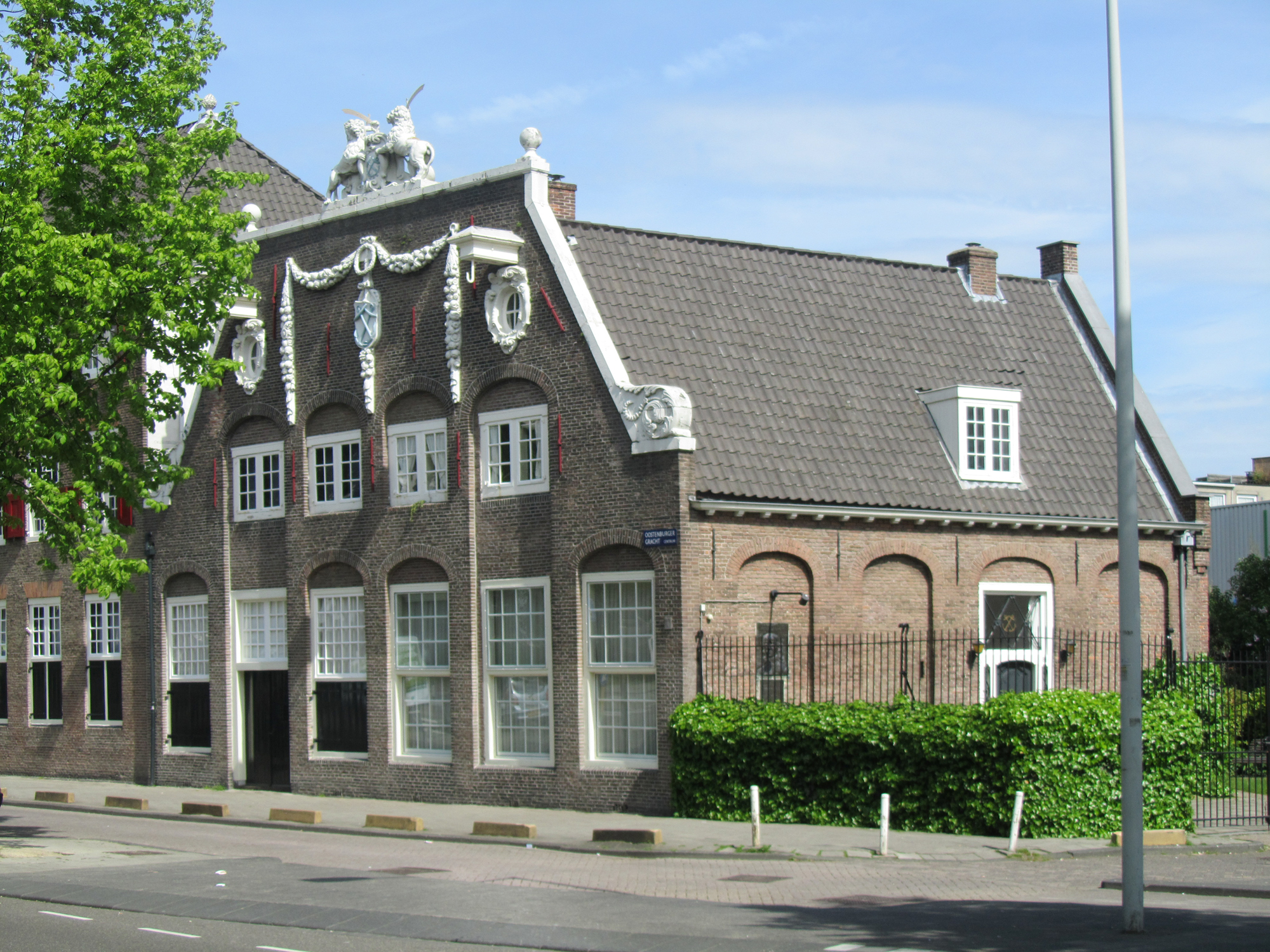
Admiraliteitslijnbaan, Amsterdam
Every wooden warship of the Dutch Golden Age required something almost no one thinks about anymore: roughly thirty miles of rope. Standing rigging, running rigging, anchor cables thick as a man's thigh, miles of cordage spun from imported hemp and rolled in tar to keep the salt out. Rope this long could not be made indoors in any normal building. It had to be twisted along a straight line, hundreds of meters of straight line, in covered sheds called ropewalks. On the eastern islands of Amsterdam, the Admiralty of Amsterdam built one of the longest such sheds in Europe, five hundred meters end to end, and at its head a small ornate building with a coat of arms of two crossed blue anchors. The shed is gone. The little building is still there.
The Industrial Geography of an Empire
In 1655, the Admiralty of Amsterdam moved its shipyards to two newly reclaimed islands in the eastern harbor: Kattenburg and Oostenburg. The islands were created deliberately for the work. They had the space, the access to the IJ bay for launching hulls, and crucially the room for what shipyards in cramped older neighborhoods could not provide - the long straight runs that ropemaking demanded. In 1660, on Oostenburg, the Admiraliteitslijnbaan was constructed. From its front building, the covered shed ran 500 meters in a straight line toward the IJ, between what are now the Oostenburgervaart canal and Conradstraat. Beside it stood a parallel building of the same year: the ropewalk of the Dutch East India Company, the VOC. Two of the most powerful organizations of the seventeenth century had set up their cordage works wall to wall. One supplied the Republic's navy, one supplied its merchant fleet. Together they produced the rope that held a maritime empire together.
The Trapezoid and the Lions
The front building was small, but it was meant to be seen. Its facade was trapezoidal, narrowing as it rose. Festoons of carved fruit and ribbon ran across the stone. Two oeil-de-boeuf windows - round oxeye openings - punctured the upper level, and niches with arched tops climbed the wall, some stretching across both floors. At the very top sat the building's signature: a sculpture of two lions, holding bronze swords, leaning against a coat of arms with two crossed blue anchors. That coat of arms was the symbol of the Admiralty of Amsterdam, and the same emblem reappeared inside the festoons. A visitor to Oostenburg in 1670 was meant to understand at a glance whose rope was being made here. It was state work, and the state wanted credit.
Fire, Fog, and a Lucky Day
Ropewalks were terrifying fire hazards. The tar pots simmering at one end, the heaps of dried hemp, the wooden walls, the tarred cordage hanging from beams - any spark could turn the entire 500 meters into a single roaring tunnel of flame. On 12 January 1673, fire broke out at the Admiraliteitslijnbaan. The crews who arrived to fight it were not using ordinary leather buckets. They were using a new device designed by the Amsterdam painter and inventor Jan van der Heyden: fire hoses fitted with fog nozzles, which broke water into a fine mist that smothered flame better than a jet ever could. The fire at the ropewalk was the first time in recorded history that fog nozzles were used in firefighting. They worked. The ropewalk was saved. Van der Heyden's design would spread across Europe and eventually around the world, and the technology that was tested on a January morning in Oostenburg now sits inside the cabs of fire trucks in every major city.
The Apprentice Tsar
In August 1697, a young Russian visitor arrived in Amsterdam under the obviously transparent alias of Pyotr Mikhailov. He was Peter Romanov, Tsar of all the Russias, then twenty-five years old and obsessed with shipbuilding. He had come west on what was known as the Great Embassy, in part to study how the Dutch built their fleet. He worked for four months at the VOC shipyards on Oostenburg, learning carpentry and naval construction with his own hands. Tradition holds, and a plaque mounted in 1947 attests, that he may have lodged at the Admiraliteitslijnbaan during this time. Whether he slept inside this exact building is uncertain. That he walked past it daily, that he saw the lions and the crossed anchors and the long shed running toward the harbor, is not. Two decades later, on the Neva, he would build a fleet and a capital named for himself, partly with what he had learned in this corner of Amsterdam.
Slow Decay and a Footprint
The Admiralty was dissolved in 1795 when the Batavian Republic replaced the old Dutch Republic. The building was renamed s Rijks Lijnbaan, the National Ropewalk, and then slowly forgotten. Through the nineteenth century both the Admiralty and the VOC ropewalks were left to decay. In 1887 they were declared too dilapidated to operate. Around 1920 the long sheds behind the front buildings were torn down. Only the ornate facades remained, repurposed as military storage for vehicles, clothing, and gear, a role they served until 1983. Squatters moved into the storage buildings in 1985 and were evicted three years later, after which the storage halls themselves were demolished. The front building of the Admiraliteitslijnbaan, with its lions and its blue anchors, became a rijksmonument in 1970 and survives intact. Walk Oostenburgergracht today and you find a residential neighborhood whose street names - Compagniestraat, Touwbaan, Admiraliteitstraat - quietly memorialize what used to lie behind that ornate facade: five hundred meters of straight darkness, and the slow turning of hemp into rope for the ships of an empire.
From the Air
The Admiraliteitslijnbaan stands at 52.368 N, 4.925 E on the Oostenburgergracht in eastern Amsterdam, on the artificial island of Oostenburg, immediately south of the IJ harbor. From altitude, look for the eastern docklands of Amsterdam, just east of the historic center and north of the Plantage. Nearest airport is Amsterdam Schiphol (EHAM) about 15 km southwest; Lelystad (EHLE) lies east-northeast. The building sits inland from the IJ by about 500 meters - exactly the length of the demolished ropewalk.