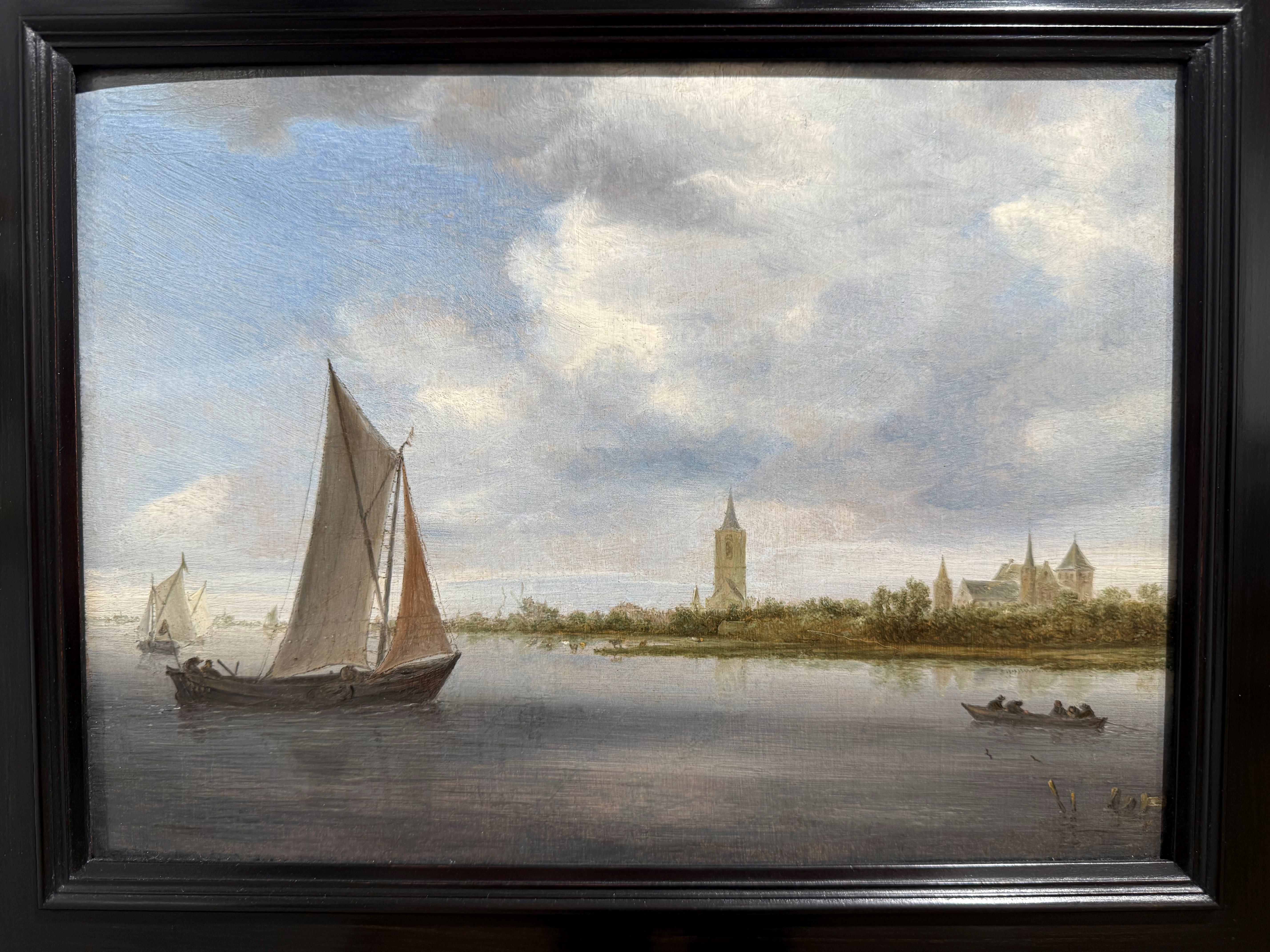
Adrichem Castle
The castle is gone. The field is a campground now - rows of caravans and pop-up tents along the Sint Aagtendijk, holidaying families running extension cords across the grass. Six hundred years ago, this same patch of damp ground in Beverwijk held a stronghold whose first lord helped kill a Count of Holland by stabbing him twenty times. The stronghold was razed in retaliation. A second castle rose. It served as a country retreat for Amsterdam merchant families through the Golden Age. The French Revolution arrived, dragged the Netherlands into its orbit, and by the early 1800s the second Adrichem too was demolished. Three layers of building, one persistent rumor of a ghost, and finally a meadow let out to campers.
The Murder of Floris V
On 27 June 1296, a group of Dutch noblemen kidnapped Floris V, Count of Holland, and locked him in Muiden Castle on the Vecht. The conspirators included Gerard van Velsen, lord of Beverwijk, Noordwijk, and Velsen - and master of the first castle on this site. When Floris tried to escape, the noblemen ran him down on horseback and stabbed him to death. Twenty wounds, by the chroniclers' count. The motive most commonly offered, then and now, is that Floris had raped Gerard's wife and that she had taken her own life as a result; whether that was true or political slander has never been settled. What followed was not in dispute. Gerard was hunted down, tried, and executed. His lands were seized. His castle at Adrichem was pulled down stone by stone. The first Adrichem ended in retribution.
The Second Castle
Thirty years later, in 1326, Dirk van Valkenburg built a new castle on the same ground. He was thought to be an illegitimate son of Dirk III van Brederode - the same Brederode family whose proper seat sat a few kilometers south, in ruins above Santpoort, even now. The second Adrichem lasted nearly five hundred years. It outgrew its medieval origins, became a moated country house, then a refined Golden Age retreat for wealthy Amsterdam merchants who escaped the city's smells for summer breezes off the Wijkermeer. By the eighteenth century it was the kind of place that drew the topographical draftsmen: Roelant Roghman drew it from front and rear in 1647, Cornelis Pronk drew it again in 1753. The pictures show formal gardens, ranked pilasters, an order pleased with itself.
Inside the Vanished Walls
The most precise account of the interior survives because of how the castle ended. An 1805 auction catalog described the building room by room, intending to fetch the best price for the dismantled materials. You entered through a vestibule with a marble floor. Then a large hall, walls decorated with Corinthian pilasters and mirrors that doubled the candlelight. The catalog is the closest a modern visitor can get: nothing else survives. The last owner was Gijsbert Karel van Hogendorp, the liberal Dutch statesman who would help draft the Netherlands' first modern constitution in 1814; he came into Adrichem through his marriage to Hester Clifford, heiress of an Amsterdam merchant family. He kept it briefly. The French period - the Batavian Republic and then Napoleonic annexation - made country castles a hard inheritance to maintain. By 1812, the second Adrichem was rubble too.
The Swan Maiden
Local tradition keeps the place alive with a story. A lord of Adrichem, the tale says, lived alone in his grand castle. One day he saw a swan maiden swimming in the waters near his home - swan by day, woman when she set aside her swan garment. The lord crept down to the water's edge, stole the garment while she bathed, and so bound her to him. They lived as husband and wife. Years passed. The lord decided he wanted a regular wife instead. The swan maiden, hearing this, collapsed in grief and died. A white swan vanished into the sky above the castle. Afterwards, the villagers said, whenever misfortune approached Adrichem, passersby could hear sorrowful sounds drifting from the water, and sometimes see a magnificent white swan floating in the air above the ruined walls. Museum Kennemerland in Beverwijk holds a 1777 map of the castle and its surrounding gardens. The campground occupies the rest of what remains.
From the Air
Adrichem sits at 52.489 N, 4.670 E in Beverwijk, North Holland, on the western shore of the former Wijkermeer (now drained polderland). From the air, look for the Sint Aagtendijk threading northwest from Beverwijk town center toward the dunes - the campground field is on its western side. The North Sea Canal runs just south. Nearest airport: Amsterdam Schiphol (EHAM), 22 km south. Best viewed at 2,500-5,000 feet.