Aduard Abbey
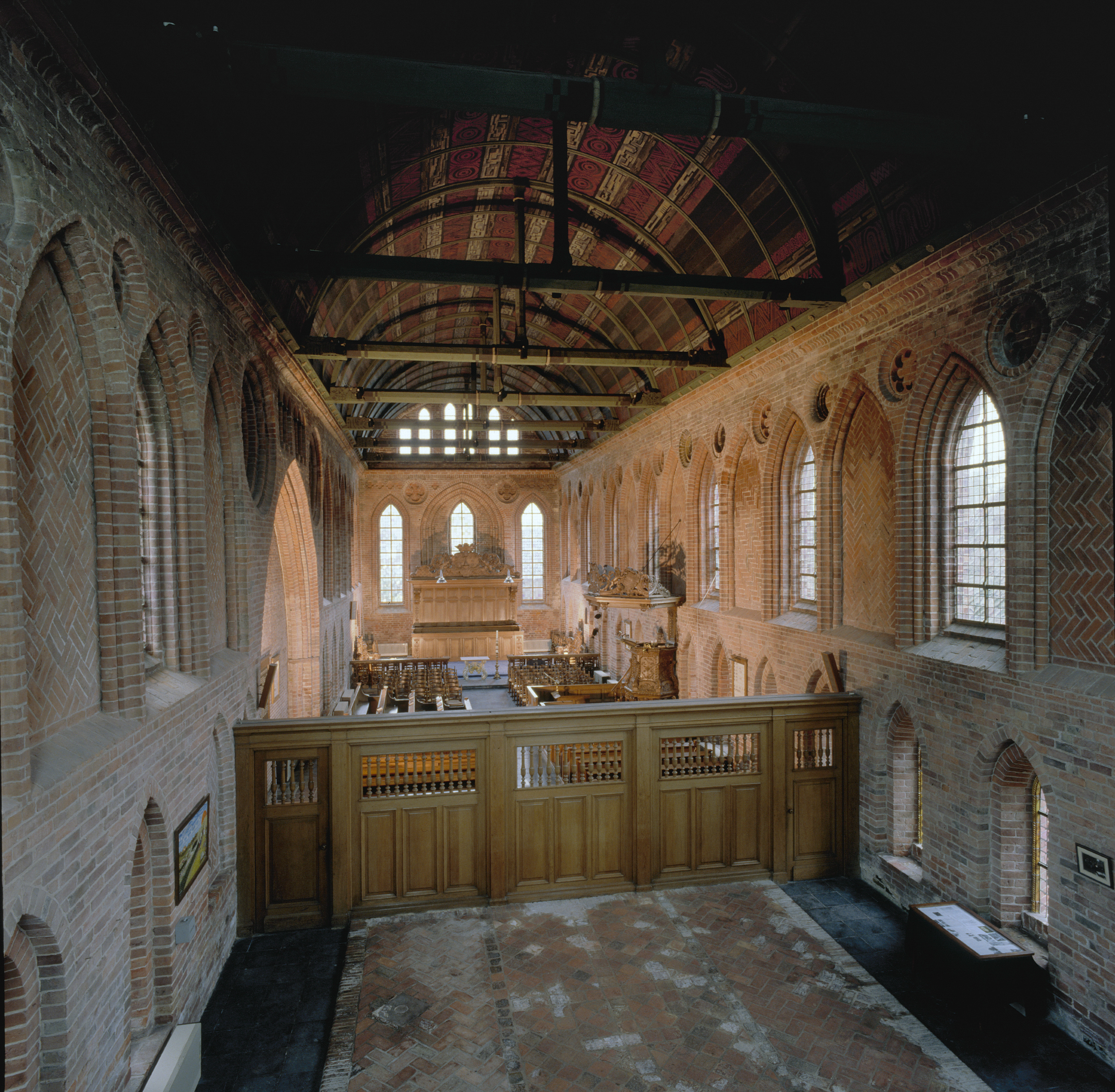
Three hundred white-robed monks once moved through the cloisters of Aduard Abbey, debating philosophy in a little academy that drew scholars from across Northern Europe. The abbey was the largest, wealthiest, and most famous monastery in the northern Low Countries. Today, the only piece of it still standing is what used to be the infirmary, repurposed in the 17th century as the village church. Walk through the present-day village of Aduard and you are walking through the abbey precinct itself - house lines and street grids still trace the bones of a vanished thing.
A Daughter of Clairvaux
The Cistercians founded Aduard in 1192, eight kilometres northwest of Groningen, as a daughter house in the long chain that ran back to Clairvaux Abbey in Burgundy. The pattern was always the same: white-habited monks arrived in a difficult landscape, drained the marshes, raised the embankments, and turned wetland into wheat. Aduard prospered. By the second half of the 15th century, under Abbot Henricus van Rees, some three hundred monks lived there. The abbey founded its own daughter, Ihlow Abbey in East Frisia, in 1231, and absorbed Termunten Abbey in 1259. Reclamation work along the Reitdiep transformed the surrounding countryside. The abbey did not merely sit in the landscape - it had built much of it.
The Aduarder Kring
From 1245 the abbey ran a school, but its real intellectual moment came two centuries later, in the mid-15th century, when the abbot opened the doors to outside scholars. They gathered in a small academy known as the Aduarder kring - the Aduard circle. Wessel Gansfort came, the Frisian theologian whose ideas would later influence Luther. Rudolf Agricola, the humanist who helped bring Italian learning north of the Alps, was a member. So was Alexander Hegius, who would teach Erasmus. A 1528 letter from Goswinus van Halen names twenty-three regular members and admits there were more. Philipp Melanchthon, writing from Wittenberg, praised the abbey and its students. For a few decades, a remote Frisian monastery was one of the more interesting rooms in Europe.
Letters in the Floor
Walk into the surviving infirmary today - the long brick hall with its pointed-arch windows and barrel-vaulted ceiling, dating from around 1300 - and look down. Part of the original 14th-century glazed-brick floor survives. Some of the plaster bricks are stamped, each with a single letter of the alphabet. They can be rearranged to spell out whole texts. Historians of typography count these letter bricks among the earliest physical experiments in moveable type, decades before Gutenberg. Whether the monks used them for inscriptions, instruction, or play is uncertain. What is certain is that on a quiet floor in the Groningen countryside, somebody was already thinking about letters as objects that could be picked up and moved.
Fire in 1580
The end came during the Reformation wars. In 1580, soldiers from the Geuzen - the Protestant rebels fighting Spanish rule - attacked the abbey. They burned the buildings. The priceless library went with them, and so did the monastery archives, centuries of land deeds and scholastic correspondence reduced to ash. The monks fled to their town house in Groningen. The empty walls did not stand long. Local people carted off the rubble and reused the bricks; you can still find Aduard brick in farmhouses across the surrounding countryside. The abbey was formally dissolved in 1594, and the last abbot died in 1613, an old man in a city that no longer needed monks. The infirmary survived only because it had been converted to other uses. In the 17th century it became a Reformed church, and it serves that purpose still.
From the Air
Aduard Abbey lies at 53.26 N, 6.46 E, about 8 km northwest of Groningen city centre. The nearest major airport is Groningen Airport Eelde (EHGG), roughly 18 km south. From low altitude on a clear day, the village of Aduard appears as a compact settlement in flat reclaimed farmland, with the surviving brick infirmary-church visible at its centre. The Reitdiep canal runs nearby - the same waterway the Cistercians helped engineer eight centuries ago.