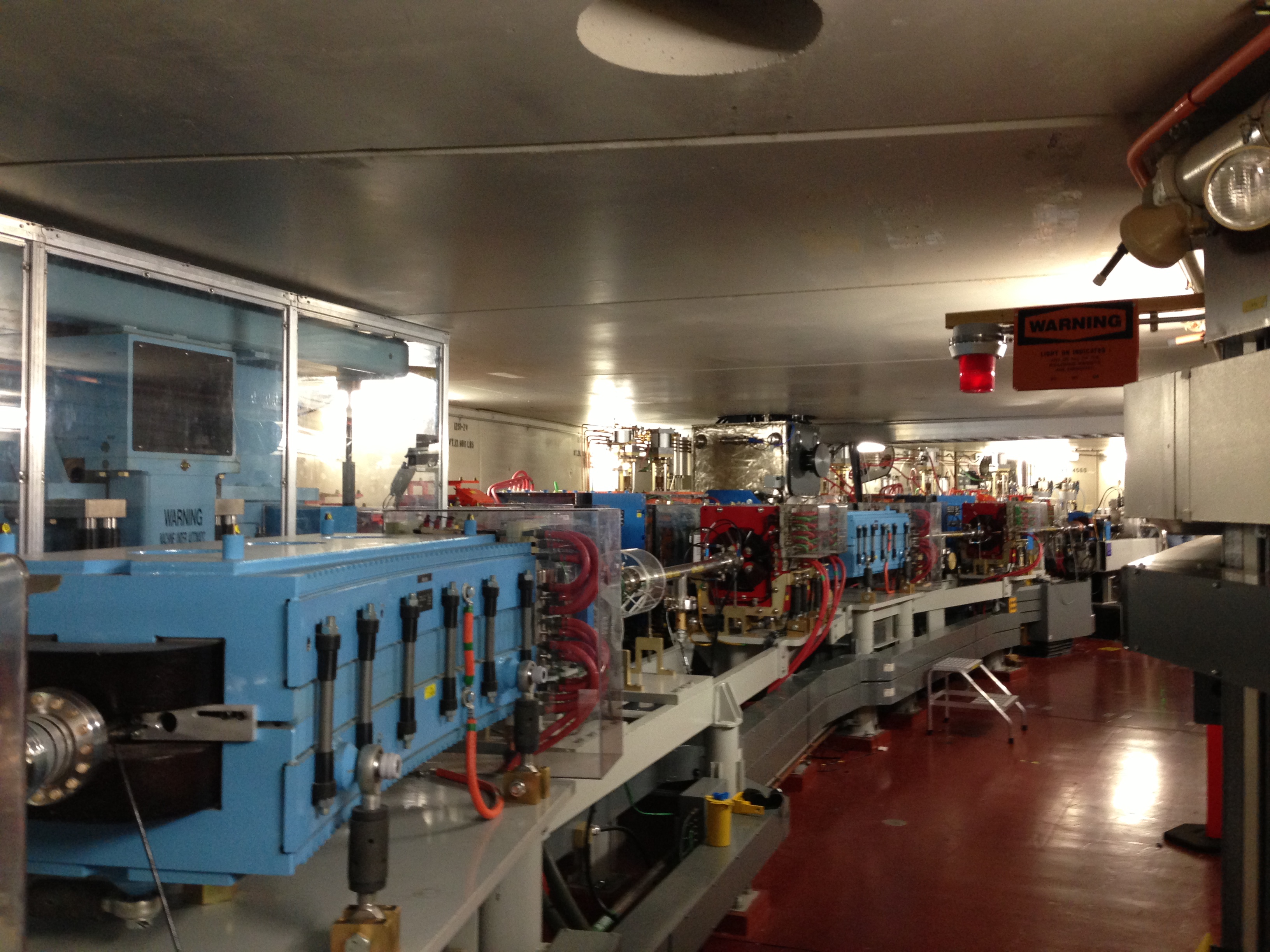
Advanced Light Source
The building gives nothing away. Perched in the eucalyptus-scented hills above the UC Berkeley campus, the domed structure at Lawrence Berkeley National Laboratory looks like it belongs to another era, because it does. Architect Arthur Brown Jr., the man who designed Coit Tower, drew up this dome in the 1930s to house Ernest O. Lawrence's 184-inch cyclotron, the machine that helped Lawrence win the 1939 Nobel Prize in Physics. Half a century later, the same dome became the shell for something Lawrence never imagined: the Advanced Light Source, one of the world's brightest sources of ultraviolet and soft X-ray light, where electrons traveling near the speed of light produce beams that let scientists see the invisible architecture of matter.
The Skeptics Were Wrong
When former Berkeley Lab director David Shirley first proposed the ALS in the early 1980s, the scientific community was unconvinced. A synchrotron optimized for soft X-rays and ultraviolet light? Who would use it? Former ALS director Daniel Chemla recalled the resistance: "The scientific case for a third-generation soft X-ray facility such as the ALS had always been fundamentally sound. However, getting the larger scientific community to believe it was an uphill battle." The Reagan administration's 1987 budget allocated $1.5 million for construction. Ground was broken in 1988. By March 1993, the ALS was commissioned, and on the morning of October 22, 1993, the facility held its official dedication. It was the first third-generation synchrotron light source in its energy range anywhere in the world. The skeptics found other things to be skeptical about.
A Slalom at Light Speed
Understanding how the ALS works requires a shift in mental scale. Bunches of electrons race around a storage ring, circling 1.4 million times per second at velocities approaching the speed of light. Powerful magnets bend them into a nearly circular path. Between the bending magnets, in straight sections of the ring, devices called undulators force the electrons into a slalom-like weave through dozens of magnets with alternating polarity. Each time the electrons change direction, they shed energy as electromagnetic radiation: beams of light spanning the spectrum from infrared through visible, ultraviolet, and X-ray wavelengths. These beams, tightly focused along the direction of the electrons' path, stream down nearly 40 beamlines to experiment stations where researchers put them to work.
What the Light Reveals
About 2,000 researchers use the ALS each year, arriving from academic, industrial, and government laboratories around the world. Sixteen percent come from outside the United States. They use the facility's soft X-rays to probe the electronic structure of matter, image biological cells in three dimensions, solve protein structures for drug design, and test the optics that will etch the next generation of computer chips. The beamlines operate more than 5,000 hours per year, generating nearly 1,000 scientific publications annually. Any qualified researcher can propose beam time, and if the work is nonproprietary, the time is free. The ALS fills a niche that complements other Department of Energy light sources: its specialty is the lower-energy soft X-rays that reveal microscopic structures with elemental and chemical specificity.
From Cyclotron to Light Fountain
The history layered into the ALS building is part of its character. Lawrence Berkeley National Laboratory traces its origins to Ernest O. Lawrence's invention of the cyclotron in the early 1930s, a device that accelerated particles in a spiral path using magnetic fields. The 184-inch cyclotron that once lived beneath the dome was the most powerful of its kind, a machine whose descendants would reshape nuclear physics. When the ALS was built inside the same structure, it preserved a physical connection between two eras of particle science. The dome, with its Depression-era bones and its late-twentieth-century instruments, embodies the laboratory's philosophy: build on what came before. Where Lawrence used magnetic fields to smash atoms apart, the ALS uses them to coax electrons into producing light fine enough to examine atoms whole.
Brighter Still
The ALS is not standing still. A major upgrade project called ALS-U will replace the existing storage ring with a new design using powerful, compact magnets arranged in a dense circular array known as a multibend achromat lattice. Combined with a new accumulator ring and other accelerator improvements, the upgraded machine will produce beams of soft X-ray light at least 100 times brighter than the current facility. For researchers, that means probing matter with unprecedented detail: watching chemical reactions unfold in real time, imaging biological structures at near-atomic resolution, and understanding the behavior of quantum materials that could power future technologies. Lawrence's dome will house yet another generation of discovery, its old walls containing light that its architect never dreamed of.
From the Air
The Advanced Light Source (37.8757N, -122.2485W) sits in the Berkeley Hills at Lawrence Berkeley National Laboratory, above the UC Berkeley campus. From 3,000-4,000 feet AGL, look for the distinctive 1930s dome structure on the hillside east of the campus. Oakland Metro (KOAK) is 6nm south; Buchanan Field (KCCR) is 13nm northeast. The laboratory campus sprawls across the ridgeline with multiple buildings visible from altitude.