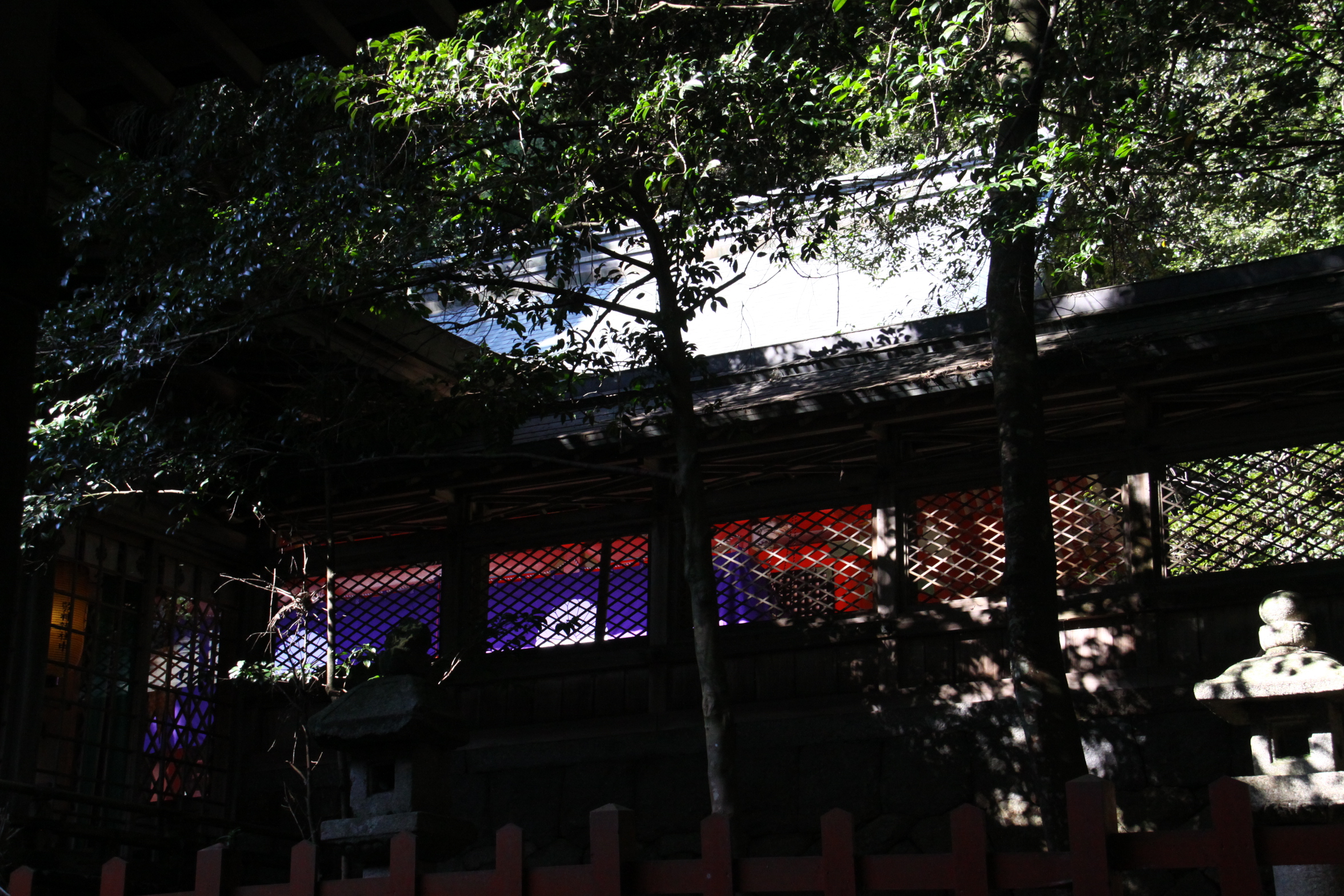
Aekuni Shrine: Guardian of the Northeast
Oda Nobunaga burned it to the ground in 1579. The mountain monks rebuilt it fourteen years later. Then the castle lord reconstructed it in 1621 because the northeast corner of his new fortress needed spiritual protection -- and Aekuni Shrine had been guarding this mountainous pocket of Japan since at least the ninth century. Tucked into the foothills of Mount Nangu in what is now the city of Iga, Mie Prefecture, Aekuni Jinja holds the title of Ichinomiya -- the first-ranked shrine -- of the former Iga Province. Its name appears in imperial chronicles dating to 850 AD, and its roots likely stretch centuries deeper, to a time when worship here centered not on a building at all, but on a massive boulder believed to be iwakura, a vessel for the divine.
Where the Gods Meet the Mountain
The original sacred presence at Aekuni was the mountain itself. Two hundred meters south of the shrine, a large boulder once served as iwakura -- a natural seat of the kami. That boulder has since been lost, but a kofun burial mound discovered nearby hints at centuries of veneration predating any formal structure. The shrine enshrines three kami: the son of Emperor Kogen, dispatched to Hokurikudo as a Shido Shogun; Okunitama, the kami of agriculture, healing, magic, brewing sake, and knowledge; and a deity from the great Nangu Taisha. According to the Engishiki, there was originally only one god here -- Aekunishin-kami, whose essence maintained power throughout the region alongside the Abe clan's patron deity, with Mount Nangu itself dedicated as their place of worship.
Written into Imperial Records
Aekuni Shrine appears in a remarkable succession of official chronicles. The Nihon Montoku Tenno Jitsuroku mentions it in 850 AD. The Nihon Sandai Jitsuroku references it again in 864 AD. The Engishiki records of 927 AD formally list it. By the late Heian period, the Genpei Josuiki -- a chronicle of the Genpei War -- calls it the 'Ichinomiya Nangu Dai-Bosatsu,' confirming its status as the province's premier shrine. During the Nanboku-cho period in the fourteenth century, Southern Court Emperor Go-Murakami spent several days here and rewarded the shrine with an estate. For centuries, Aekuni stood as the spiritual anchor of Iga Province, its fortunes rising and falling with the political tides of medieval Japan.
Fire, Yamabushi, and the Castle's Shadow
The Tensho Iga War of 1579 brought devastation. Oda Nobunaga, the great unifier, invaded this mountainous province of independent warriors, and Aekuni Shrine was burned in the assault. For fourteen years the shrine lay in ruins. In 1593, yamabushi -- the ascetic mountain monks who roamed Japan's peaks in pursuit of spiritual power -- rebuilt it. The reconstruction proved temporary. When Iga Ueno Castle was constructed in the early Edo period, the castle's lord Todo Takatora ordered a full reconstruction of the shrine in 1621. The reason was spiritual architecture: Aekuni Shrine sat in the northeast quadrant relative to the castle, the kimon or 'demon gate' -- the direction from which malevolent forces were believed to approach. The shrine became the castle's spiritual shield. After the Meiji Restoration, the shrine received formal ranking in the modern system of Shinto shrines in 1884.
Lions Dance Through the Centuries
Aekuni Shrine holds a living calendar of ritual. Kagura performances anchor the Festivals of the Dancing Lion on January 3 and April 17, along with the annual shrine festival on December 5. This sacred dance tradition is said to have originated in the Keicho Era, between 1596 and 1615 -- placing its beginnings in the same period as the shrine's post-war rebuilding. Mie Prefecture designated the shrine's performing arts as Intangible Cultural Folk Properties in 1954. Among the shrine's designated tangible cultural properties are an iron yugama kettle craftwork dedicated in 1598 -- the third year of the Keicho Era -- and stone lantern craftwork designated in 2004. A full-moon festival recurs with every lunar cycle, threading an ancient rhythm through the modern calendar.
Ninja Country's Spiritual Heart
The Hattori clan, one of the three great ninja families of Iga, was closely associated with Aekuni Shrine. They are thought to have originated the Kurondo Matsuri, a festival in which participants dress entirely in black. In 1580, on the eve of Nobunaga's devastating second invasion, Iga's jizamurai warrior-farmers held a festival at Aekuni Shrine attended by Kanemi Yoshida, a priest from the prestigious Yoshida Shrine in Kyoto. It was a gathering of spiritual and military significance -- the province's warriors seeking divine favor at its highest-ranked shrine. Today the shrine sits quietly at the foot of Mount Nangu, reached by bus from Shindo Station or by car from the Iga Ichinomiya Interchange on National Highway 25. The mountain still rises behind it. The boulder is gone, but the kami remain.
From the Air
Located at 34.787N, 136.164E in the city of Iga, Mie Prefecture, nestled at the foot of Mount Nangu. From altitude, the shrine grounds are visible among forested hills southeast of the Iga basin. The region is mountainous with narrow valleys -- historically difficult terrain to invade, which helped Iga's ninja confederacy thrive. Iga Ueno Castle sits to the northwest. The nearest major airport is Chubu Centrair International Airport (RJGG), approximately 80 km to the northeast. Nara (RJNN/Yao Airport area) lies roughly 50 km to the west. Best viewed at 3,000-5,000 feet AGL to see the shrine in relation to the surrounding mountain landscape.