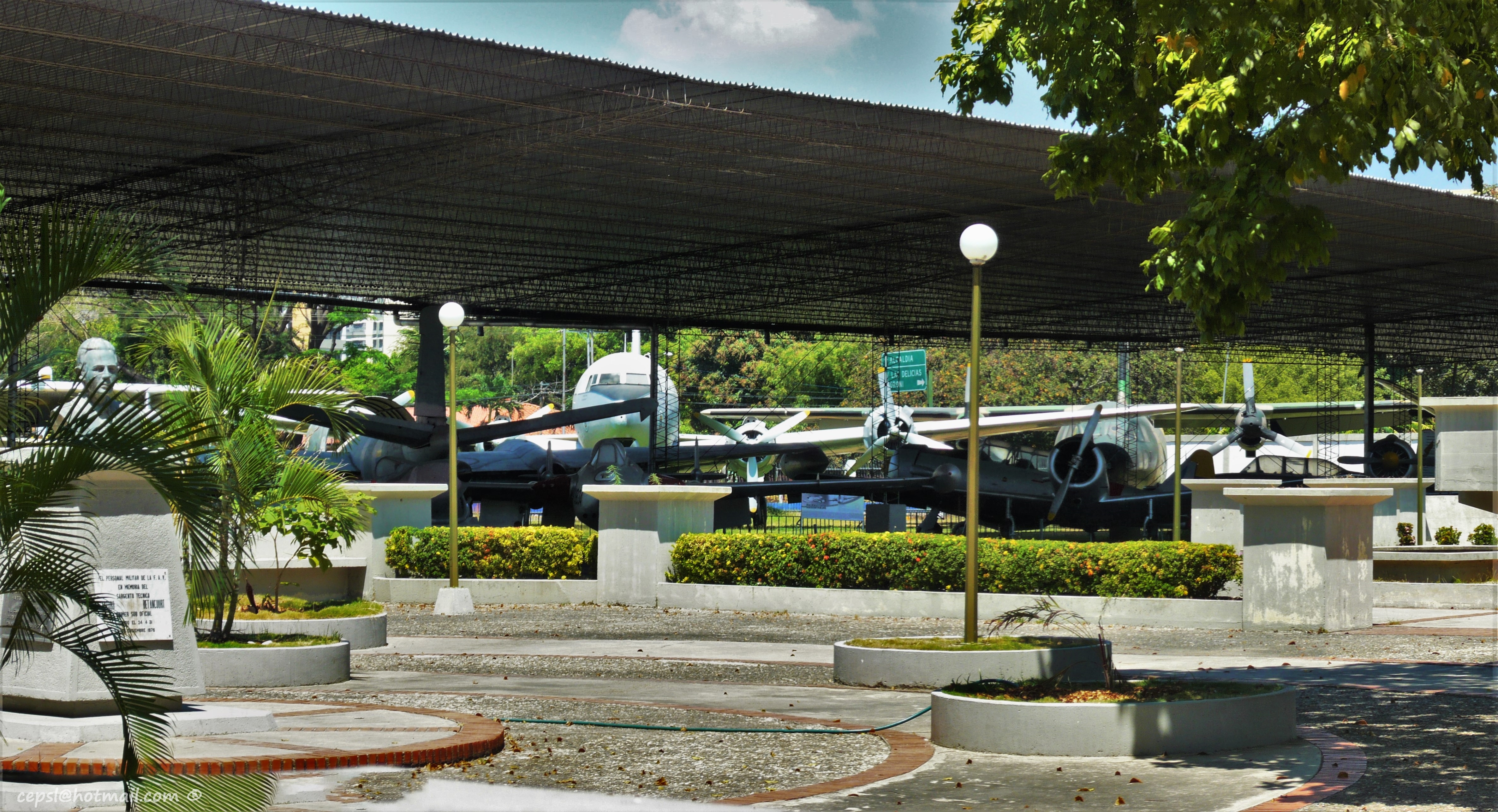
Aeronautics Museum of Maracay
In October 1937, a Flamingo monoplane named El Río Caroní landed on top of Auyantepui, the massive tabletop mountain that gives Angel Falls its plunge. The pilot was Jimmie Angel, the American adventurer whose name the waterfall still carries. The landing went badly - the plane bogged down in mud and stayed there for 33 years, rusting in the clouds. When Venezuelan military helicopters finally lifted it off the mountain in 1970, piece by disassembled piece, the aircraft came here: to a hangar in Maracay that had quietly become one of Latin America's most remarkable aviation collections.
Where Military Flight Was Born
Maracay calls itself the Cradle of Venezuelan Military Aviation, and the claim is literal. The museum sits on the grounds of the former Aeropuerto Nacional Florencio Gómez, the city's first airport, adjacent to the Air Force officer graduation school. When the Ministry of Defense moved its air base from downtown Maracay to the outskirts at Palo Negro in the early 1960s, the old hangars stood empty. A high-ranking officer named Luis Hernán Paredes saw their potential. His proposal for an aeronautical museum was immediately approved, and on December 10, 1963, President Rómulo Betancourt inaugurated the collection. The museum was later named after Paredes himself - the colonel who understood that empty hangars could hold history.
Wings Across the Decades
Over 40 aircraft fill the museum, spanning the full arc of Venezuelan aviation. A French-made Caudron G.3 biplane from the 1910s holds a special distinction: it was the first airplane the Venezuelan Air Force ever owned. Nearby sits a Douglas DC-3 from the 1930s, once piloted by Paul Vachet during the era of Aeropostal, the airline nationalized in 1934 by President Juan Vicente Gómez. The collection moves forward through World War II-era trainers like the Boeing-Stearman PT-17 and combat aircraft like the Republic P-47D Thunderbolt and North American B-25J Mitchell. Cold War jets follow - F-86 Sabres, a Dassault Mirage 50, an F-16 Fighting Falcon. There are helicopters dating from the 1920s through the 1950s, a gyroplane, and transport aircraft that carried troops and cargo across a country shaped by its mountains and coastlines.
The Plane on the Mountaintop
El Río Caroní remains the museum's most storied artifact, even though the aircraft no longer resides here. When Jimmie Angel landed atop Auyantepui on October 9, 1937, none of his passengers - his second wife Marie, Gustavo Heny, and Miguel Angel Delgado - were injured, but the plane was stuck. For three decades it sat on that flat summit, battered by wind and sun, parts slowly disappearing. The 1970 recovery was a feat of logistics: the monoplane had to be disassembled on the mountaintop and airlifted by military helicopters to Maracay for an aviation fair. Reassembly proved especially challenging, with several components missing after their long exposure. The aircraft was later moved to Ciudad Bolívar's airport, where it stands in front of the passenger terminal. Sections of the Venezuelan military still argue it belongs back in Maracay.
La Vaca Sagrada and a Hall of Memories
Among the collection sits a plane nicknamed La Vaca Sagrada - the Holy Cow - the aircraft in which dictator Marcos Pérez Jiménez fled Venezuela in 1958 when his regime collapsed. It is one of those objects where history concentrates into something you can touch. In 1976, a Hall of Fame was added to the museum, gathering military memorabilia dating back to the wars of independence. Medals, maps, photographs, documents, and paintings arrived from across the country, transforming the museum from an aircraft collection into something broader: a record of what it meant to build an air force in a nation still defining itself. Maracay's two major Air Force bases anchor the city's identity, and this museum - with its quiet hangars full of aluminum and memory - anchors the story of how Venezuelan aviation began.
From the Air
Located at 10.253N, 67.594W in Maracay, Aragua state, Venezuela. The museum is at the former Aeropuerto Nacional Florencio Gómez, adjacent to the Venezuelan Air Force academy. From the air, look for the military airfield installations on the eastern side of Maracay. The city sits in a valley surrounded by the coastal mountains of Henri Pittier National Park to the north. Nearest major airfield: Base Aérea El Libertador at Palo Negro (SVBL), approximately 10 km southwest. Maracay's valley location can produce thermal activity; expect clear conditions most of the year.