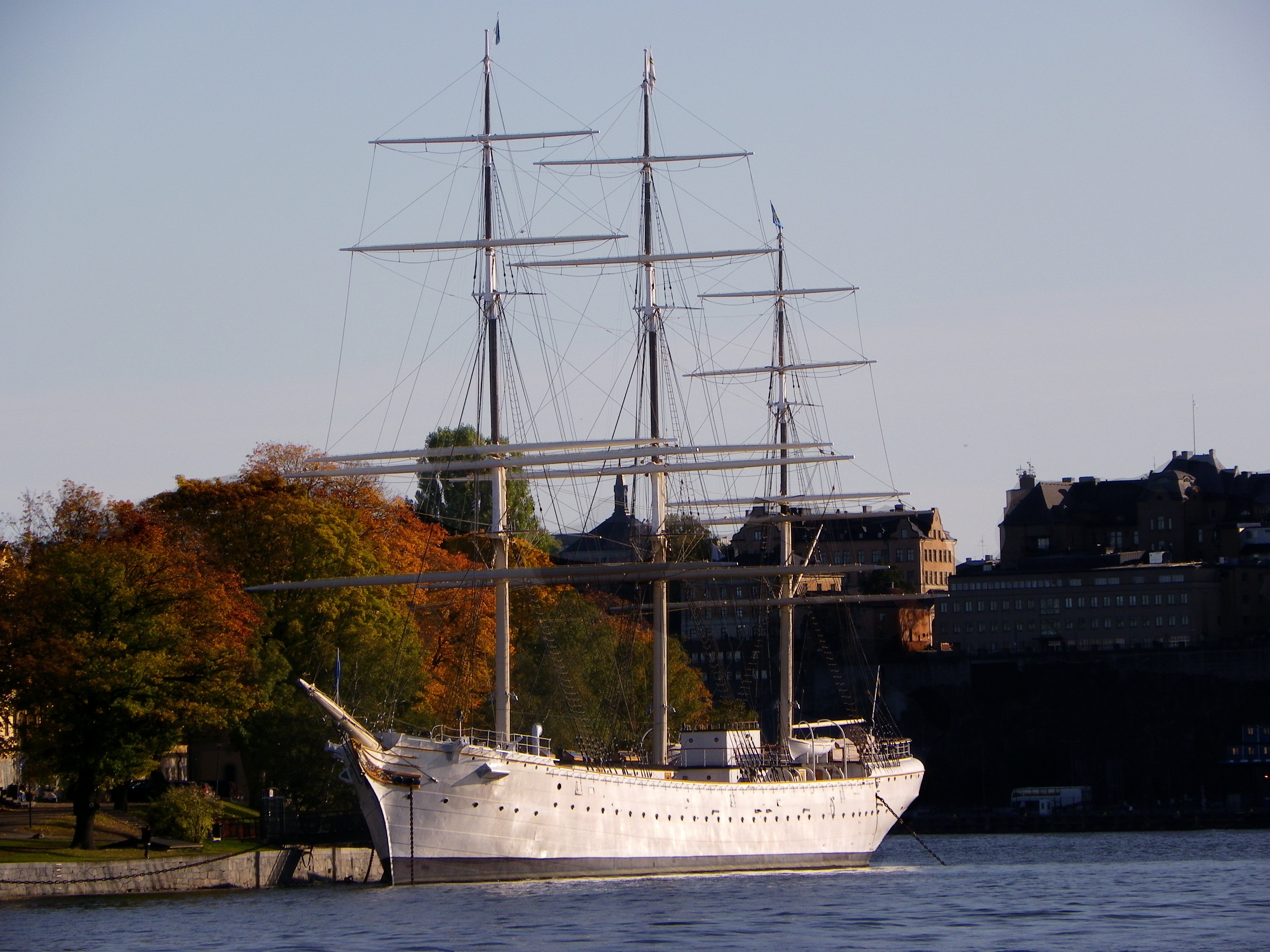
af Chapman
She was born as Dunboyne in the shipyards of Whitehaven, England, in 1888, named for an Irish town in County Meath. Today she rests at anchor off Skeppsholmen island in Stockholm harbor, her three masts still reaching toward the sky, though her sails have been furled for nearly a century. The af Chapman has carried cargo across the Pacific, trained Swedish naval cadets on voyages around the world, served as a barracks during World War II, and faced the scrapyard before becoming something entirely unexpected: a youth hostel where 285 travelers sleep each night in the belly of a full-rigged sailing ship, rocked gently by the waters of the Baltic.
Three Names, Three Lives
The Whitehaven Shipbuilding Company launched her in early 1888 for Charles E. Martin & Co of Dublin. As Dunboyne, she made her maiden voyage from Maryport, Cumberland, to Portland, Oregon, then spent two decades hauling cargo between Europe, Australia, and the west coast of North America. Norwegian owners acquired her in 1909, and the Swedish shipping company Transatlantic purchased her in 1915, renaming her G.D. Kennedy. But her merchant days were ending. The Swedish Navy bought the vessel in 1923 and bestowed upon her the name she carries today: af Chapman, honoring Fredrik Henrik af Chapman, the legendary 18th-century shipbuilder and Vice Admiral who revolutionized Swedish naval architecture between 1721 and 1808.
Around the World Under Swedish Colors
As a naval training ship, af Chapman introduced generations of Swedish cadets to life under sail. She circumnavigated the globe multiple times, teaching young sailors the ancient rhythms of wind and wave that no engine-powered vessel could replicate. But even veteran ships face misfortune. On July 13, 1934, she ran aground at Port Aleza, Puerto Rico, during what would prove to be her final voyage under sail. Though repaired, she never returned to the open ocean. When World War II engulfed Europe, the Navy pressed her into service as a barracks ship, housing sailors in her cargo holds rather than training them on her decks. By war's end, her fate seemed sealed: the scrapyard awaited.
Saved by a Museum, Reborn as a Hostel
In 1947, the Stockholm City Museum intervened to prevent af Chapman's destruction. The old ship had become a landmark, her silhouette inseparable from Stockholm's waterfront identity. Two years later, the Svenska Turistforeningen, the Swedish Tourist Association, assumed management and transformed her into one of the world's most distinctive youth hostels. Today, 285 beds fill her interior, and travelers from across the globe book months in advance for the chance to sleep aboard a genuine tall ship. The experience is no mere gimmick; waking to the gentle motion of the harbor, ascending narrow companionways to deck, watching sunrise illuminate Stockholm's spires from a vessel that once rounded Cape Horn carries an authenticity no modern hotel could manufacture.
The Admiral's Neighborhood
The af Chapman rides at anchor beside the Admiralty House on Skeppsholmen, a small island that once served as the Swedish Navy's Stockholm base. The location proves fitting for a vessel named after a naval legend. The adjacent Skeppsholmen hostel building handles reception and common facilities, operating as a single establishment with the ship. Comprehensive restoration in 2008 ensured the af Chapman would endure for future generations, and additional renovation work from October 2021 to April 2022 continued preserving her steel hull and wooden decks. She remains a working vessel in spirit if not in practice, her purpose transformed from carrying cargo or cadets to carrying memories for young travelers discovering Stockholm.
From the Air
Located at 59.325N, 18.08E on Skeppsholmen island in Stockholm harbor. The three-masted silhouette of af Chapman is unmistakable from the air, moored on the western shore of the small island between Gamla Stan (Old Town) and Djurgarden. The Admiralty House stands adjacent on shore. Skeppsholmen connects to Blasieholmen via a small bridge, forming a chain of islands between the city center and the museum district. Stockholm Arlanda Airport (ESSA) lies 37km north. Stockholm Bromma Airport (ESSB) is 9km west. When flying over Stockholm harbor, af Chapman appears as a distinctive tall ship amid modern vessels, her masts marking Skeppsholmen's western edge.