AFC Ajax
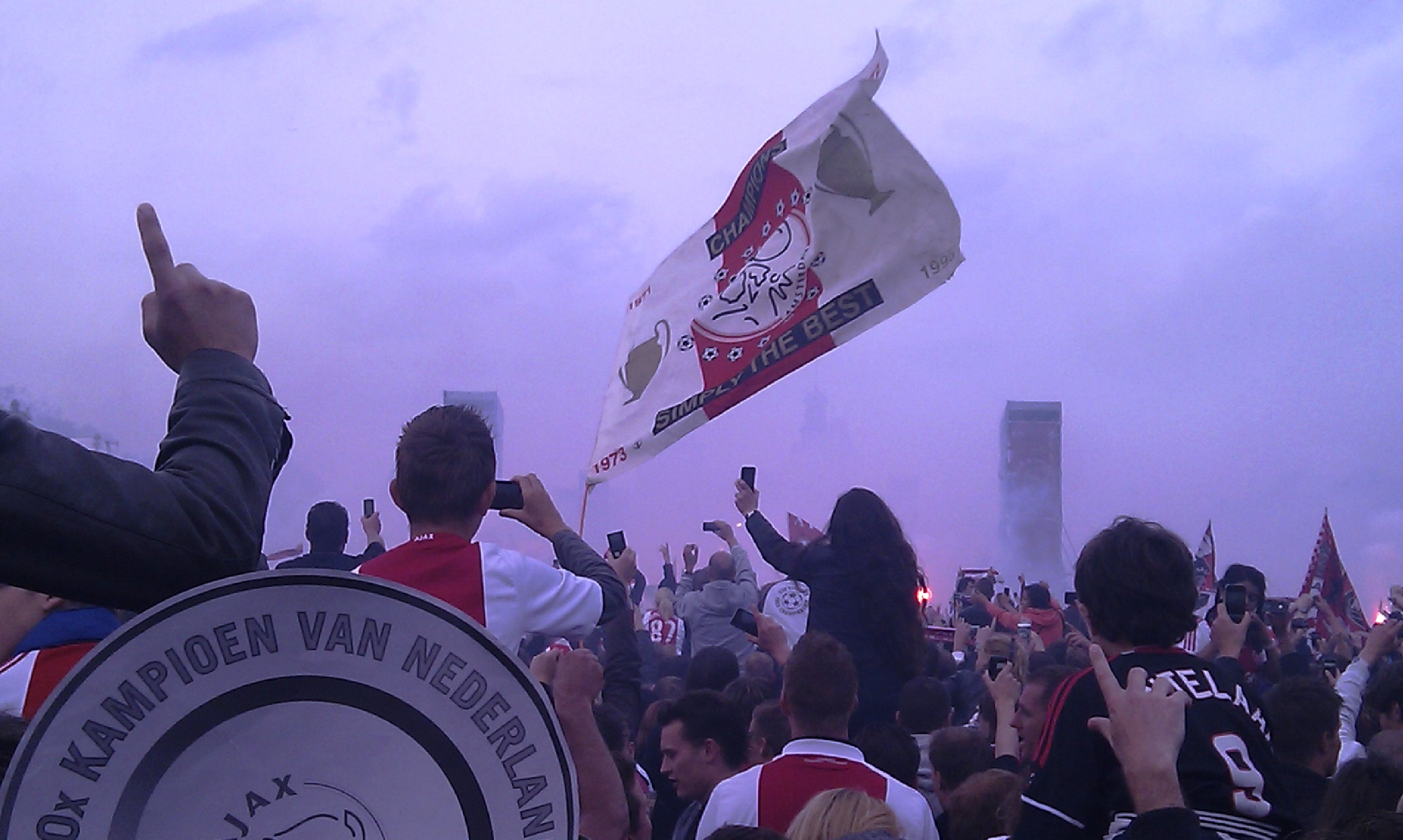
In the spring of 1995, in Vienna's Ernst-Happel-Stadion, a Dutch teenager named Patrick Kluivert came off the bench in the 68th minute of the Champions League final, took one touch, and beat Milan's goalkeeper with the next. He was 18 years old. Almost everyone on the Ajax bench that night had come up through the same youth academy on a piece of land at the edge of Amsterdam called De Toekomst - the Future. They had played together since they were children. Twenty-five years earlier, on the same continent, an older Ajax team had won its first European Cup with a Cruyff-led generation that did not so much play football as redefine what football was. The story of Ajax is the story of those two waves, twenty-five years apart, that both started in the same place: a youth field on the south side of Amsterdam.
The Idea That Became a Name
Ajax was founded on 18 March 1900 and named for the Greek hero of the Iliad, the warrior second only to Achilles in strength. The classical reference was self-consciously grand for a club that, in its early decades, was a regional power that could not quite hold the national stage. Promotion to the top flight came in 1911, the first KNVB Cup in 1917, the first national title in 1918. Through the 1930s, under the English manager Jack Reynolds, the club gathered five championships and built the foundations of something larger. By the time the Eredivisie was inaugurated in 1956, Ajax was already one of the founding members - and immediately, its first champion. The badge on the shirt was the head of the Greek hero, drawn in heavy lines. Decades later it would be redrawn with exactly eleven strokes, one for each player on a football team. The classical name had become a logo, and the logo had become a philosophy.
Michels, Cruyff, and Total Football
In 1965 Rinus Michels, who had played for Ajax in the 1950s, was appointed manager. The year before, a fragile-looking 17-year-old named Johan Cruyff had made his debut. Together, manager and player built something that football had not quite seen before. They called it totaalvoetbal. Total football. Every outfield player had to be capable of playing every position; the defender stepping into midfield, the winger dropping to fullback, the geometry of the team continuously shifting so that whoever held the ball had three angles of pass and whoever lost it could be smothered by the next nearest player in a heartbeat. It demanded extraordinary fitness, extraordinary intelligence, and total mutual trust. It produced extraordinary football. Between 1966 and 1973 Ajax won seven Eredivisie titles, four KNVB Cups, and three consecutive European Cups - 1971, 1972, 1973 - the first club to do that since Real Madrid in the 1950s. Cruyff was twice named European Footballer of the Year wearing the Ajax shirt. His No. 14 is the only number the club has ever retired.
The Class of '95
Cruyff returned in 1985 as manager and rebuilt Ajax around a new generation: Marco van Basten, Frank Rijkaard, a teenage Dennis Bergkamp. They won a Cup Winners' Cup in 1987 before Cruyff left for Barcelona and his protégés scattered to Italy and Portugal. The next great Ajax was assembled by Louis van Gaal in the early 1990s, and it was almost entirely homegrown. Frank and Ronald de Boer. Edwin van der Sar in goal. Clarence Seedorf, Edgar Davids, Michael Reiziger, Winston Bogarde. Around this core were the foreign talents - Finidi George, Nwankwo Kanu, Jari Litmanen - and the veteran captain Danny Blind. They won the 1992 UEFA Cup, then three straight Eredivisie titles. The 1994-95 league season Ajax played entirely without losing a match, the only time any Dutch team has ever done that. In the Champions League final in Vienna on 24 May 1995, they beat Milan with the goal from Kluivert. Then, almost as quickly, van Gaal and most of the squad were gone, sold across Europe for sums Ajax had never seen before.
Mokum and the Stars of David
Ajax has carried a Jewish identity for nearly a century, despite never having had a particularly Jewish player base. In the 1930s, when the club played at De Meer Stadion in east Amsterdam, opposing supporters had to walk through Amsterdam's old Jewish neighborhoods to reach the ground. The city itself was known as Mokum, from the Hebrew makom, meaning place or safe haven - though that safety was catastrophically broken when roughly 75 percent of Amsterdam's Jewish citizens were murdered in the Holocaust. After the war, anti-Semitic chants from rival fans were directed at Ajax supporters regardless of their actual heritage. The Ajax supporters did something unusual. They embraced the slur. They began calling themselves Super Jews, waving Israeli flags and Stars of David in the stadium, claiming the identity that opponents had tried to use as a weapon. The effect is complicated and contested. Many actual Jewish fans eventually stopped attending matches, unable to be inside what had become a stylized symbol. In November 2024, a UEFA Europa League match in Amsterdam between Ajax and Maccabi Tel Aviv erupted into violence on the streets around the stadium, the past and the present folding into a single uneasy weekend.
What the Academy Still Builds
Ajax's home is now the Johan Cruyff Arena - built as the Amsterdam ArenA in 1996, renamed in 2018 after Cruyff died of lung cancer at sixty-eight. Its capacity is 55,865 under a retractable roof that took years to learn to handle properly because the closed roof starved the grass of light. Beside the stadium sits De Toekomst, the academy training ground. The academy has produced van der Sar, van Basten, Rijkaard, Bergkamp, Sneijder, Frenkie de Jong, Matthijs de Ligt. The pattern is consistent across the decades. A boy arrives at twelve. By eighteen he is in the first team. By twenty-one he is being sold to a club whose budget Ajax could never match. The fee funds the next generation. In 2019, an Ajax team built around twenty-something academy graduates beat Real Madrid 4-1 at the Bernabeu in the Champions League and reached the semifinal, where they lost to Tottenham on Lucas Moura's hat-trick scored across the second half - the last goal in the 96th minute. The team broke up the following summer. The cycle began again. Ajax is not the wealthiest club in Europe and never will be. But for more than half a century, by accident or by intention, it has been one of the most consequential.
From the Air
The Johan Cruyff Arena stands at 52.314 N, 4.942 E in the southeastern Amsterdam district of Bijlmer, adjacent to Amsterdam Bijlmer ArenA railway station. Nearest airport is Amsterdam Schiphol (EHAM), about 12 km west; the approach to runway 18R brings aircraft directly past the stadium. The retractable-roof arena is a clear landmark from the air, situated in the modern southeastern expansion of the city. The academy ground De Toekomst sits immediately adjacent. From the cockpit on a clear approach, the stadium and Amsterdam's historic center are visible simultaneously to the northwest.