Africa (Roman Province)
Rome fed its people on African grain. For eight months of every year, the wheat and barley that kept the imperial capital alive crossed the Mediterranean from the province the Romans simply called Africa. Established in 146 BC on the ashes of Carthage, this territory along the northern coast of the continent became one of the wealthiest provinces in the entire empire, second only to Italy itself. Its story spans eight centuries, three religions, and a cast that includes Jugurtha, Belisarius, and the Vandal kings who briefly thought they could hold what Rome had built.
Born from Carthage's Destruction
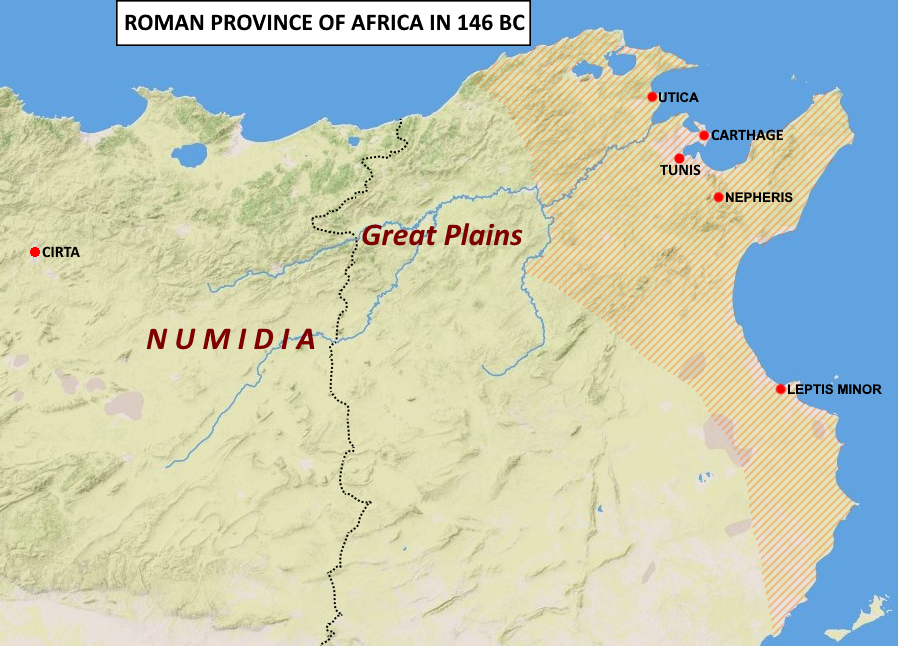
When Scipio Aemilianus razed Carthage at the end of the Third Punic War in 146 BC, Rome did not merely destroy a rival. It inherited a sophisticated North African civilization that Phoenician colonists had been building since the 9th century BC. The Berber peoples, known to the Romans as Numidae and Maurii, had inhabited the land long before either Phoenician or Roman ships appeared on the horizon. Utica, which had sided with Rome against Carthage, became the administrative capital of the new province. The territory roughly comprised modern Tunisia, northeastern Algeria, and the western Libyan coast along the Gulf of Sidra. Over the following century, through the Jugurthine War and Caesar's civil conflicts, the province expanded and consolidated until Augustus made it a senatorial province in 27 BC.
The Granary and the Kiln
Africa's prosperity rested on extraordinarily productive agriculture. By one estimate, the province produced a million tons of cereals annually, with roughly a quarter destined for export to Rome. Olive oil rivaled grain as a trade commodity by the 2nd century BC, and the list of exports grew to include textiles, marble, wine, timber, livestock, and wool. The province also developed a distinctive pottery tradition. African Red Slip ware, mass-produced using innovative molds from the 1st century BC onward, became the most widely distributed fine pottery in the Mediterranean world. Lamp makers demonstrated particular skill, creating decorative motifs on individual molds and then using plaster half-molds to produce copies at scale. The cities that produced these goods became highly organized urban centers, their artisan economies tightly linked to long-distance trade networks stretching from rural hinterlands to markets across the empire.
Roman Africans
The military garrison was surprisingly small for such a wealthy province: roughly 28,000 troops and auxiliaries across Numidia and the two Mauretanian provinces. By the 2nd century AD, most soldiers were recruited locally, including from Berber communities. A Latin-speaking population of mixed origin shared the region with speakers of Punic and Berber languages. Historian Abun-Nasr observed that the Romans "did not display any racial exclusiveness and were remarkably tolerant of Berber religious cults." Yet Romanization was uneven. Pockets of non-Romanized Berbers persisted even in deeply Romanized regions of Tunisia and Numidia. By the end of the Western Empire, however, the area east of the Fossa Regia was heavily Romanized, with roughly a third of the population descended from Italian colonists and the remaining two-thirds Latin-speaking, Christian Berbers.
Vandals, Belisarius, and the Fall
The province survived the 5th-century upheavals longer than most of the Western Empire. When the Vandals crossed from Spain in AD 429, they conquered the region within a decade, founding a kingdom that also encompassed Corsica, Sardinia, and the Balearic Islands. The Vandals, adherents of Arian Christianity, persecuted the Chalcedonian Roman Africans and Berbers, but never fully controlled the interior. In AD 533, Emperor Justinian sent his general Belisarius to recover the province. In a brilliant year-long campaign, Belisarius defeated the Vandals and entered Carthage in triumph, restoring Roman rule and extending it back into the interior through an extensive network of fortifications. The restored exarchate prospered so impressively that Heraclius, who seized the imperial throne in AD 610, briefly considered moving the capital from Constantinople to Carthage.
The End of Eight Centuries
The final chapter was written by armies carrying a new faith. In AD 698, the Umayyad general Hassan ibn al-Nu'man al-Ghassani conquered Carthage and defeated the Exarchate, ending more than 800 years of Roman and Christian rule in Northwest Africa. The Islamic conquest did not erase everything Rome had built; the roads, the agriculture, and the urban patterns persisted in altered forms. But the province called Africa, which had fed an empire and produced some of its most brilliant thinkers and fiercest soldiers, passed into a new civilization. The amphitheater at El Djem, the mosaics of Cirta, and the ruins scattered across Tunisia and Libya remain as evidence of how thoroughly Rome transformed this coast, and how thoroughly this coast sustained Rome in return.
From the Air
The Roman province of Africa centered on modern Tunisia and extended along the Libyan coast. The coordinates 31.80N, 12.74E place this near the Tripolitanian portion of the province. Major Roman ruins visible from altitude include Sabratha (32.79N, 12.49E) and Leptis Magna (32.64N, 14.29E) on the Libyan coast. Nearest airports include Tripoli International (HLLT) and Tunis-Carthage (DTTA). Recommended altitude 15,000-20,000 ft for appreciating the coastal geography that shaped the province.