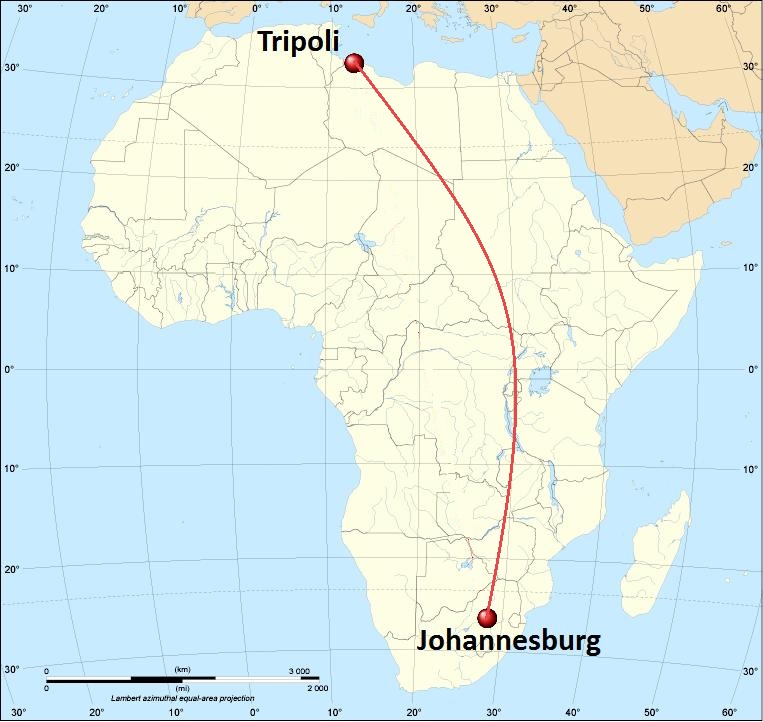
Afriqiyah Airways Flight 771
Ruben van Assouw was nine years old when he woke up in a Libyan hospital with fractures across his body and no memory of why he was there. His parents were dead. His brother was dead. So were 99 other people aboard Afriqiyah Airways Flight 771, which had crashed at 6:01 a.m. on May 12, 2010, while on final approach to Tripoli International Airport. The Airbus A330-200, arriving from Johannesburg after a long overnight flight, struck the ground roughly 1,200 meters short of Runway 09. Ruben was the sole survivor -- the only person pulled alive from the wreckage of what became the deadliest aviation disaster in Libya since 1992.
A Long Night's Final Minutes
Flight 771 departed O.R. Tambo International Airport in Johannesburg as a routine overnight service. At the controls sat First Officer Tareq Abu-Shawashi, 42, handling the flying duties, while Captain Yousef al-Saadi, 57, monitored from the left seat. A relief first officer, Nazem al-Tarhuni, completed the crew of three. All had logged exactly 516 hours on the A330 type. The flight carried 93 passengers of various nationalities -- Dutch, South African, Libyan, German, British, Irish, and others. Many were connecting onward to Dusseldorf or Brussels. The weather at Tripoli that morning was benign: light variable winds, 6,000 meters visibility, no significant cloud cover. Nothing in the conditions suggested danger.
The Black Hole
The approach to Tripoli's Runway 09 was a non-precision procedure, meaning the pilots received lateral guidance from ground beacons but no vertical glideslope information to manage their descent. In the pre-dawn darkness over the Libyan coast, with few ground lights to provide spatial reference, the crew had to rely on instruments and their own judgment to maintain the correct descent path. Investigators later determined that the pilots experienced spatial disorientation -- a phenomenon sometimes called a "black hole approach," where the absence of visual cues makes it nearly impossible to gauge altitude by looking outside. The aircraft descended too steeply, and the crew did not recognize the error in time. At no point did the pilots report any difficulty to the control tower. The A330 struck the ground at high speed and was destroyed by impact and fire.
Grief Across Continents
The crash touched communities from Tilburg to Johannesburg to Tripoli. Among the dead were novelist Bree O'Mara from Ireland, Dutch singer Joelle van Noppen of the group WOW!, and Frans Dreyer, brother of South African MP Anchen Dreyer. The Dutch government established a crisis team within hours and dispatched forensic investigators. By June 15, all bodies had been identified and repatriated. A national commemoration was held on June 30 at Dr. Anton Philips Hall in The Hague, attended by Queen Beatrix and Prime Minister Jan Peter Balkenende, where victims' names were read aloud one by one. In Tilburg, Ruben's family held a private memorial attended by the city's mayor and 1,200 guests. For a small Dutch city, the loss was deeply personal.
The Boy Who Survived
Ruben van Assouw had been returning from a family safari in South Africa with his parents and older brother. He was found in the wreckage with serious injuries but nothing life-threatening. While still recovering at Al-Khadhra Hospital in Tripoli, he was contacted by phone by a journalist from the Dutch newspaper De Telegraaf -- an act that provoked national outrage. Government minister Andre Rouvoet called the intrusion "shameless." The Ministry of Foreign Affairs labeled it "reprehensible." Meanwhile, the mayor of Roermond, Rianne Donders, whose own son died in the crash, revealed that victims' families had resorted to meeting in secret to avoid the press, only for photographers to track them down. The Netherlands Journalist Council eventually issued new guidelines for reporting on accident victims, prompted directly by the conduct surrounding Flight 771.
What the Wreckage Revealed
The Libyan Civil Aviation Authority led the investigation, assisted by France's Bureau of Enquiry and Analysis and advisors from Airbus and the Dutch Safety Board. The flight data recorder, recovered and sent to Paris, showed no evidence of mechanical failure, fuel shortage, or crew incapacitation. The investigation concluded that pilot error was the primary cause -- specifically, disorientation during the non-precision approach in dark conditions. It also found systemic deficiencies within Afriqiyah Airways: flight data analysis tapes were rarely reviewed, safety protocols were loosely followed, and the crew had not adequately briefed the approach procedure. In 2016, on the sixth anniversary, a memorial was unveiled at Noorderveld cemetery in Nieuwegein: a golden globe bearing the date of the disaster, surrounded by plaques engraved with the name of every person who died.
From the Air
Located at 32.66N, 13.12E, near the approach path to Tripoli International Airport (HLLT), Runway 09/27, which is 3,600 meters long. The crash site is approximately 1,200 meters short of the Runway 09 threshold. Tripoli's coastal plain offers limited visual references on the approach from the south, especially before dawn. Best viewed at 2,000-4,000 feet AGL to appreciate the airport geometry and surrounding terrain.