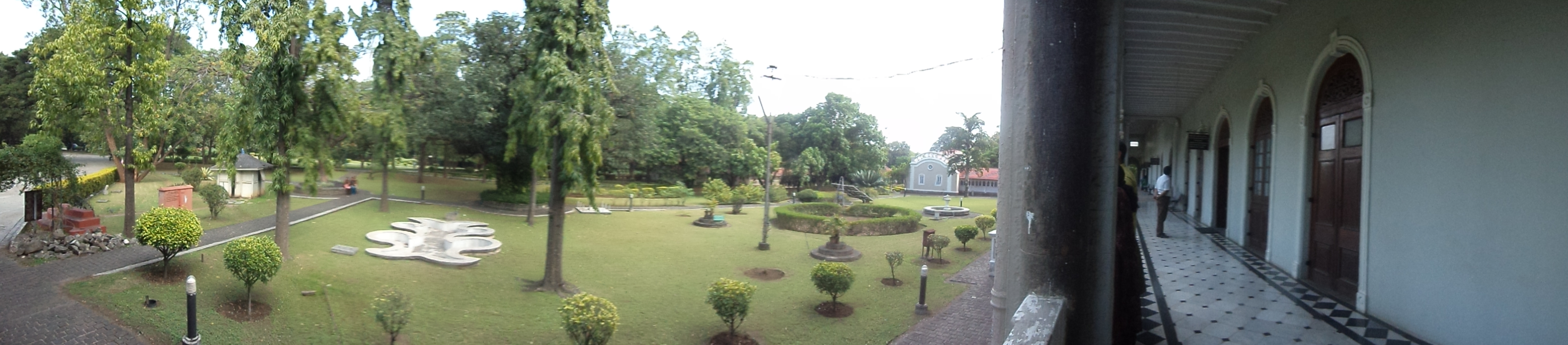
Aga Khan Palace
Two people died here while the world's most famous advocate of nonviolence watched helplessly from an adjacent room. Mahadev Desai, Gandhi's devoted secretary of twenty-five years, suffered a heart attack on August 15, 1942, just six days into their imprisonment. Kasturba Gandhi, the Mahatma's wife of sixty-two years, followed on February 22, 1944, after months of declining health. The Aga Khan Palace in Pune, built decades earlier as an act of charity, had become their cage. Gandhi, Kasturba, and Desai were interned here from August 9, 1942 to May 6, 1944, following the launch of the Quit India Movement that demanded an end to British colonial rule. The palace that was meant to save lives through employment became the place where two people central to Gandhi's life and work breathed their last.
Charity in Stone
Sultan Muhammed Shah Aga Khan III, spiritual leader of the Nizari Ismaili Muslims, built the palace with a specific purpose that had nothing to do with his own comfort. Famine had devastated the communities surrounding Pune, and the Aga Khan wanted to create employment. Construction stretched over five years and put roughly a thousand workers on the payroll, at a total cost of approximately 1.2 million rupees, equivalent to 12 lakh. The building followed the Indo-Saracenic style of architecture, its facade marked by pediments and turrets that blended Mughal, Hindu, and Gothic elements in the manner fashionable among India's elite in the late 19th century. The complex covers 7.7 hectares in total, with the built-up palace accounting for 2.8 hectares and the remainder given over to landscaped gardens near the Mula River. The famine-relief origins of the palace are essential to understanding what came later: a building conceived to alleviate suffering became, decades on, a site of confinement and grief.
Prison Without Bars
On August 8, 1942, the All-India Congress Committee passed the Quit India resolution demanding immediate British withdrawal from India. Within hours, the colonial government arrested Gandhi and the movement's leadership. Gandhi, Kasturba, Mahadev Desai, and the poet-politician Sarojini Naidu were brought to the Aga Khan Palace and confined there. The internment lasted nearly two years. It was not a dungeon; the grounds were spacious, the gardens pleasant. But it was a prison nonetheless, and its occupants were denied contact with the outside world at a critical moment in the independence struggle. Desai's death came first, sudden and devastating. Kasturba's was slower, a gradual deterioration that Gandhi could do nothing to reverse. When he was finally released on May 6, 1944, he left behind two people who had defined his personal and professional life. Their samadhis - memorial shrines - now stand in the palace grounds, octagonal marble structures containing their remains.
From Palace to Memorial
In 1969, Aga Khan IV donated the palace to the Indian people as a mark of respect for Gandhi and his philosophy. The gesture was significant: a Muslim spiritual leader honoring a Hindu political leader by turning private property into public memory. What followed was less noble. The monument was neglected for decades, its condition deteriorating until a 1999 protest at Gandhi's statue near Pune railway station forced attention to the issue. In 2003, the Archaeological Survey of India declared the Aga Khan Palace a monument of national importance. The present condition has improved substantially. The palace now houses the Gandhi Museum, spread across six galleries with statues, photographs, charts, and displays documenting the Quit India Movement. In 1992, a portion of Mahatma Gandhi's ashes were transferred to the complex and placed in a samadhi similar to those of Kasturba and Desai, reuniting in death the three people who had shared those rooms during the war years.
What Remains
A shop in the museum complex sells khadi cloth, the hand-loomed fabric that Gandhi championed as a symbol of self-reliance and resistance to British manufactured goods. The detail matters because it connects the palace's present function to the movement that brought its most famous prisoners here. The three octagonal marble samadhis stand enclosed within a walled area with marble flooring, a quiet space within the larger gardens. Between 1953 and 1972, the palace housed a residential co-education school, one of its less remembered incarnations. The Indo-Saracenic architecture remains intact, its turrets and pediments framing views across the gardens that Gandhi himself would have seen during his confinement. Visitors today walk the same corridors, stand in the same rooms. The scale of the place - 7.7 hectares of grounds, the broad facade, the arched windows - makes the confinement feel paradoxical. It was, in every physical sense, a palace. But for twenty-one months, it was something else entirely.
From the Air
Located at 18.55N, 73.90E in Pune, India, on the northern bank of the Mula River. The palace complex covers 7.7 hectares and is visible from low altitude as a large white Indo-Saracenic structure surrounded by gardens in the Yerwada area of Pune. Pune Airport (VAPO) lies approximately 5 km to the northeast. Mumbai's Chhatrapati Shivaji International Airport (VABB) is roughly 150 km to the northwest. The palace sits in a densely urban area; look for the green garden space contrasting with surrounding development. Best viewed at 2,000-4,000 feet in clear conditions.