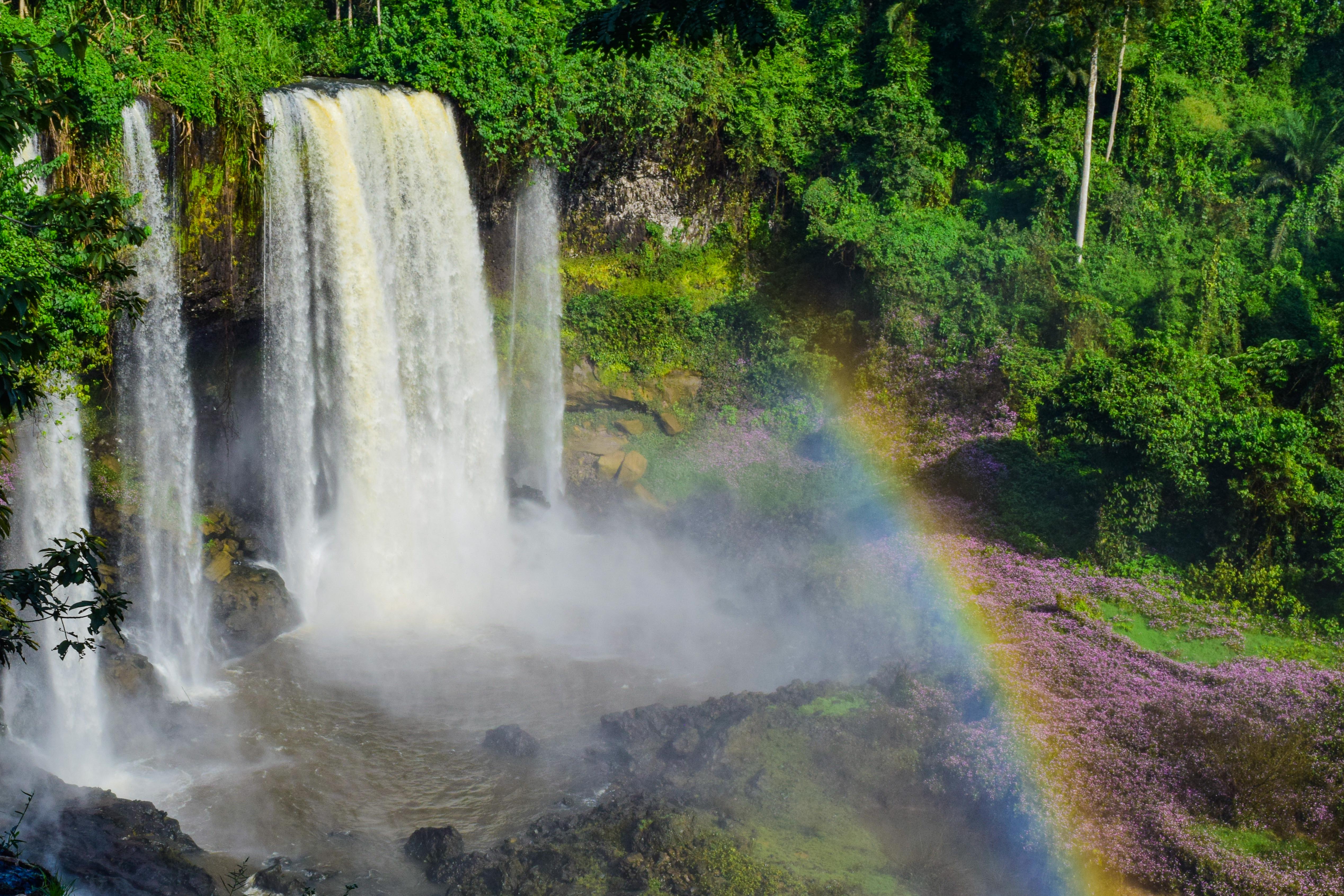
Agbokim Waterfalls
Not one waterfall, but seven. At the edge of Cross River State, just fifteen kilometers from the town of Ikom and close enough to the Cameroon border to hear a different country's birds, seven streams converge at the lip of a high cliff and drop together into the tropical rainforest below. The effect is not a single thundering curtain of water but a seven-part cascade -- each stream finding its own path over the rock, each with its own rhythm and volume. Agbokim Waterfalls is one of Nigeria's most striking natural features, hidden in a remote corner of the country's southeast where the hills are steep, the forest is thick, and visitors are still rare enough to feel like discoverers themselves.
A Hunter's Discovery
The waterfalls' recorded history begins in the early 1900s with a man named NTankum, an Ijagam hunter who came upon the cascade while moving through the forest. Whatever he was tracking, the falls stopped him. He brought his family to settle in the hills surrounding the site, establishing a presence that connected the community to this landscape long before any tourist infrastructure existed. The story of NTankum is the kind of origin that feels right for a place like Agbokim -- discovered not by surveyors or explorers with government backing, but by someone who knew the forest intimately enough to reach its most hidden corners. The Etung Local Government Area, where the falls are located, remains one of the more remote parts of Cross River State.
Seven Streams, One Cliff
The visual power of Agbokim comes from its multiplicity. Most waterfalls are singular events -- a river finds a ledge and goes over. Here, seven separate streams approach the cliff face and spill over simultaneously, creating a panoramic wall of falling water that spreads across the rock. The surrounding landscape is hilly and steeply contoured, funneling the streams toward their common destination. Below the falls, the water collects and flows onward through dense tropical rainforest, the kind of vegetation that makes the ground level feel like a separate world from the canopy above. The mist thrown up by seven simultaneous cascades keeps the immediate area perpetually damp, nurturing ferns, mosses, and epiphytes that cling to every available surface.
Getting There Is the Adventure
Agbokim does not make itself easy to reach. The nearest airport is Margaret Ekpo International Airport in Calabar, roughly 315 kilometers to the south -- a journey that involves hiring a taxi to a motor park, boarding another vehicle to Ikom, and then finding yet another ride for the final fifteen kilometers to the falls. The remoteness is both the site's greatest charm and its biggest challenge. Motorcycles are the primary mode of local transport, and the roads leading to the waterfalls test the suspension of anything with four wheels. There is no standard entrance fee; visitors typically pay around one thousand naira to local guides who know the trails. There are no hotels at Agbokim itself -- the nearest lodging is back in Ikom or all the way in Calabar.
A Border Landscape
Agbokim sits in a landscape defined by borders, both political and ecological. The Cameroon frontier is close enough that the hills on the other side are visible from elevated points near the falls. Cross River State itself is one of Nigeria's most biodiverse regions, home to the Cross River gorilla and vast tracts of tropical forest that have survived partly because the terrain makes development difficult. The waterfalls exist within this broader context -- a natural feature in a region where nature still dominates human infrastructure. Mobile phone coverage fluctuates unpredictably, the nearest amenities are kilometers away, and the forest presses in on every side. For travelers willing to make the effort, Agbokim offers something increasingly rare: a landscape that has not been trimmed, paved, or packaged for easy consumption.
From the Air
Located at 5.91N, 8.91E in the Etung Local Government Area of Cross River State, southeastern Nigeria, near the Cameroon border. Best viewed at 2,000-4,000 feet AGL. The seven-stream cascade may be visible as a white break in the dense green canopy. Nearest airport is Margaret Ekpo International Airport in Calabar (DNCA), approximately 315 km to the south. The Nigeria-Cameroon border runs through the hills to the east, and the town of Ikom is about 15 km to the northwest.