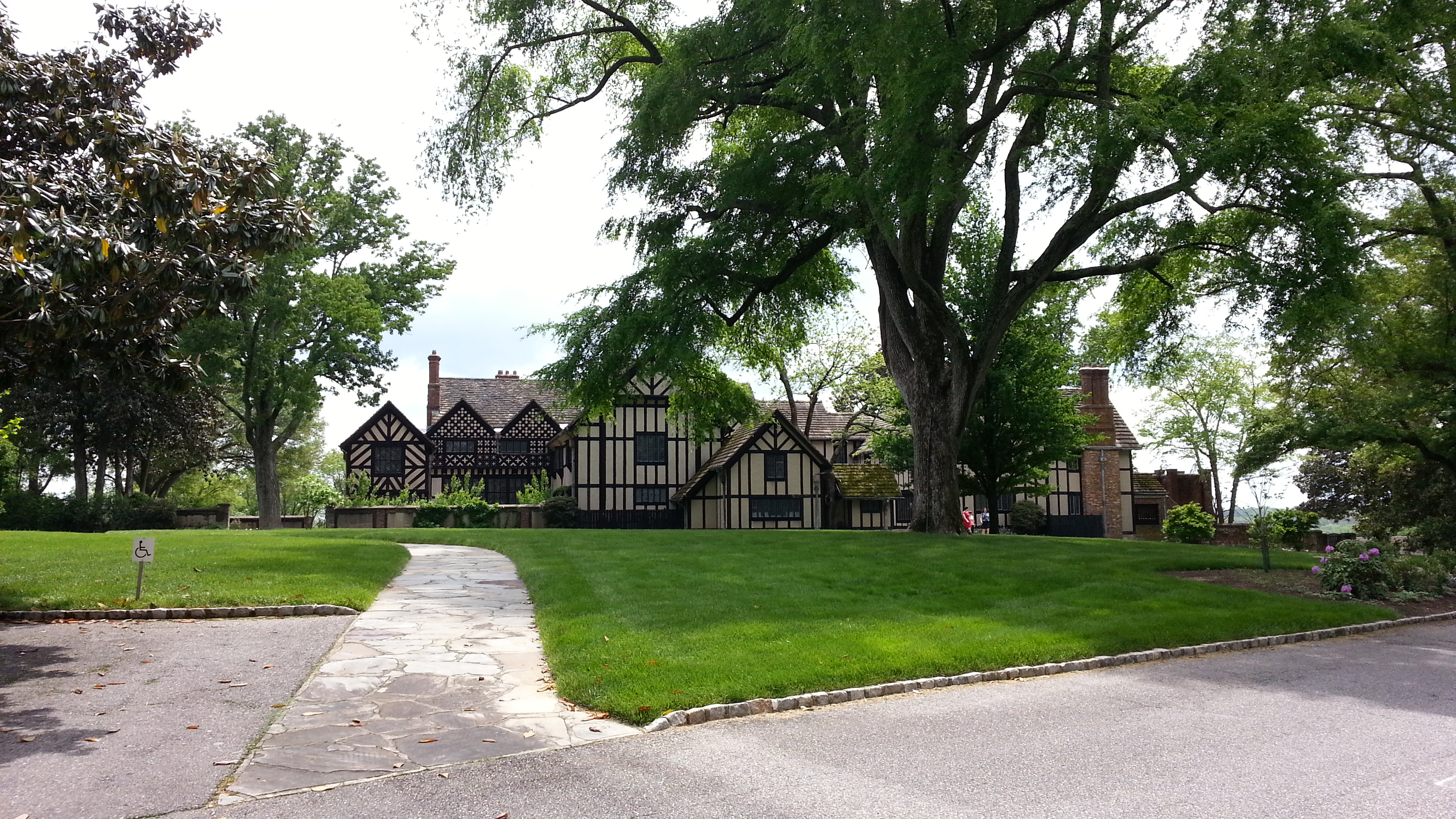
Agecroft Hall
The name means "field of wild celery," from the Old English ache and croft, and it was adopted around 1376 for a manor house on the banks of the River Irwell in Lancashire. Six centuries later, that same house stands on the banks of the James River in Richmond, Virginia, surrounded by Elizabethan knot gardens and the hum of American traffic. Agecroft Hall crossed the Atlantic in crates, piece by numbered piece, because a Richmond tobacco magnate decided that the best way to build an English manor house was to buy an actual English manor house and move it 3,500 miles.
Seven Centuries of Langleys
Agecroft Hall's story begins in 1292, when Edmund Crouchback, Earl of Lancaster, granted land on the River Irwell to Adam de Prestwich. The Prestwich family built three manor houses there. In 1350, after the Black Death likely killed her parents and brothers, Johanna de Tetlow married Richard de Langley of Middleton, bringing the property into the Langley family. For the next two centuries, the Langleys accumulated power and land across Lancashire. The first Robert Langley was a ward of John of Gaunt and supported the overthrow of Richard II. The second Robert Langley won a lifetime annuity from Henry VII. The third Robert Langley earned a knighthood from Edward VI and a pardon from Elizabeth I. But Sir Robert and his wife Cecily de Trafford had no sons, and when he died in 1561, the estate was divided among his four daughters. Anne, the third daughter, inherited Agecroft Hall.
Coal Pits and Dirty Lakes
For centuries Agecroft Hall endured, its eleven hearths recorded in the 1662 Hearth Tax returns out of just thirty-five in all of Pendlebury. But the Industrial Revolution showed no deference to Tudor timberwork. By the late 19th century, coal pits had opened on all sides of the estate. Railway tracks cut across the manor grounds. Mining subsidence above the Clifton Hall Colliery created a filthy lake at the edge of the property. The great hall that had hosted Lancashire gentry for generations sat empty, its timbers blackened, its grounds scarred. By the early 20th century, the house was unoccupied and falling apart. In 1925, it was put up for auction, and a buyer appeared from across the ocean.
Across the Atlantic in Crates
Thomas C. Williams Jr. of Richmond was a man of considerable wealth and specific ambitions. His business interests spanned tobacco, banking, and shipping. During the Country Place Era of the early 20th century, wealthy Americans were building elaborate country estates modeled on European originals. Williams wanted something more authentic. On the advice of his architect, Henry G. Morse, he purchased Agecroft Hall at auction and had it dismantled timber by timber and stone by stone. The pieces were crated, loaded onto ships, and transported across the Atlantic to Richmond. There, on Williams's 23-acre family estate overlooking the James River in what would become the Windsor Farms neighborhood, Morse supervised the reconstruction. The goal was not an exact replica of the Lancashire original but a functional, comfortable mansion that captured the spirit of its English predecessor. The original floor plan was abandoned. Modern conveniences were built in. The project took two years and cost approximately $250,000. Construction was completed in the spring of 1928.
The Babes in the Wood
Agecroft Hall carries a legend darker than its Tudor charm suggests. According to Cyril Bracegidle's book Dark River: Irwell, the fairy tale of the Babes in the Wood may trace back to an incident at the hall during the reign of Edward III. On the morning of the Feast of the Ascension in 1374, young Roger Langley and his sister fled from the villainous Robert de Holland and his men, hiding in the thick forest that covered the slopes of the Irwell Valley. Loyal retainers sheltered the children until their guardian, John of Gaunt, the first Duke of Lancaster, rescued them. Whether this is truly the origin of the famous tale is debated, as other sources point to Wayland Wood in Norfolk, but the connection gives the hall a storybook past that suits its fairy-tale journey across the sea.
A Manor Reborn on the James
Williams died in 1929, just a year after the reconstruction was complete. His will stipulated that upon his widow's death or departure, Agecroft Hall would become a house museum. Today it operates as exactly that, open to the public on Sulgrave Road in Windsor Farms. The grounds, designed by noted landscape architect Charles Gillette, feature formal English gardens with Elizabethan aromatic plants, a sunken garden, and a knot garden. Inside, Tudor-era architectural details stand alongside the 20th-century modifications that made the house livable for a Virginia family. Back in England, only the gatehouse remains of the original Agecroft estate. The hall itself lives on beside the James River, a Lancashire manor house that found its second life in the American South, overlooking a river an ocean away from the Irwell.
From the Air
Agecroft Hall is located at 37.55N, 77.51W in the Windsor Farms neighborhood of Richmond, Virginia, on the north bank of the James River. From the air, look for the distinctive Tudor manor house and formal gardens along the river in the affluent residential area west of downtown Richmond, near the intersection of Sulgrave Road and Canterbury Road. The nearby Virginia House, another relocated English building, sits just to the east along the same riverbank. Nearest airports: Richmond International (KRIC) approximately 12 nm east; Hanover County Municipal Airport (KOFP) approximately 18 nm north. Best viewed at 1,500-2,500 ft AGL following the James River through western Richmond.