Agha Bozorg Mosque
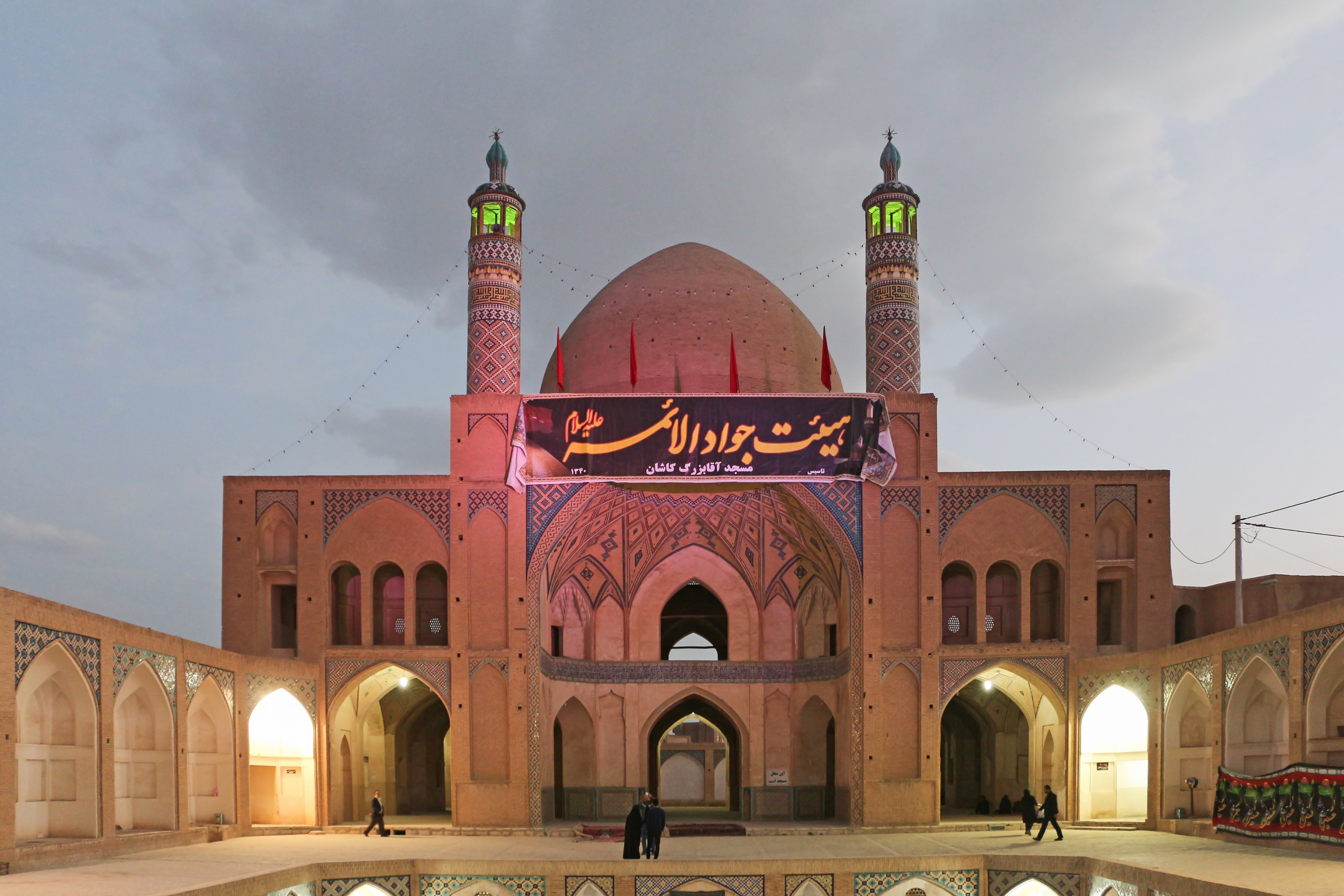
Most mosques reach upward. The Agha Bozorg Mosque digs down. At the heart of Kashan's old city, where the desert heat can be merciless, the master builder Ustad Haj Sa'ban-ali carved a sunken courtyard into the earth itself, creating a mosque-and-school complex that breathes coolness even in August. The result, completed between 1844 and 1850, has been called "the finest Islamic complex in Kashan and one of the best of the mid-19th century." Step inside and the reason becomes immediately clear: every arch mirrors another, every sightline resolves into balance, and the subterranean pool at the courtyard's base reflects the sky like a window cut into the ground.
A Cleric and His Architect
The mosque was built to honor Mulla Mahdi Naraqi II, a prominent Shia cleric known by the honorific Agha Bozorg, meaning "Great Master." His reputation for scholarship drew students from across Iran, and the complex was designed to serve both worship and education, a mosque and madrasa combined under one architectural vision. The man responsible for translating that vision into brick and tile was Ustad Haj Sa'ban-ali, a mi'mar, or master architect, whose name survives in inscriptions on the building itself. He worked in the Qajar style that dominated nineteenth-century Iran, but his solution to Kashan's particular challenges -- the punishing heat, the cramped urban site -- was anything but conventional.
Descending into Symmetry
The building's most striking feature is its sunken sahn, or courtyard, built on two levels. Visitors enter from a bustling shopping street through an arched, domed iwan-portal that opens onto a vestibule overlooking the courtyard from above. The upper level serves as a balcony ringed with deep blind niches, each large enough to sit in. On the southeastern side, the facade of the main prayer hall rises with its paired minarets. Stairs at four corners descend to the ground level, where a pool catches light at the center and former student dormitories line three sides. Below the entrance pavilion, a vaulted basement called a sardab provides additional cooling, with wind catchers, or badgirs, rising as towers to funnel breezes underground. The entire complex is a masterclass in passive climate control disguised as devotional architecture.
Tile, Light, and Proportion
Qajar-era architecture is sometimes dismissed as derivative of the earlier Safavid golden age, but the Agha Bozorg Mosque makes its own argument for excellence. The tilework is intricate without being overwhelming, geometric patterns interlocking across iwan facades and dome interiors. The proportions are precise: the rectangular footprint runs northwest to southeast, and the central axis from entrance portal through courtyard to prayer hall creates an unbroken line of sight that draws the eye and the body forward. At sunset, light rakes across the upper balcony and fills the niches with warm shadow, turning the courtyard into a study in amber and blue. The adjacent Khaje Taj od-Din Mausoleum, dating to the fifteenth century, adds historical depth to the site.
Living Heritage
The mosque was added to the Iran National Heritage List on December 3, 1951, and it remains both an active place of worship and one of Kashan's most visited landmarks. Its location in the city center places it within walking distance of Kashan's famous traditional houses and the historic bazaar. Restoration work has preserved the structural integrity of the sunken courtyard and the decorative surfaces. For visitors arriving in the rosewater city of Kashan, the Agha Bozorg Mosque offers something unexpected: a building that achieves grandeur not by soaring above the skyline but by settling quietly into the earth, letting gravity and geometry do the work that elsewhere requires height.
From the Air
Located at 33.978N, 51.445E in the center of Kashan, Isfahan Province. The mosque's paired minarets and domed entrance are identifiable from low altitude within the dense urban fabric. Kashan Airport (OIFK) is nearby; Isfahan Shahid Beheshti International Airport (OIFM) is approximately 130 km to the south. The city sits on the rim of the Dasht-e Kavir central desert, and the contrast between green irrigated gardens and surrounding arid landscape is dramatic from altitude. Best viewed at 2,000-4,000 feet to appreciate the building's integration into the city grid.