Agra
Agra exists in global consciousness because of the Taj Mahal - the white marble mausoleum that Shah Jahan built for his wife Mumtaz Mahal, completed in 1653 after 22 years of construction by 20,000 workers. The monument that has become symbol of India, that every visitor to the country feels obligated to see, that appears on every list of world wonders - this single building defines a city that was once Mughal India's capital. Agra holds 1.6 million people in the city, another million in surrounding areas, an industrial center that exists despite the monument rather than because of it. The Taj is sublime; the city around it is ordinary; the contrast is part of what visitors experience.
The Taj Mahal
The Taj Mahal is white marble perfection - the mausoleum rising from a plinth above the Yamuna River, its proportions calculated to create symmetry that the eye perceives as beauty, its inlaid semiprecious stones forming flowers that seem to grow from stone. Shah Jahan built it for Mumtaz Mahal, his wife who died giving birth to their fourteenth child, the grief that produced the monument visible in its extravagance. The craftsmanship that twenty thousand workers over twenty-two years produced has never been matched.
The Taj at dawn, at sunset, under moonlight - the changing light transforms white marble in ways that photographs suggest but cannot capture. The crowds that fill the gardens diminish the experience that solitude would enhance, yet the Taj rewards even crowded viewing. The symmetry that appears perfect reveals subtle asymmetries when examined; the tomb of Mumtaz lies exactly center while Shah Jahan's tomb beside it breaks the pattern he himself designed. The Taj is love monument and architectural achievement, romantic and mathematical, the combination explaining its power.
The Agra Fort
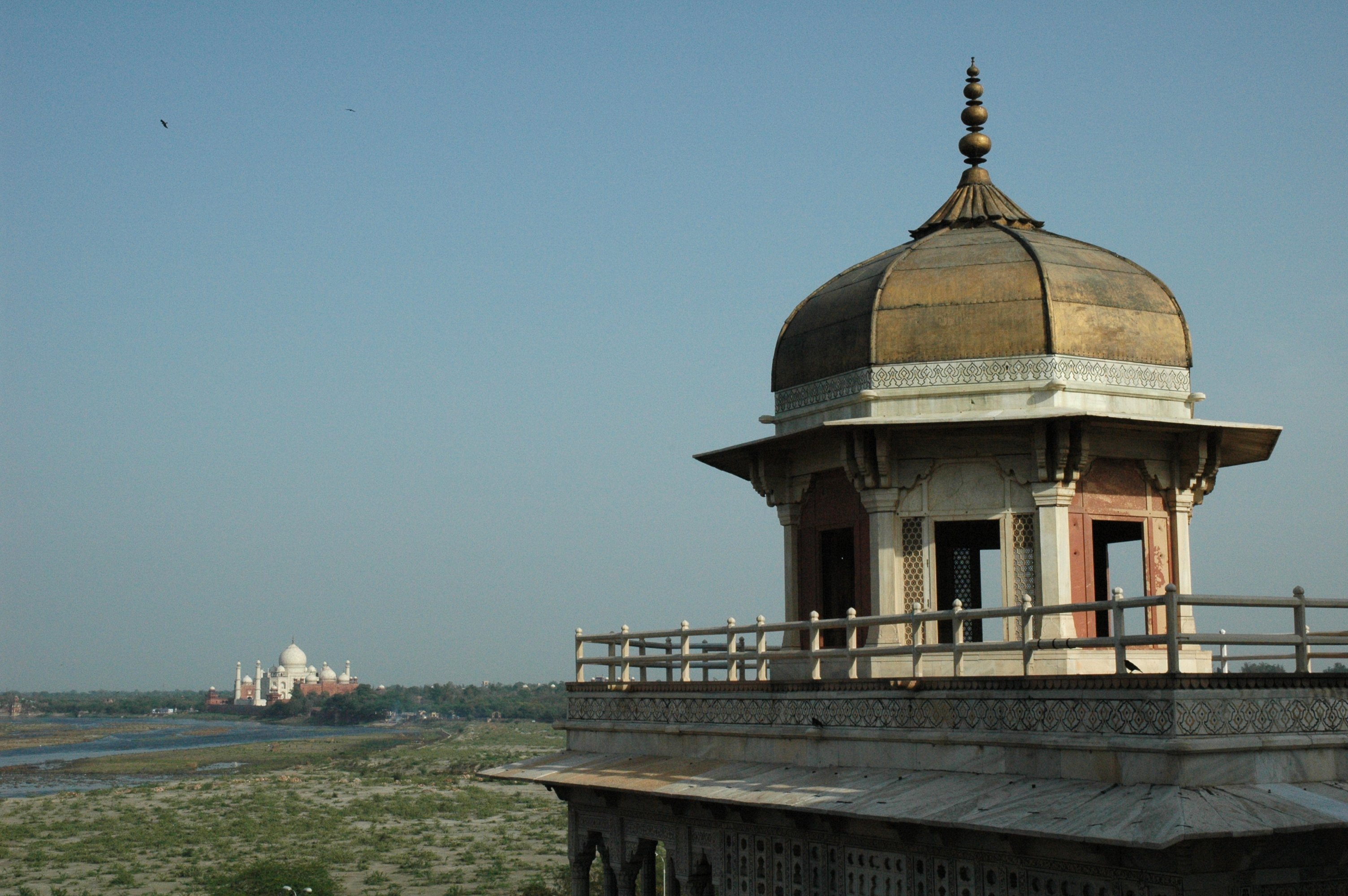
The Agra Fort is where Mughal emperors actually lived and ruled, its red sandstone walls enclosing palaces and halls that the Taj's white marble overshadows. The fort began under Akbar and was expanded by his successors; Shah Jahan rebuilt much of it in the white marble he preferred. The view of the Taj from the fort's marble balconies was Shah Jahan's only view in his final years, his son Aurangzeb having imprisoned him here after seizing power.
The fort contains multitudes that rushed visitors miss - the Diwan-i-Am where the emperor held public audience, the Diwan-i-Khas where private councils met, the Sheesh Mahal whose mirror fragments still sparkle, the Musamman Burj where Shah Jahan died gazing at his wife's tomb. The fort is where Mughal power was exercised; the Taj is where Mughal wealth was displayed. Together they explain each other.
The Baby Taj
Itimad-ud-Daulah's Tomb, called the Baby Taj, was built by Nur Jahan for her father and is considered a precursor to the Taj Mahal. The white marble tomb, decorated with inlaid stone in floral patterns, introduced techniques that Shah Jahan would perfect at larger scale. The tomb sits in gardens across the Yamuna from the Taj, often overlooked by visitors whose itineraries allow only one monument.
The Baby Taj is intimate where the Taj is overwhelming, its smaller scale allowing appreciation of details that the Taj's grandeur subsumes. The pietra dura inlay work, the geometric patterns that frame tomb chambers, the gardens that restoration has renewed - these reward attention that the Taj's fame often diverts. The Baby Taj is what visitors with time should see; the reality is that most visitors do not have time.
The Pollution Problem
The Taj Mahal is yellowing, its white marble stained by the pollution that Agra's industry and traffic produce. The Supreme Court has ordered restrictions - the vehicular exclusion zone, the closure of polluting industries, the regulations that enforcement struggles to maintain - but the damage continues. The cleaning that restoration requires scrubs marble that may not withstand much more scrubbing; the causes of discoloration persist despite the orders meant to address them.
The pollution is metaphor for what India struggles with - the development that growth requires threatening the heritage that makes India distinctive, the economic needs of Agra's residents conflicting with the preservation that the Taj demands. The solution that would protect the monument would impoverish the city; the development that would enrich the city may destroy the monument. The Taj yellows while the debate continues.
The Golden Triangle
Agra forms the Golden Triangle with Delhi and Jaipur, the tourist circuit that most India visitors follow, the route that tourism has made standard. The journey from Delhi takes four hours by road, two by express train; the overnight stays that Agra's hotels offer allow sunrise Taj visits that same-day trips cannot. The triangle concentrates tourist infrastructure where tourist attractions cluster.
The Golden Triangle is India simplified - the Mughal monuments of Agra, the Rajput palaces of Jaipur, the colonial and modern in Delhi. The India beyond the triangle is different in ways that the triangle cannot suggest. Yet the triangle's attractions are genuine, the Taj and the forts and the pink city worth the crowds that concentrated tourism creates. Agra is cornerstone of the triangle, the destination that justifies the circuit, the stop that no itinerary omits.
From the Air
Agra (27.18N, 78.02E) lies on the Yamuna River in Uttar Pradesh, northern India. Agra Airport (VIAG/AGR) is located 7km from the city center with one runway 11/29 (2,743m), though most visitors arrive by train or road from Delhi. The Taj Mahal on the Yamuna River bend is unmistakable from the air. Agra Fort is 2.5km upstream. The river is often low or dry. The terrain is flat Gangetic plain. Weather is semi-arid - extremely hot summers (40-45°C), mild winters, monsoon July-September. Fog can be severe in winter months, affecting visibility. Haze and pollution common.