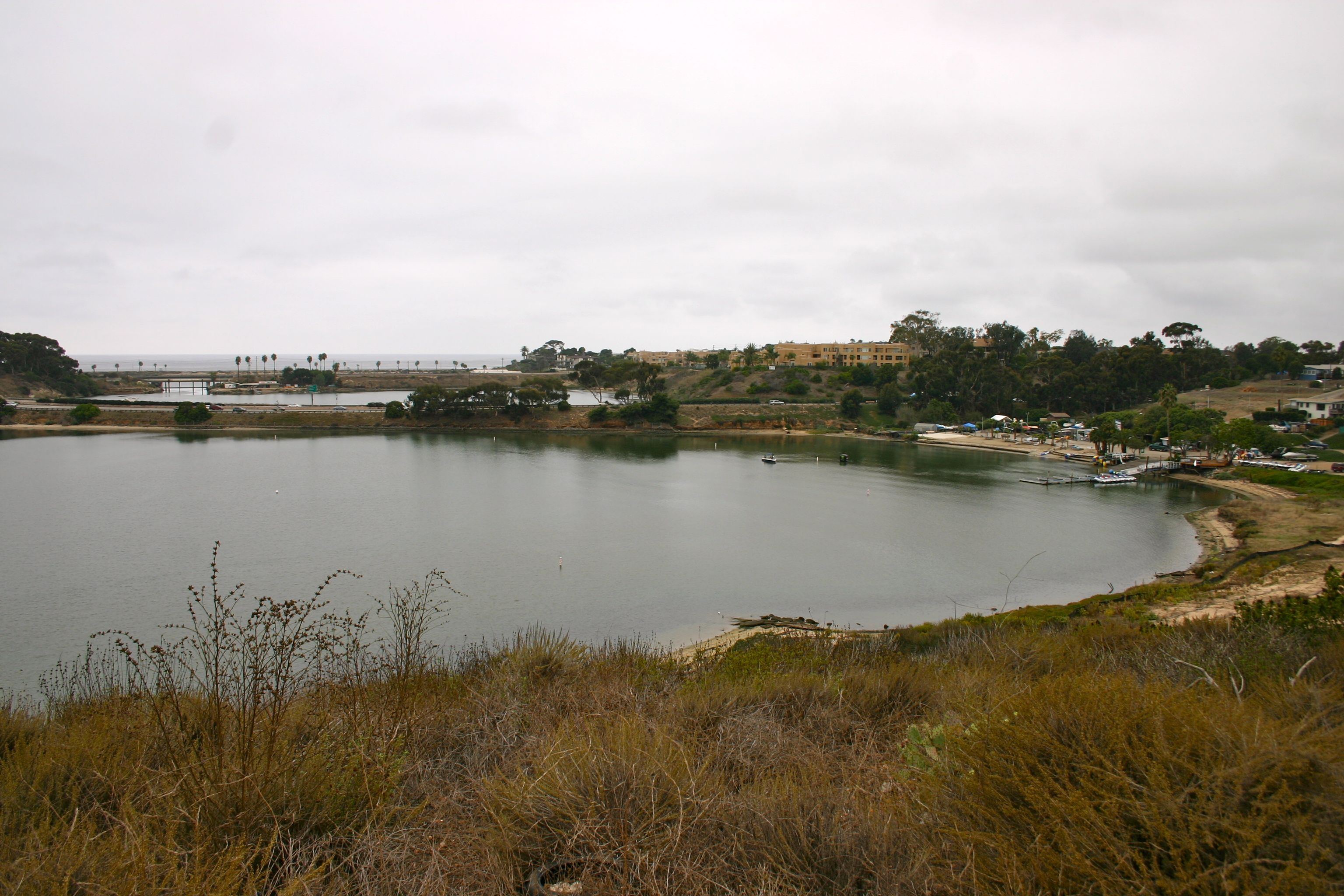
Agua Hedionda Lagoon
The name is Spanish and plainly descriptive: agua hedionda, stinking water. The lagoon at the mouth of Agua Hedionda Creek in Carlsbad earned the label from the sulfur-rich sediments that collect in its shallow basin, though the smell is gentler now than it once was. What drives the lagoon's character today is not chemistry but hydraulics: without regular dredging, the sediment carried by winter storm runoff would fill the inlet, cutting off the tidal exchange that keeps the water oxygenated and the ecosystem alive. Since 1954, when the Encina Power Station was built along its shore and began requiring cooling water from the lagoon, that dredging has happened on a cycle. The power station closed in 2018. The dredging continues.
The Industrial Bargain
When the Encina Power Station was constructed in 1954, it required a reliable flow of seawater for cooling. The lagoon provided it, but only if the inlet to the Pacific remained open. Encina's operators dredged the lagoon entrance every two to four years to maintain that opening, a maintenance cycle they continued for sixty-four years. The arrangement was industrial in its logic: keep the water moving, keep the turbines cool. What it also did, without intending to, was keep the lagoon from silting shut. When Encina retired in December 2018, the Carlsbad desalination plant — built adjacent to the lagoon in 2015, capable of producing 50 million gallons of drinking water per day from Pacific seawater — took over responsibility for the dredging. The lagoon's ecological continuity now depends on a water processing facility rather than a power plant. The cycle continues, with different machinery.
The Tidewater Goby's Lagoon
In 2000, the U.S. Fish and Wildlife Service designated Agua Hedionda as critical habitat for the tidewater goby, a small fish whose existence depends on the brackish water conditions found in coastal California lagoons. The goby requires exactly the mix that tidal exchange creates: not fully marine, not fully fresh, but the unstable middle ground where the two meet. That habitat exists in Agua Hedionda only because the inlet stays open. Close the inlet for a season, let sediment accumulate, and the salinity balance shifts in ways the goby cannot tolerate. The critical habitat designation added a federal layer of protection to a lagoon that industry had been inadvertently maintaining for decades. The Discovery Center, which opened in 2006 on the lagoon's western shore, now provides public access to the habitat that the goby designation made legally significant.
What the Lagoon Holds
Agua Hedionda covers 231 acres in three interconnected basins: the outer lagoon nearest the Pacific, the middle lagoon, and the inner lagoon that extends inland toward Interstate 5. The outer basin is open to recreational use — kayaking, paddleboarding, wakeboarding — while the inner basin functions primarily as wildlife habitat and a staging area for the dredging operations. Great blue herons and snowy egrets work the margins. Least terns nest in the protected areas. Brown pelicans, which once faced extinction from DDT contamination and now fill the California coast in numbers that would have seemed impossible in 1970, raft on the open water. Human habitation around this lagoon has been documented for more than nine thousand years. The Luiseño people fished and hunted here long before the power plant arrived. What has changed is the mechanism of maintenance. What has not changed is that the lagoon, once opened to the sea, keeps something alive.
From the Air
Agua Hedionda Lagoon is located at approximately 33.1425°N, 117.327°W in Carlsbad, visible from altitude as a three-basin coastal water feature parallel to the Pacific. The Encina Power Station's 400-foot smokestack (now decommissioned but standing) is a prominent visual landmark immediately north of the lagoon. Recommended viewing altitude 2,500–5,000 ft AGL. Nearby airports: KOKB (Oceanside Municipal, ~6 nm north), KSEE (Gillespie Field, ~20 nm southeast).