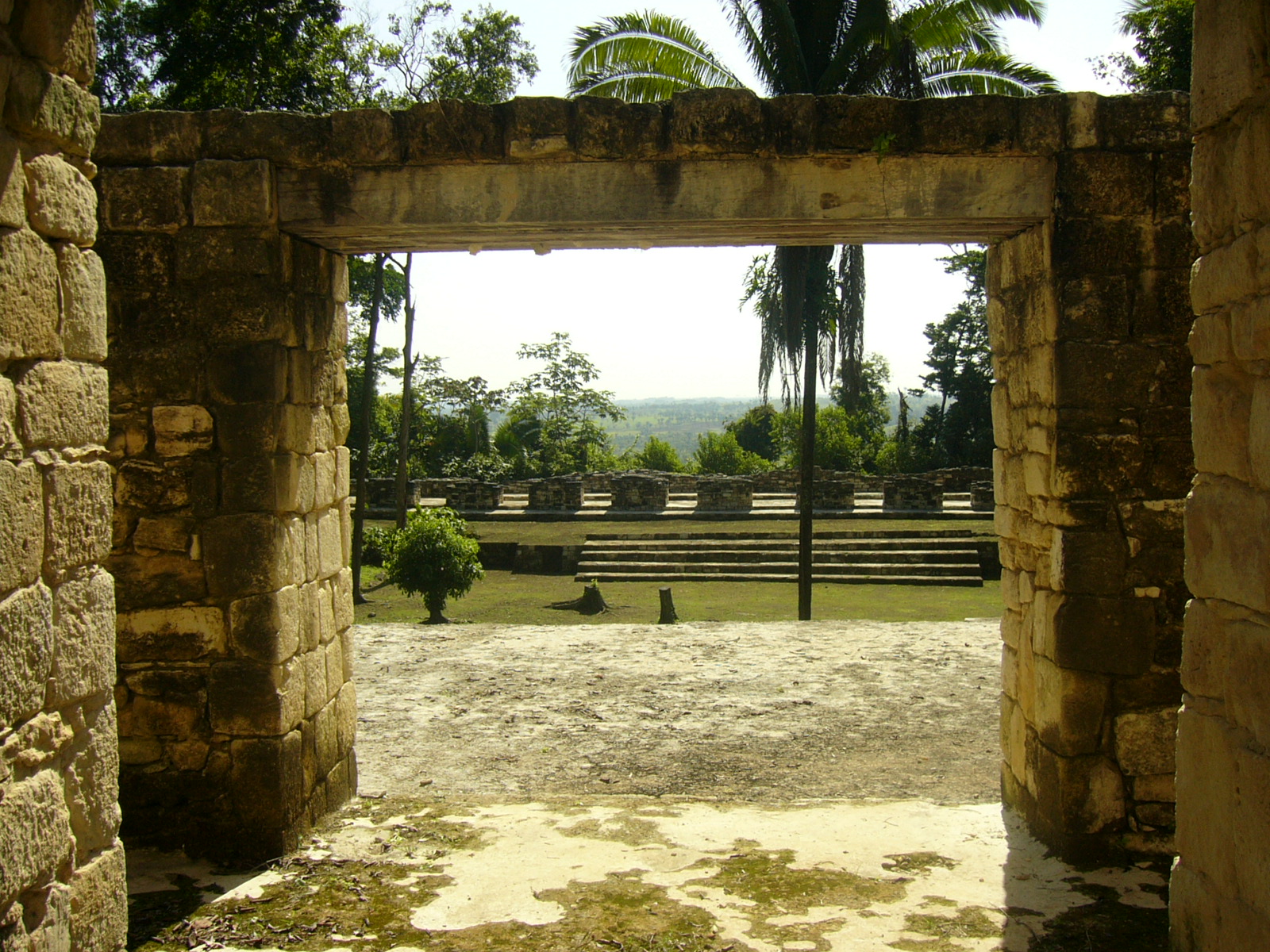
Aguateca: The Maya Pompeii on the Cliff's Edge
Somewhere around 830 CE, the people of Aguateca ran. They did not pack their belongings. In elite residences, obsidian blades and ceramic vessels remained where they had last been used. A six-meter-tall temple stood half-finished, its stone blocks cut but not yet placed. In the Palace Group, the royal family appears to have cleaned out their own rooms and fled before the attackers reached the center - but everywhere else, fire swept through and sealed the moment in ash and rubble. Archaeologists working the site centuries later found what they describe as Pompeii-style assemblages: the everyday objects of Classic Maya life frozen in their original domestic positions, undisturbed since the day the city burned. Aguateca sits atop a 90-meter limestone bluff in Guatemala's Petexbatun Basin, overlooking the lagoon of the same name. The cliff that made it defensible could not, in the end, save it.
Twin Capitals, One Dynasty
Aguateca and the nearby city of Dos Pilas were twin capitals of a powerful dynasty that claimed descent from the rulers of Tikal. The first settlements at Aguateca date to the Late Preclassic period, around 300 BCE to 350 CE, but the city's rise to prominence came later. Around 700 CE, Dos Pilas Rulers 3 and 4 began shifting the dynasty's focus southward to Aguateca, as recorded on stelae and monuments at both sites. By 761 CE, the rulers of Dos Pilas appear to have abandoned their city entirely and relocated to the clifftop fortress. Aguateca swelled into a large, densely populated center - denser in structures per area than most other lowland Maya sites. The influx of people likely came from across the Pasion region, drawn by the dynasty's political gravity. Building a new capital required enormous labor: temples, palaces, causeways, and plazas all had to be constructed, and securing a controllable workforce was as much a political necessity as a practical one.
Where Public and Private Merged
Because Aguateca was abandoned so rapidly, its ruins offer an unusually detailed picture of how Classic Maya elites actually lived. The distinction between home and workplace that defines modern life did not exist here. An elite Maya man might spend his morning knapping stone tools, his afternoon carving wood or bone, and his evening performing diplomatic or ritual duties - all within or adjacent to his own residence. Elite women engaged in artistic production alongside domestic work, collaborating with men on stone carving and other crafts. The royal family and high-ranking courtiers manufactured not only luxury goods and weaponry but also utilitarian items. One household might specialize in carving stelae for the ruler; another might emphasize shell and bone objects of high symbolic value. Obsidian, a material of immense prestige in Classic Maya society, was controlled and distributed by the royal court. The rulers and elite scribes possessed larger, more substantial obsidian blades than those found in smaller residences - a material hierarchy as clear as any written inscription.
Theater, Spectacle, and Power
The Main Plaza at Aguateca was designed for performance. Stone monuments depicting rulers lined the open space, and the plaza's dimensions accommodated large crowds for ceremonial occasions. The Classic Maya treated rulership as theater - the visibility of the king was not incidental but essential. Plazas of varying sizes suggest that some performances were public while others were restricted to elites, separating those allowed to witness exclusive rituals from the broader community. The Palace Group reinforced this dynamic of calculated visibility. Central rooms served as settings for royal audiences and political meetings, their architecture arranged so that gatherings inside could be partially observed by those standing outside. Meeting scenes painted on Maya ceramics suggest this was intentional: certain royal gatherings were meant to be witnessed, their authority performed for an audience that included both participants and excluded spectators.
Fire, Abandonment, and What Remained
The end came during the reign of Tan Te' K'inich. Warfare had destabilized the Petexbatun region for decades - inter-group conflict, climate shifts, and environmental degradation all contributed to growing social upheaval. But the destruction of Aguateca was not gradual. It was an attack, swift and devastating. The unfinished temple tells the story in stone: workers had been cutting blocks, masons setting them with mortar, sculptors carving monuments - all working side by side when the assault came and everything stopped. Fire consumed the center of the city. In the burned structures, archaeologists found craft tools alongside weapons - spear and dart points that served both as instruments of war and as carving implements, a reminder that Aguateca's artists and its warriors were often the same people. Maize had been cultivated in the seasonal wetlands below the bluff, exploiting the deep, fertile soils of natural karst features called rejolladas. All of it was abandoned. The city fell completely silent around 830 CE, and the jungle grew over what remained.
From the Air
Located at 16.41N, 90.19W in Guatemala's Petexbatun Basin, Peten department. The site sits atop a dramatic 90-meter limestone escarpment overlooking Petexbatun Lagoon - a striking visual feature from the air. The lagoon and bluff are clearly distinguishable from altitude, with the cliff face dropping sharply to the water. The site is accessible by boat from the lagoon. Nearest major airport: Mundo Maya International Airport (MGFL/FRS) in Flores, Guatemala, approximately 100 km to the northeast. Best viewed at 3,000-5,000 feet to appreciate the cliff-lagoon relationship. The main chasm running through the site's western edge is visible from lower altitudes.