Ahmed Bey Palace
There are 540 doors in the Ahmed Bey Palace, and every one of them is carved from cedar. That number alone hints at the scale of ambition that drove the last Ottoman-era ruler of Constantine to commission this sprawling residence in 1825. Ahmed Bey ben Mohamed Cherif wanted a palace that would rival anything in Algiers or Oran, and he had exactly ten years to enjoy it before French troops breached the city walls and ended the Beylik of Constantine forever.
A Genovese Engineer in Algeria
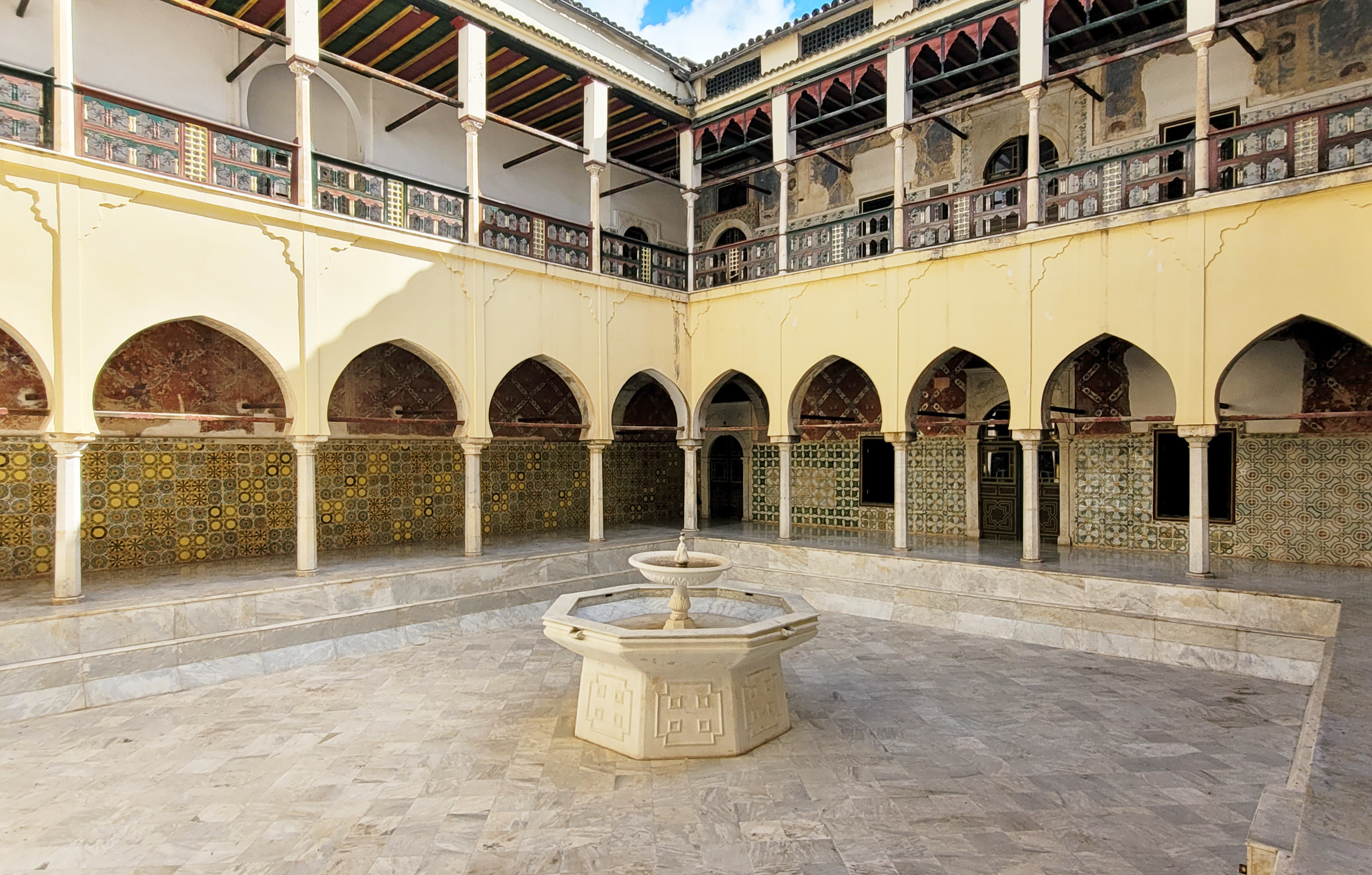
To build his palace, Ahmed Bey assembled a team that reflected the cosmopolitan world of 19th-century Mediterranean trade. He summoned a Genovese engineer named Chiavino, along with two celebrated artists, Al-Jabari and Al-Khatabi, who handled the architectural design and ornamentation. Construction began in 1825 and was completed in 1835. The result was a complex of three suites connected by hallways lined with arcs supported by 266 marble columns, surrounding three courtyards adorned with marble fountains. The ceilings were tiled with marble. Orange trees and palms filled the garden. It was a statement of Ottoman refinement built on North African soil, designed by an Italian and decorated by Algerian masters.
Walls That Tell Journeys
The palace's most remarkable feature is not its marble or cedarwork but its murals. More than 2,000 square meters of wall paintings depict Ahmed Bey's extensive travels through the Mediterranean world. Scenes show his visits to Alexandria, Tripoli, and other parts of Algeria. Most elaborate are the paintings recording his 15-month journey to Istanbul, Cairo, and the Hejaz in 1818 and 1819, a grand tour undertaken before he became Bey. These are not abstract decorations. They are a visual autobiography, a ruler painting his worldliness onto his own walls. The murals show harbors, cities, processions, and landscapes, capturing a moment when an Algerian notable could move freely through Ottoman domains from North Africa to the Arabian Peninsula.
Two Years Before the Fall
The palace was finished in 1835, and its timing carries a bitter irony. In October 1837, French forces besieged Constantine in a decisive assault that ended the Beylik. Ahmed Bey fled, and the palace he had spent a decade building passed into the hands of the colonial administration. The building survived the transition, though its purpose changed repeatedly over the following century. What the French found when they entered was not a military fortress but a work of art, a palace where every door told a story in carved cedar and every wall narrated a journey in pigment. That it was built during the final years of Ottoman-era Algerian autonomy gives the murals a retrospective poignancy: they document a world that was about to disappear.
Capital of Arab Culture
When Constantine was selected as the Arab Capital of Culture in 2015, the Ahmed Bey Palace was one of the city's showcase sites. The designation brought renewed attention to a building that had survived nearly two centuries of political upheaval, from Ottoman rule through French colonization to Algerian independence. The palace today stands as a monument to a specific kind of North African sophistication, one that blended Ottoman, Genovese, and indigenous Algerian artistic traditions into something distinctly Constantinian. The 266 marble columns still support their arcs. The cedar doors still bear their carvings. And the painted walls still carry Ahmed Bey's journeys, frozen in a palace he barely had time to inhabit.
From the Air
Located at 36.37N, 6.61E in the heart of Constantine, Algeria. The palace sits in the old city center on the rocky plateau above the Rhumel River gorge. Best viewed at 2,000-4,000 feet AGL as part of the dense urban fabric of Constantine's historic core. Nearest airport: Mohamed Boudiaf International Airport (DABC) approximately 10 km south. The city sits at roughly 640 meters elevation.