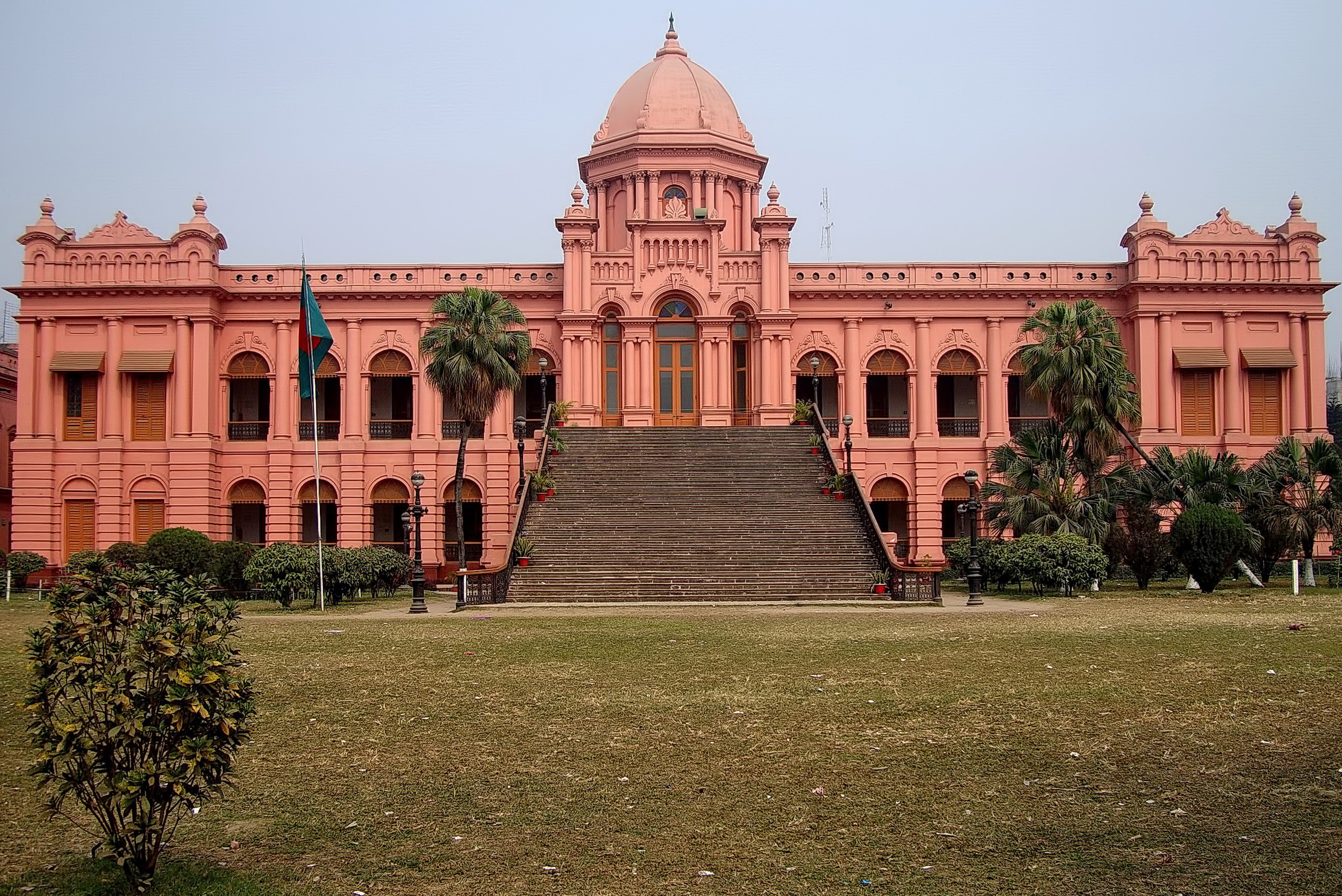
Ahsan Manzil
They call it the Pink Palace, and the color is not subtle. Ahsan Manzil rises from the banks of the Buriganga River in a wash of salmon plaster, its central dome cresting at 27 meters like a lotus bud about to open. For a building that has been flattened by a tornado, shaken by one of the deadliest earthquakes in Indian history, and left to deteriorate into a crowded slum, the palace looks remarkably sure of itself. That confidence is earned. This was the seat of the Nawabs of Dhaka, the house where the All India Muslim League took shape, and the place where Bengal's political future was debated over card games and state dinners in rooms tiled in white, green, and yellow ceramic.
From Garden House to Power
The story begins in the Mughal era, when Sheikh Enayetullah, the zamindar of the Jalalpur Pargana covering Faridpur and Barisal, maintained a garden house on this stretch of riverbank. He added a palace and called it Rang Mahal. Around 1740, his son Sheikh Matiullah sold the property to French traders, who built a trading house beside the existing structures. The French connection would leave a permanent mark: when the Nawab family later rebuilt the compound, the old trading house was reconstructed as a two-storey building mirroring the Rangmahal, with a wooden bridge connecting the first floors. The palace eventually took its current name from Nawab Ahsanullah, and its pink facade became inseparable from the identity of Old Dhaka itself.
Destruction and Resurrection
On 7 April 1888, a tornado tore through Dhaka and left Ahsan Manzil in ruins. Only the Rangmahal section survived with damage limited to repairs; every other building had to be rebuilt from the ground up. The Nawab family pressed on with renovations, restoring the compound to its former grandeur. Less than a decade later, the 1897 Assam earthquake tested the structure again, requiring another round of repairs. But the most damaging blow came not from nature. In 1952, the government acquired the property under the East Bengal Estate Acquisition Act, and the palace that had hosted viceroys and shaped subcontinental politics was carved into a slum. For more than three decades, Ahsan Manzil's ballrooms and libraries housed families in cramped quarters, its ornamental details crumbling under neglect.
The Dome and the Drawing Room
Built on a raised platform one meter above the surrounding ground, the palace stretches 125 meters long and nearly 29 meters wide. Five-meter porticos run along the northern and southern facades, and open verandas with terraces line both sides. The building divides neatly into two halves: the eastern Rangmahal, containing the dome, a drawing room, card room, library, state room, and guest rooms; and the western Andarmahal, with its ballroom, dining hall, music room, and residential quarters. Both the drawing room and music room feature artificial vaulted ceilings, lending them an acoustics and grandeur that visitors in the Nawab's era found remarkable. The dome itself is an exercise in geometric transformation. Its base room is square, but brickwork at the corners rounds it into a circle. Squinches at the roof corners then push the shape into an octagon, and the walls slant inward to form the distinctive lotus-bud silhouette visible from the river.
Where Politics Met Power
Ahsan Manzil was never merely a residence. Lord Dufferin, the Viceroy of India, stayed here during visits to the region. The palace served as the official seat of the Nawab of Dhaka, making it the political nerve center of eastern Bengal. Most significantly, the All India Muslim League emerged from gatherings at this property, a political movement that would eventually reshape the subcontinent. The staterooms and reception halls witnessed the conversations, alliances, and rivalries that shaped the trajectory of Muslim political identity in British India. When the Government of Bangladesh finally acquired the decaying property in 1985, the restoration effort was careful and deliberate, preserving original structural elements while converting just under five acres into a museum that now tells the story of a palace, a city, and the political currents that flowed through both.
From the Air
Located at 23.709°N, 90.406°E on the north bank of the Buriganga River in Old Dhaka. The pink palace and its dome are visible from low altitude against the dense urban fabric. Nearest major airport is Hazrat Shahjalal International Airport (VGHS), approximately 12 km north. Best viewed on approach from the south, following the Buriganga River eastward through the city.