The Ahwahnee
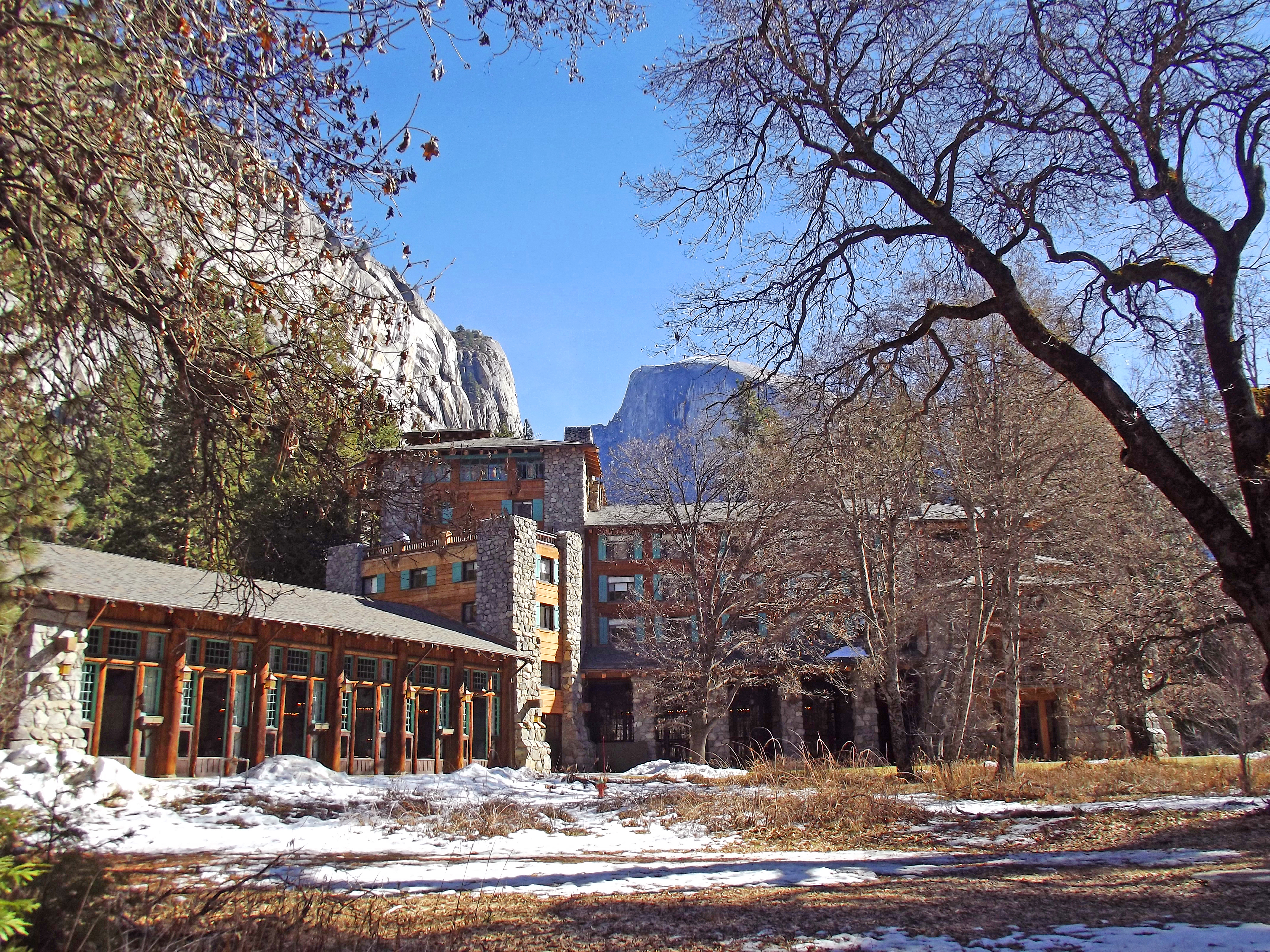
The wood beams spanning the Grand Dining Room are a lie. They look like massive timbers, rough-hewn and rustic, the kind of structural honesty you would expect from a building made of 5,000 tons of granite quarried from the valley floor. But crack one open and you would find a steel I-beam inside - fire safety disguised as frontier authenticity. That tension between the wild and the carefully engineered runs through everything about the Ahwahnee Hotel, a place that has managed since 1927 to feel like it grew from the rocks of Yosemite Valley while being, in fact, a 150,000-square-foot feat of modern construction. The hotel was declared a National Historic Landmark in 1987, and its dining room window was designed to perfectly frame Yosemite Falls. Even the name carries layers: "Ahwahnee" was chosen by Donald Tresidder just before opening to honor the indigenous name for the valley, replacing the original working title, the deeply uninspiring "Yosemite All-Year-Round Hotel."
Two Schoolteachers and a Monopoly
The Ahwahnee exists because of David and Jennie Curry, Indiana schoolteachers who arrived in Yosemite in 1899 and opened a campsite that would grow into a concessions empire. The Currys believed national parks were for recreation, and they marketed Yosemite aggressively, staging spectacles like the famous Firefall - burning embers pushed off Glacier Point to cascade like liquid flame. Their success made them politically powerful within the park. When the National Park Service decided in 1925 to consolidate Yosemite's messy concessions landscape under a single operator, the Curry Company merged with the failing Yosemite National Park Company. Donald Tresidder, from the Curry side, took charge. The new entity finally had the resources to realize Stephen Mather's long-frustrated dream of a luxury hotel in the valley. What began with two schoolteachers running a campsite ended with the sole concession for one of America's most visited national parks.
Parkitecture and Persian Rugs
Architect Gilbert Stanley Underwood, who also designed Zion Lodge and Bryce Canyon Lodge, created a Y-shaped building that was meant to disappear into its setting. His original concept was far grander - a six-story colossus - but the final design struck a balance between ambition and landscape. The interior tells a different story. Phyllis Ackerman and Arthur Upham Pope, husband-and-wife art historians, created an aesthetic that braided Art Deco, Native American motifs, Middle Eastern patterns, and Arts and Crafts sensibilities into something that should not have worked but did. Much of the original decoration was Persian; the couple would later become art consultants in Iran. The Great Lounge stretches the full width of its wing, anchored by sandstone fireplaces at each end and lined with floor-to-ceiling windows topped by stained glass. Construction consumed 1,000 tons of steel and 30,000 feet of timber, all wrapped in rough-cut granite so the building reads as a natural outcropping rather than a hotel.
The Jester in the Rafters
Park officials wanted to close the hotel in winter. Tresidder's solution was to make winter the point. He championed skiing at nearby Badger Pass and invented a Christmas tradition that endures nearly a century later. The Bracebridge Dinner, inspired by Washington Irving's tale of an eighteenth-century English Yule celebration, is a seven-course theatrical feast staged in the Grand Dining Room with costumed performers, music, and pageantry. Tresidder and his wife Mary Curry played the Squire and his Lady for the first two decades. The real scene-stealer was Ansel Adams. The photographer, already well known in Yosemite for his eccentricities, was cast as the Jester. When he asked the director how to play the role, he was told to just act like a jester. Adams fortified himself with drinks and proceeded to scale the Grand Dining Room's granite pillars to the rafters. In 1992, the dinner drew 60,000 lottery applications for 1,650 seats. After a five-year hiatus, the tradition returned in 2024 with adult tickets priced around $320 per person.
The Company That Tried to Own a Name
In 1993, Delaware North took over the park concession, purchasing the Yosemite Park and Curry Company's assets for $115 million. When Delaware North lost its contract renewal to Aramark in 2014, it made a remarkable claim: it owned the trademarks for names including Ahwahnee, Badger Pass, Curry Village, and even "Yosemite National Park" itself. The Park Service estimated those intellectual property assets were worth $3.5 million; Delaware North wanted far more. While the dispute played out, the hotel was renamed the "Majestic Yosemite Hotel" in 2016 - a forced anonymity that struck many visitors as absurd. Outside magazine publicized the controversy, the Sierra Club organized petitions, and the case became a national conversation about whether anyone should be allowed to trademark a public landscape. The settlement came in 2019, restoring the Ahwahnee name and ending one of the stranger chapters in national park history.
Kubrick's Blueprint
Guests checking into the Ahwahnee sometimes feel a flicker of unease they cannot quite place. The soaring ceilings, the long corridors, the massive stone fireplaces, the sense of a building too large and too grand for its remote setting - it all feels familiar. That is because Stanley Kubrick used the Ahwahnee's interiors as templates for the Overlook Hotel in The Shining. The Grand Dining Room's cathedral proportions, the Great Lounge's intimidating scale, the way the building seems to swallow its occupants - Kubrick recognized that the hotel's beauty carried an edge of menace. The guest list over the decades reinforces the sense of a place slightly outside ordinary experience: Walt Disney, Charlie Chaplin, Lucille Ball, Judy Garland, Steve Jobs, Gertrude Stein, Leonard Nimoy, and William Shatner have all slept here. The Ahwahnee is a hotel where the rocks outside the windows are older than civilization, and the building itself seems to know it.
From the Air
Located at 37.7457°N, 119.5742°W on the floor of Yosemite Valley, at the base of the Royal Arches formation. The Y-shaped building is visible from the air as a large structure amid meadows on the north side of the valley. Nearest airports: Fresno Yosemite International (FAT), 65 miles south; Mariposa-Yosemite Airport (MPI), approximately 30 miles west. Best viewed at 3,000-5,000 ft AGL. The hotel sits near the confluence of the Merced River and Tenaya Creek, with Half Dome prominent to the east and Yosemite Falls visible to the northwest.