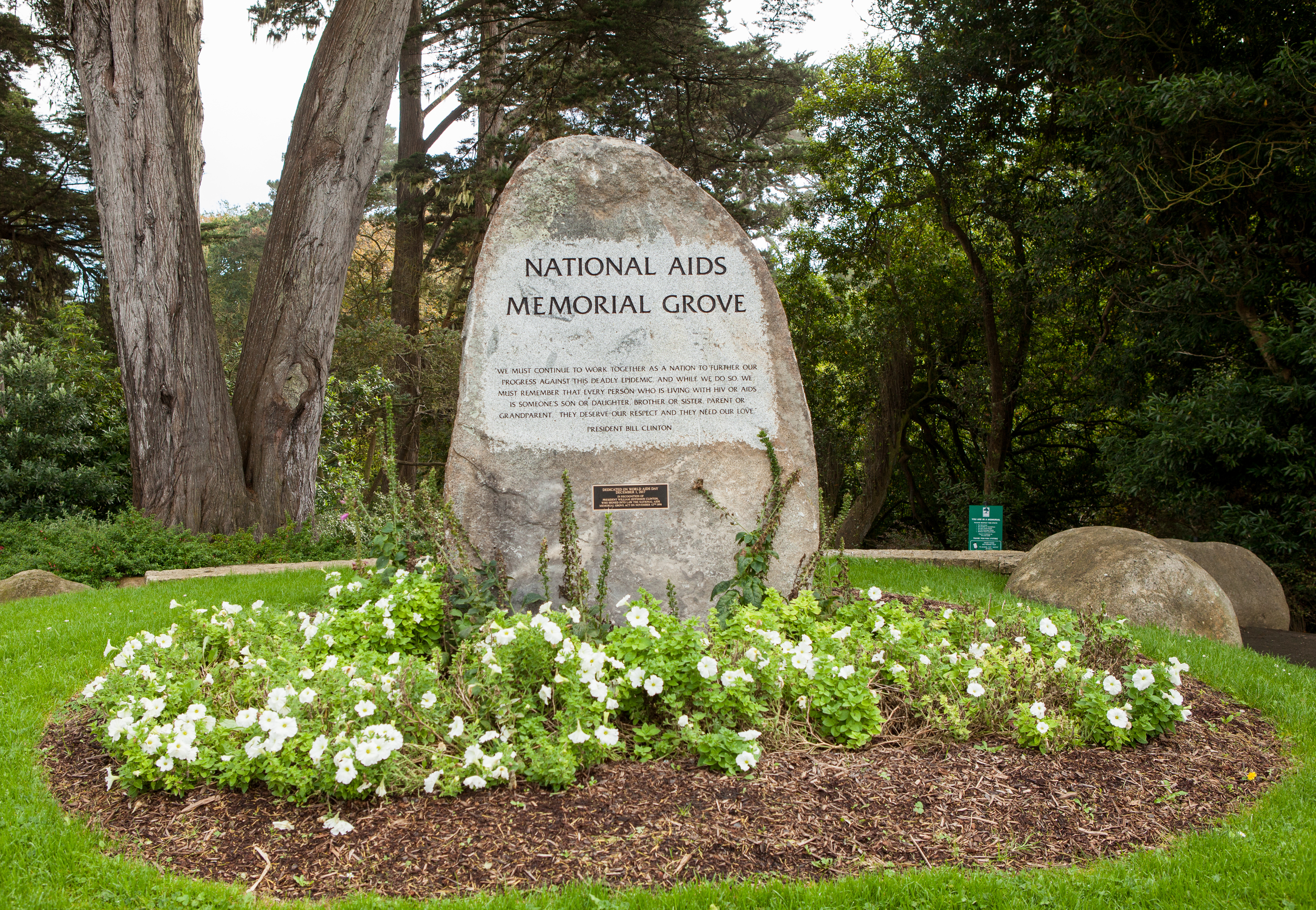
National AIDS Memorial Grove
The inscription on the stone terrace reads simply: 'Circle of Friends: Lives Touched By AIDS... Donors to the Grove... Those Who Have Died... Those Who Loved Them.' In 1988, when Isabel Wade and Nancy McNally first envisioned a living memorial to friends they had lost, there was no federal funding, no official recognition, and little hope for those diagnosed. What they created in the de Laveaga Dell of Golden Gate Park would become the nation's first AIDS memorial, a sanctuary maintained entirely by volunteers and private donations, blessedly removed from the political battles that still surround the epidemic.
A Forgotten Dell Transformed
The de Laveaga Dell had been a jewel of Golden Gate Park when it opened to the public on June 21, 1921. Created through a gift from the estate of Jose Vicente de Laveaga in 1898, the dell featured a lake, a meandering stream, beds of irises beneath overhanging oaks, and spectacular ferns. John McLaren, the legendary park superintendent, supervised its development with rare rhododendrons, lush camellias, and artfully constructed faux boulders. But by 1990, when the Grove Steering Committee chose this site, decades of neglect had left it overgrown and forgotten. The transformation would take years, accomplished not by construction crews but by thousands of volunteers passing stones hand to hand in bucket brigades to rebuild the Woodland Stream.
From Grief to National Recognition
In October 1996, Congress and President Clinton approved legislation designating the AIDS Memorial Grove as an official National Memorial of the United States, the first such memorial to those lost to the epidemic. The legislation was written by Executive Director Kerry Enright and championed by Representative Nancy Pelosi and Senator Dianne Feinstein. Yet the Grove has never received federal money. This independence, as former executive director Thom Weyand noted, keeps the memorial 'blessedly removed from the fight over the controversy of AIDS.' The only public funds in the Grove's history came in 2000 when California appropriated $500,000. Everything else, every pathway, every terrace, every restored rhododendron, has come from private donors and volunteer labor.
Layers of Memory
The Grove unfolds through a series of gathering spaces, each with its own character. The Dogwood Crescent holds the Circle of Friends terrace, where names of those lost are inscribed in stone. The Fern Grotto in the western section offers a quieter refuge, where a poem by Thom Gunn is carved into the landscape. The Meadow Overlook, funded by the Richard and Rhoda Goldman Fund, provides views across the dell. The Belvedere Overlook, added in 2002, features a granite Timeline of the Epidemic sculpture. In 2019, Speaker Nancy Pelosi announced that all 50,000 panels of the AIDS Memorial Quilt, the massive collaborative artwork that once stretched across the National Mall, would find a permanent home at the Grove beginning in 2020.
The Community That Built It
Every feature in the Grove carries a story. Tom Hanks, who won an Academy Award for his portrayal of a gay man suing his employer for AIDS-based discrimination in 'Philadelphia,' recorded public service announcements for the memorial in 1997. Ruth Brinker, founder of Project Open Hand, received the Grove Award in 2007. In 2020, the National AIDS Memorial honored Dr. Anthony Fauci and Dr. David Ho during the virtual World AIDS Day commemoration. The monthly volunteer workdays that have maintained the landscape for over three decades are themselves fed by community members: for thirteen years, the McCormick family, owners of Magnani Chicken, provided lunches to the workers who keep the Grove alive.
A Sanctuary That Endures
The main portal entrance stands at 856 Stanyan Street, at the eastern edge of Golden Gate Park. Three decades after its founding, the Grove continues to serve as what its creators envisioned: a beautiful space where people can find solitude and hope while remembering loved ones, a place to provide a positive focus for grief. Each December 1, on World AIDS Day, the Grove hosts commemorations and presents awards to those who have served the communities affected by the epidemic. Youth scholarships honor young essayists. The 'Light in the Grove' gala raises funds for continued maintenance. And in the quiet hours between events, visitors walk the pathways through what was once a neglected corner of a city park, now transformed into seven acres of living memory.
From the Air
The National AIDS Memorial Grove (37.77N, -122.46W) occupies the de Laveaga Dell in eastern Golden Gate Park, visible as the large green rectangle stretching from the Pacific Ocean to the Haight-Ashbury neighborhood. The Grove sits in the park's eastern section near Stanyan Street. From 2,000 feet, Golden Gate Park's distinctive rectangular shape contrasts with the surrounding urban grid. San Francisco International Airport (KSFO) lies 12 miles south. The Golden Gate Bridge marks the park's northern horizon.