Airwork Flight 23
The cabin was packed with palletized mail, not passengers, which is why no one outside the aviation community remembers Airwork Flight 23. On the night of May 3, 2005, the Fairchild Metroliner was running late on a New Zealand Post cargo run from Auckland to Woodbourne. Captain Clive Adamson, 43, had 6,500 hours in his logbook and was a line check captain -- the pilot who evaluated other pilots. First Officer Anthony Drummond, 41, had 2,300 hours total but only 70 on the Metroliner, which he had started flying earlier that year. What killed them was not inexperience, nor weather, nor mechanical failure in any conventional sense. It was a fuel imbalance, a trim wheel, and an autopilot that quit without warning.
Thirty-Six Minutes Late
The flight was scheduled for 9:00 PM but delayed while cargo was loaded. During the wait, the pilots ordered an extra 570 liters of fuel and told the refueler to put it all in the left wing tank -- a departure from company procedure, which required fuel to be split evenly between tanks. The Metroliner took off at 9:36 PM with the autopilot engaged almost immediately. To make up for lost time, the pilots held full power instead of reducing to cruise setting, climbing to flight level 220 -- approximately 22,000 feet. It was a dark night with low cloud. Fifteen minutes into the flight, they reduced to cruise power, and the captain noticed something the uneven fueling had guaranteed: the tanks were out of balance.
Forty-Seven Seconds
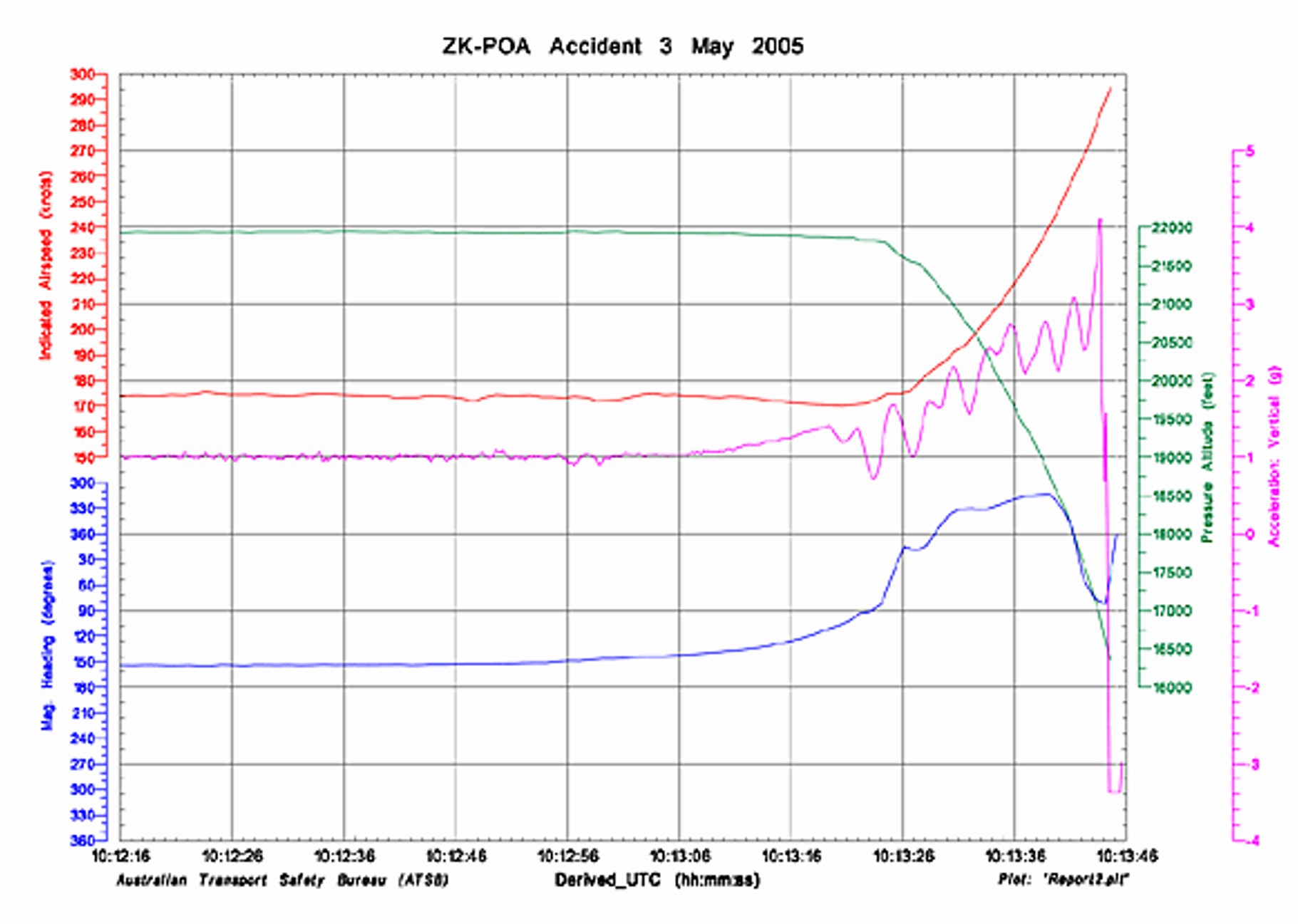
What happened next unfolded with the terrible precision that accident investigators later reconstructed from the cockpit voice recorder and flight data. Adamson initiated the cross-flow procedure to balance the fuel, then told Drummond to "sit on left ball and trim it accordingly" -- meaning apply rudder trim to counteract the asymmetric fuel load while the autopilot was still flying the aircraft. He repeated the instruction five times in nineteen seconds. Drummond replied, "I was being a bit cautious." Adamson's response became part of the accident record: "Don't be cautious mate, it'll do it good." The rudder trim input pushed the aircraft into a sideslip while the autopilot fought to keep wings level. Forty-seven seconds after the cross-flow was opened, Adamson said, "Doesn't like that one mate... you'd better grab it." One second later, a bank angle warning sounded.
The Autopilot Lets Go
The investigation by New Zealand's Transport Accident Investigation Commission pieced together what the pilots could not have seen in the darkness. The autopilot's servo had reached its torque limit trying to compensate for the rudder trim input and disengaged -- silently handing control of a badly out-of-trim aircraft back to pilots who did not realize they were now flying manually. Without the autopilot's corrections, the sideslip became a roll. The roll became a spiral descent. At 10:13 PM, the Metroliner broke apart at approximately flight level 199, scattering wreckage across the Taranaki countryside. Both pilots died. The investigation concluded that poor visibility in night cloud conditions prevented them from recognizing the aircraft's attitude in time to recover.
The Corrections That Followed
Aviation safety advances through grief, and Flight 23 was no exception. Within weeks, the operator issued a notice requiring fuel to be split evenly between tanks before engine start. The company checklist was amended to include a "cross flow closed" check during lineup and approach. The autopilot procedures in the Metro Training Manual were rewritten with explicit cautions about fuel cross-flow use. Most significantly, the TAIC recommended that the aircraft flight manual be amended -- in coordination with the U.S. Federal Aviation Administration -- to require that the autopilot and yaw damper be disconnected before any in-flight fuel balancing. The chain of small, reasonable decisions that killed Adamson and Drummond -- extra fuel in one tank, trim adjustment with the autopilot engaged, a captain's encouragement to be less cautious -- became a case study in how routine procedures can mask catastrophic risk.
From the Air
The crash site is located at approximately 39.32S, 174.36E in the Taranaki region of New Zealand's North Island, east of Stratford. The aircraft was en route from Auckland International Airport (NZAA) to Woodbourne Airport (NZWB) at flight level 220 when it broke apart. Mount Taranaki rises to the west. New Plymouth Airport (NZNP) is approximately 30 km to the northwest. The terrain below is rolling farmland. Recommended viewing altitude 5,000-8,000 feet.