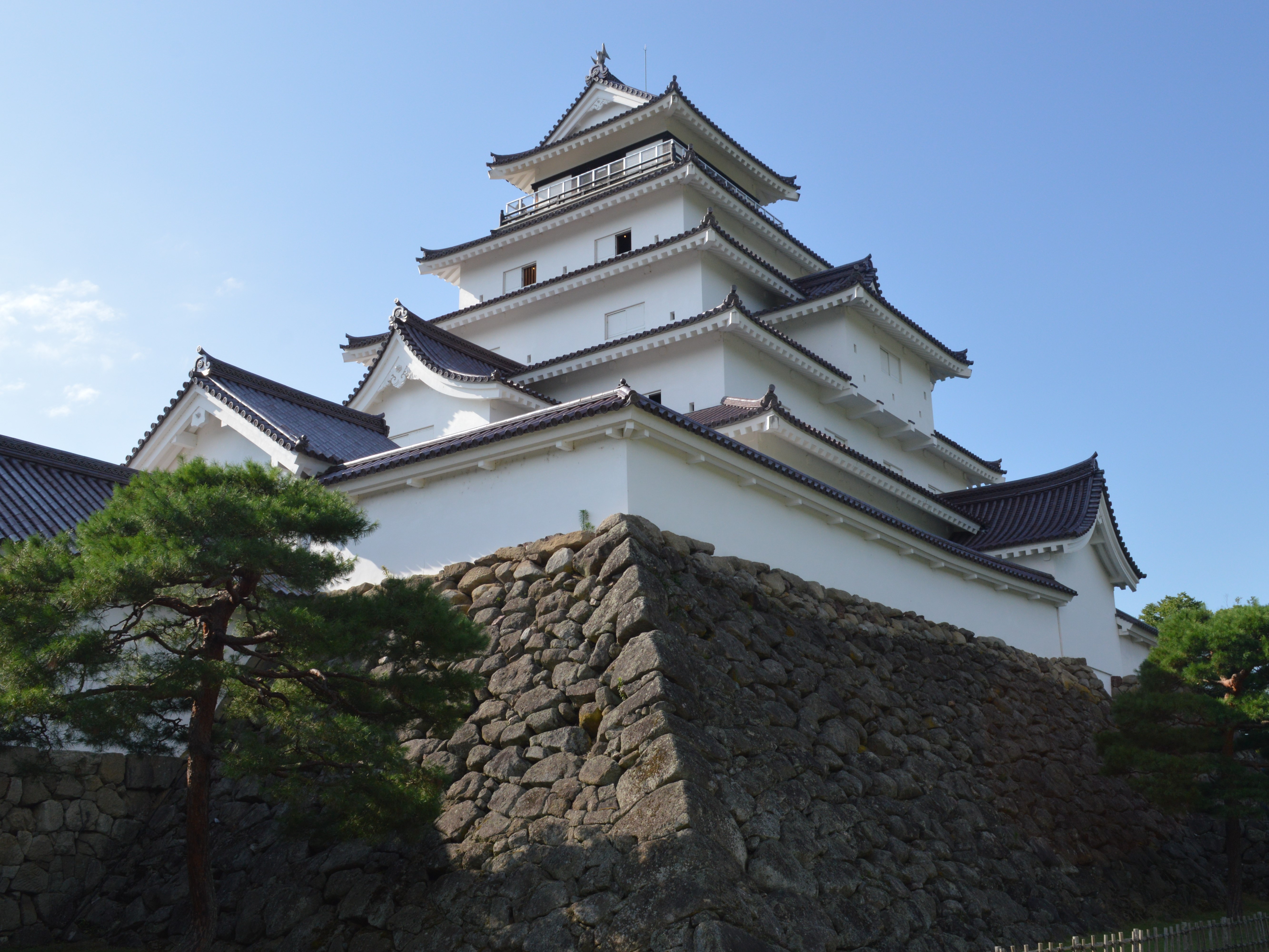
Aizuwakamatsu Castle
In 1868, western artillery shells rained onto Tsuruga Castle for more than a month. The white walls of the keep -- once the seat of one of Tokugawa Japan's most powerful domains -- became so pockmarked that the structure was deemed unsalvageable. The new Meiji government demolished what remained in 1874. For nearly a century, the castle grounds endured a series of indignities, including a stint as a velodrome. Today, a concrete reconstruction of the tenshu stands at the center of Aizuwakamatsu, housing a museum and an observation gallery. But the real story of this castle is not its architecture. It is the parade of warlords, shoguns' sons, and doomed loyalists who occupied it across five centuries of Japanese history.
Warlords at the Crossroads
The Aizu basin sits at a strategic junction in northern Honshu, linking routes to Koriyama, Yonezawa, and the Sea of Japan coast at Murakami. The Ashina clan recognized this and built the castle's predecessor in 1384 during the Nanboku-cho period. They held the fortress for two centuries until the Sengoku period eroded their power. In 1589, Date Masamune, the most formidable warlord of the Tohoku region, captured the castle after years of conflict with the Ashina at the Siege of Kurokawa Castle. His victory was short-lived. By 1590, the rising hegemon Toyotomi Hideyoshi forced Masamune to pledge fealty and relocate to Sendai. Hideyoshi placed his own general, Gamo Ujisato, in the castle with orders to keep an eye on the defeated Date. Ujisato rebuilt the fortress in 1592, renamed it Tsuruga Castle, and crowned it with an enormous seven-story tenshu in 1593 -- a tower with black walls and gold roof tiles modeled after Hideyoshi's own Osaka Castle.
Earthquake, Rebuilding, and the Shogun's Blood
Ujisato died young at 39, and the domain passed through Uesugi Kagekatsu and then the Kato clan. A devastating earthquake in 1611 wrecked the castle, and the Kato rebuilt the tenshu in a smaller, white-walled form -- the configuration that would define the castle for the rest of its existence. In 1643, the Kato were dispossessed, and Aizu received its most consequential lord: Hoshina Masayuki, the illegitimate son of Shogun Tokugawa Hidetada and half-brother of the third shogun, Tokugawa Iemitsu. Masayuki served as regent to the fourth shogun, developed Aizu's commerce and agriculture, and founded the Nisshinkan, the domain's school. His descendants adopted the Matsudaira surname, and for the rest of the Edo period, Aizu Domain functioned as the Tokugawa clan's most reliable stronghold in the north, one of the most militarily powerful domains in all of Japan.
The Last Stand of the Loyalists
When the Tokugawa shogunate collapsed in the 1860s, the ninth lord, Matsudaira Katamori, refused to bend. One of the shogunate's most able and loyal supporters, Katamori rallied a pro-Tokugawa alliance against the new Meiji government even after the shogun himself had abdicated. In October 1868, during the Battle of Aizu in the Boshin War, forces of the Satcho Alliance besieged Tsuruga Castle. The fortress was formidable by traditional standards, but the government army brought modern western artillery and shelled it from the surrounding hills for over a month. Faced with inevitable defeat, Katamori surrendered the castle and his remaining forces in November. The story of the Byakkotai -- a unit of young Aizu warriors who died in the conflict -- became one of the most enduring legends of the era.
Ruins, Revival, and Remembrance
After the surrender, the battered castle buildings were torn down in 1874. One watchtower was saved by being relocated to a Buddhist temple five kilometers away. The government sold off most of the grounds to private landowners, keeping only the central 23 hectares for an Imperial Japanese Army garrison that remained until 1908. As the Byakkotai legend grew in the prewar era, public sentiment swung toward preservation. The site became a park and earned National Historic Site designation in 1934. In 1965, the city completed a concrete reconstruction of the tenshu as a civic symbol, adding a gate and later rebuilding a watchtower and connecting corridor in 1991. The restored tea room Rinkaku, designated a Fukushima Prefecture Important Cultural Property, hosts tea ceremonies within sight of the pentagonal inner bailey, its deep moats, and the tall stone walls that still trace the outline of a fortress that five centuries of warlords fought to possess.
From the Air
Aizuwakamatsu Castle (Tsuruga Castle) is located at 37.49N, 139.93E in the center of Aizuwakamatsu city, in the Aizu basin of Fukushima Prefecture. The reconstructed white tenshu (castle keep) is visible from the air as a distinctive structure surrounded by moats and stone walls, set within a park covering approximately 23 hectares. The castle grounds measure roughly 600 by 400 meters. The city sits in a broad basin with Mount Bandai prominent to the north and Lake Inawashiro to the east. Best viewed at 3,000-5,000 feet AGL. Nearest airport: Fukushima Airport (RJSF) approximately 40nm southeast. The basin geography and surrounding mountain ring make this area distinctive from altitude.