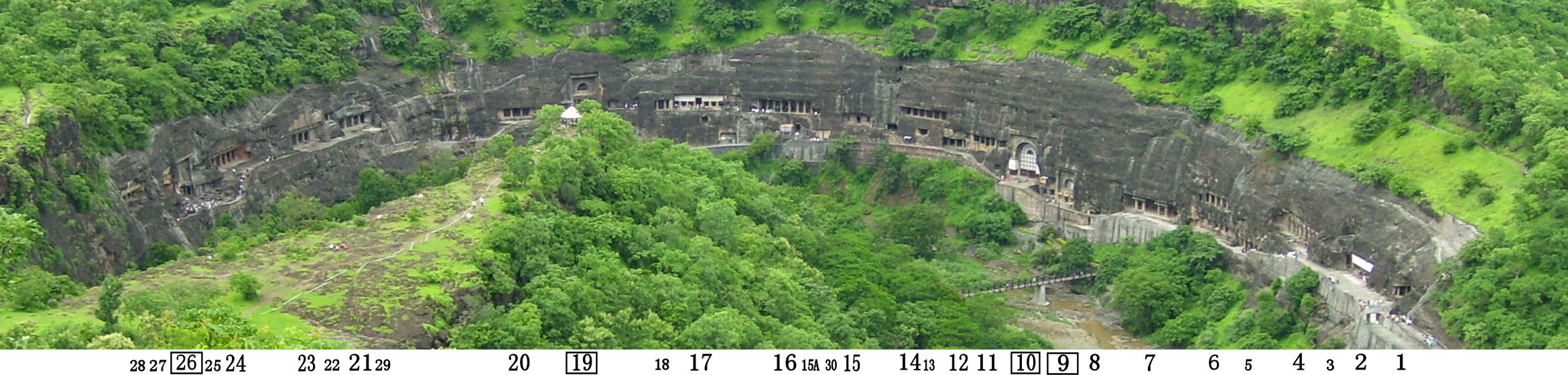
Ajanta Caves
In April 1819, a British officer named John Smith was hunting tigers in the ravines of the Sahyadri Hills when he spotted something through the undergrowth: a horseshoe-shaped cliff face riddled with dark openings, half-swallowed by vegetation. He had stumbled upon the Ajanta Caves - thirty rock-cut Buddhist temples and monasteries that had been carved between the 2nd century BCE and roughly 480 CE, then abandoned and forgotten for over a thousand years. Inside the caves, Smith and subsequent visitors found what writer William Dalrymple later called "the greatest ancient picture gallery" in the world: murals so vivid, so technically accomplished, and so emotionally rich that they would reshape the understanding of Indian art. Smith scratched his name on a pillar in Cave 10. It is still there.
Two Ages of Faith
The caves were not carved all at once. The earliest group dates to the Satavahana dynasty in the 2nd and 1st centuries BCE - simple prayer halls and monastic cells that reflect the austerity of early Buddhist practice. Then work stopped for centuries. Around 460 CE, during the reign of the Vakataka king Harishena, a second burst of construction produced the most spectacular caves in barely two decades. Scholar Walter Spink argued that nearly all the later caves were excavated between 460 and 480 CE, an astonishing concentration of artistic energy. The Vakatakas were Hindu rulers, but their court included Buddhist ministers and merchants who sponsored individual caves as acts of merit. When Harishena died around 480 CE and his empire fractured, work ceased abruptly. Unfinished caves preserve the moment of abandonment - half-carved columns, sketched-out murals never painted, tools seemingly set down mid-stroke. The jungle closed in, and Ajanta vanished from memory.
Walls That Breathe
The murals at Ajanta are painted on a thin layer of plite applied over the rough basalt, using mineral and organic pigments that have survived fifteen centuries in the humid gorge. They depict Jataka tales - stories of the Buddha's previous lives - along with scenes of court life, processions, hunting parties, and intimate domestic moments rendered with a naturalism that Western art would not achieve for another millennium. In Cave 1, the famous Padmapani Bodhisattva gazes downward with half-closed eyes and an expression of infinite compassion, holding a blue lotus in his right hand. In Cave 2, foreign visitors - possibly Persians or Central Asians - share a drink of wine on the ceiling. Cave 17 shows a servant from Central Asia and foreign horsemen attending the Buddha. These are not rigid devotional images. They are alive with personality, movement, and detail - the drape of silk on a queen's shoulder, the startle of a deer, the flicker of a lamp in a palace corridor.
Architecture Underground
Of the thirty caves, five are chaitya halls - worship spaces with vaulted ceilings and a stupa at the far end - and the rest are viharas, or monasteries, built around central halls ringed with monks' cells. Cave 10 is the oldest surviving chaitya hall, dating to the 2nd century BCE, its interior shaped like the hull of an inverted ship. Cave 19, carved in the 5th century CE, is among the most ornate, its facade covered in carved Buddhas and its interior rising to a ribbed vault. Cave 26 contains a monumental reclining Buddha, seven meters long, carved into the wall in the moment of parinirvana - the final passing into nirvana. The caves line a ravine carved by the Waghora River, whose seven waterfalls once provided water to the monastic community. From inside the caves, the view opens onto the gorge, the river, and the forested hills opposite, a natural setting so beautiful it feels deliberately chosen as a frame for contemplation.
The Ripples of Rediscovery
After John Smith's chance discovery, the caves became a sensation among British colonial officers, artists, and archaeologists. Major Robert Gill spent twenty-seven years making oil copies of the murals, only to lose most of them in a fire at London's Crystal Palace in 1866. John Griffiths of the Bombay School of Art spent thirteen years on a second set of copies, many of which were also destroyed by fire. The caves seemed to resist reproduction, as if the paintings belonged only to their stone walls. But the influence spread regardless. Indian artists Nandalal Bose and Abanindranath Tagore drew on Ajanta's style to forge the Bengal School of art in the early 20th century. The Russian ballerina Anna Pavlova visited in the 1920s and choreographed a ballet called Ajanta's Frescoes, which premiered at Covent Garden in 1923. The American poet Muriel Rukeyser wrote about the caves in her 1944 collection Beast in View. Ajanta's artistic legacy flows far beyond the gorge that holds it.
The Gorge Endures
UNESCO designated the Ajanta Caves a World Heritage Site in 1983, recognizing them as a masterpiece of Buddhist religious art. The Archaeological Survey of India now manages the site, and access is carefully controlled to protect the fragile murals from humidity, light, and the sheer volume of visitors. The caves remain difficult to reach - the nearest airport at Aurangabad is over 100 kilometers away, and the final approach winds through dry Deccan hills before dropping into the green gorge of the Waghora. That remoteness was always the point. Buddhist monks carved these caves at the edge of the known world precisely because they wanted silence, distance from the distractions of empire. Fifteen centuries later, the silence persists. Inside Cave 1, the Padmapani still gazes down with that half-closed expression, and the quality of attention the painting demands - slow, quiet, intimate - is exactly what the monks intended.
From the Air
Located at 20.553N, 75.700E in the Sahyadri Hills of Maharashtra, India. The caves are carved into a horseshoe-shaped basalt cliff overlooking the gorge of the Waghora River, which is visible from altitude as a deeply incised U-shaped ravine in the otherwise dry Deccan landscape. The cave openings face south and are visible as a series of dark marks along the cliff face. Nearest airport is Chhatrapati Sambhaji Nagar Airport (VAAU/IXU), approximately 105km to the southwest. Jalgaon Airport (VAJL) is approximately 60km to the north. The site sits at roughly 450m elevation. From the air, look for the distinctive horseshoe bend of the Waghora gorge - the seven seasonal waterfalls may be visible during or after monsoon season (July-September). The Ellora Caves are approximately 100km to the southwest. Best visibility October through March.