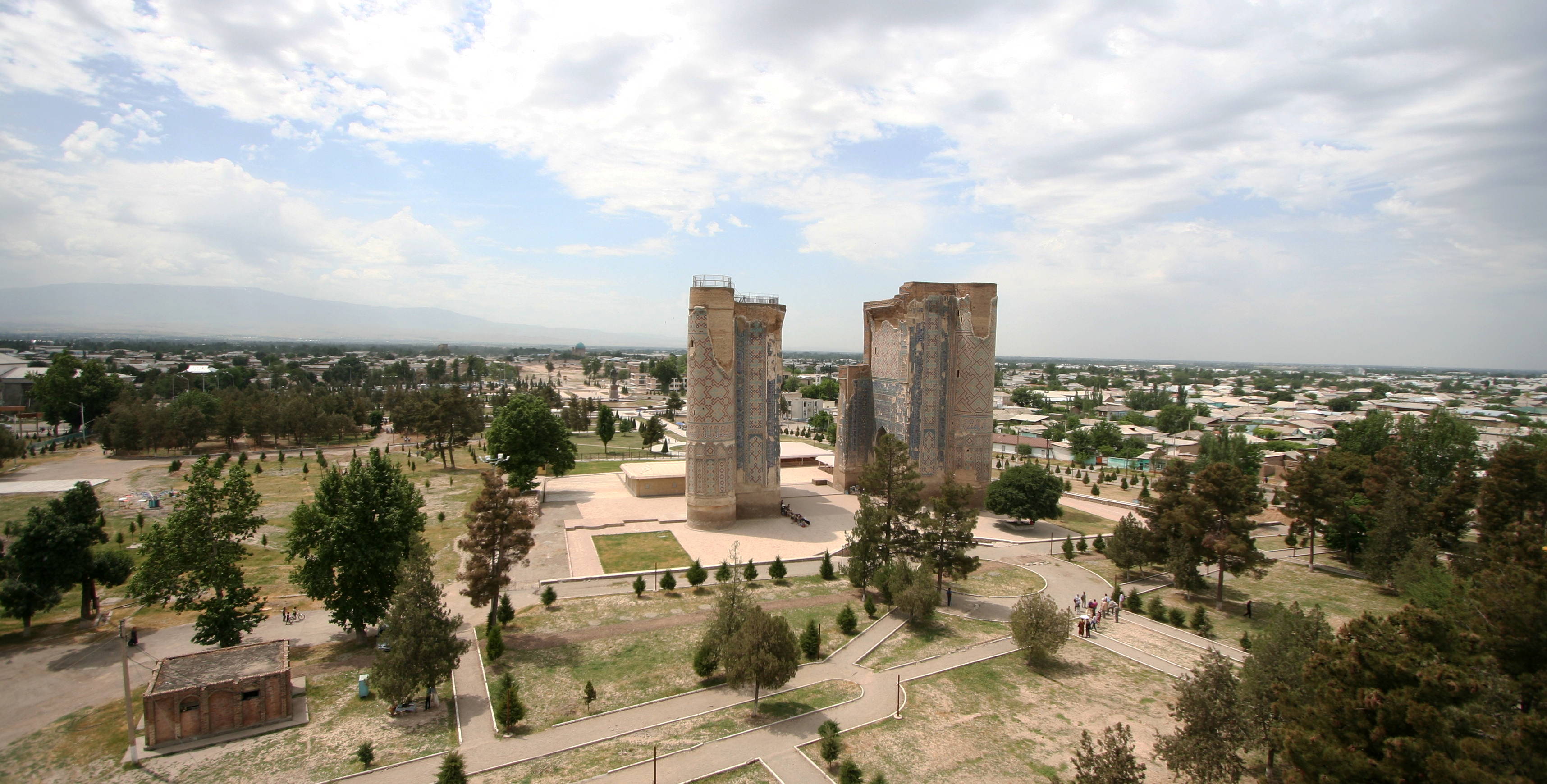
Ak-Saray Palace
Two pylons stand in Shahrisabz like broken teeth against the sky. They are 38 meters tall, faced in ocher and blue glazed brick, and they are all that remain of the entrance to a palace that took 24 years to build and only a century to destroy. Timur -- the conqueror who assembled an empire from Anatolia to India -- was born near this city, which was then called Kesh, and he wanted it to outshine Samarkand. The Ak-Saray Palace was his instrument for that ambition. Its name translates to "White Palace," though the color that survives is the deep blue of its tilework, still vivid after six hundred years of weather and neglect.
A Hometown Monument to World Conquest
Construction began in 1380, when Timur was at the height of his military campaigns. He chose Shahrisabz -- his birthplace, his emotional capital -- as the site for a palace that would declare his power in architectural terms. The building stretched across the northern edge of the city's historic center, near the north gate in the old walls. Surrounding structures rose as high as six stories. The central portal, whose vault spanned 22 meters, was decorated with intricate geometric and floral patterns in glazed brick. A scroll inscription ran across the facade, reading: "God prolong the Sultan's days." Work continued for 24 years, right up to Timur's death in 1405. The palace was never quite finished, and Timur never succeeded in making Shahrisabz his primary capital. Samarkand, with its established infrastructure and prestige, held on.
What Abdullah Khan Destroyed
The Ak-Saray survived Timur by about a century. In the 16th century, Abdullah Khan II -- the Khan of Bukhara -- turned his forces on Shahrisabz. The city and its palace were systematically destroyed, an act of political erasure designed to eliminate a rival power center. What the Bukharans could not topple were the portal pylons, which proved too massive to bring down efficiently. Everything else -- the residential quarters, the courtyards, the six-story wings -- was reduced to rubble. The scale of the original complex can no longer be determined with certainty because of that destruction. What remains is dramatic precisely because it is a fragment: two towering columns of brick and tile, standing in open parkland, their isolation making their height seem even more improbable.
Tilework That Outlasted the Empire
The surviving facade rewards close inspection. Large patterns of ocher, dark blue, and light blue glazed bricks cover the pylons in geometric compositions that are characteristic of Timurid architecture at its most confident. The tilework is not delicate; it is assertive, designed to be read from a distance by arriving visitors who would pass through the portal into the palace grounds. The colors have weathered differently -- the blues remain strong while the lighter tones have faded -- creating an effect that the original builders did not intend but that carries its own beauty. The inscription asking God to prolong the sultan's days reads now as an unintentional irony: the sultan's days ended in 1405, but the tiles endured. In 2000, UNESCO designated the palace ruins as part of the Shahrisabz World Heritage Site.
Timur Returns in Bronze
After Uzbekistan gained independence in 1991, the country reclaimed Timur as a national hero. Conservation work on the Ak-Saray ruins was carried out between 1994 and 1998, stabilizing the surviving pylons. A colossal bronze statue of Timur was erected on a high pedestal on the original site of the palace -- the conqueror returned to his hometown in metal, standing where his grand hall once stood. The statue faces outward, as though surveying the empire he built. From the air, the site reads as a park at the northern edge of Shahrisabz, the two surviving pylons casting long shadows across manicured ground that was once the floor of the most ambitious private building in Central Asia.
From the Air
Ak-Saray Palace ruins are located at 39.06N, 66.83E at the northern edge of Shahrisabz's historic center. The two 38-meter pylons are visible from moderate altitude and cast distinctive shadows. Nearest airport: Karshi Airport (UTSL) approximately 80 km north. Shahrisabz lies in a valley south of the Zarafshan Range; watch for mountain turbulence when approaching from the north. The site is part of the UNESCO World Heritage zone -- the city grid and surrounding agricultural land provide useful orientation landmarks.