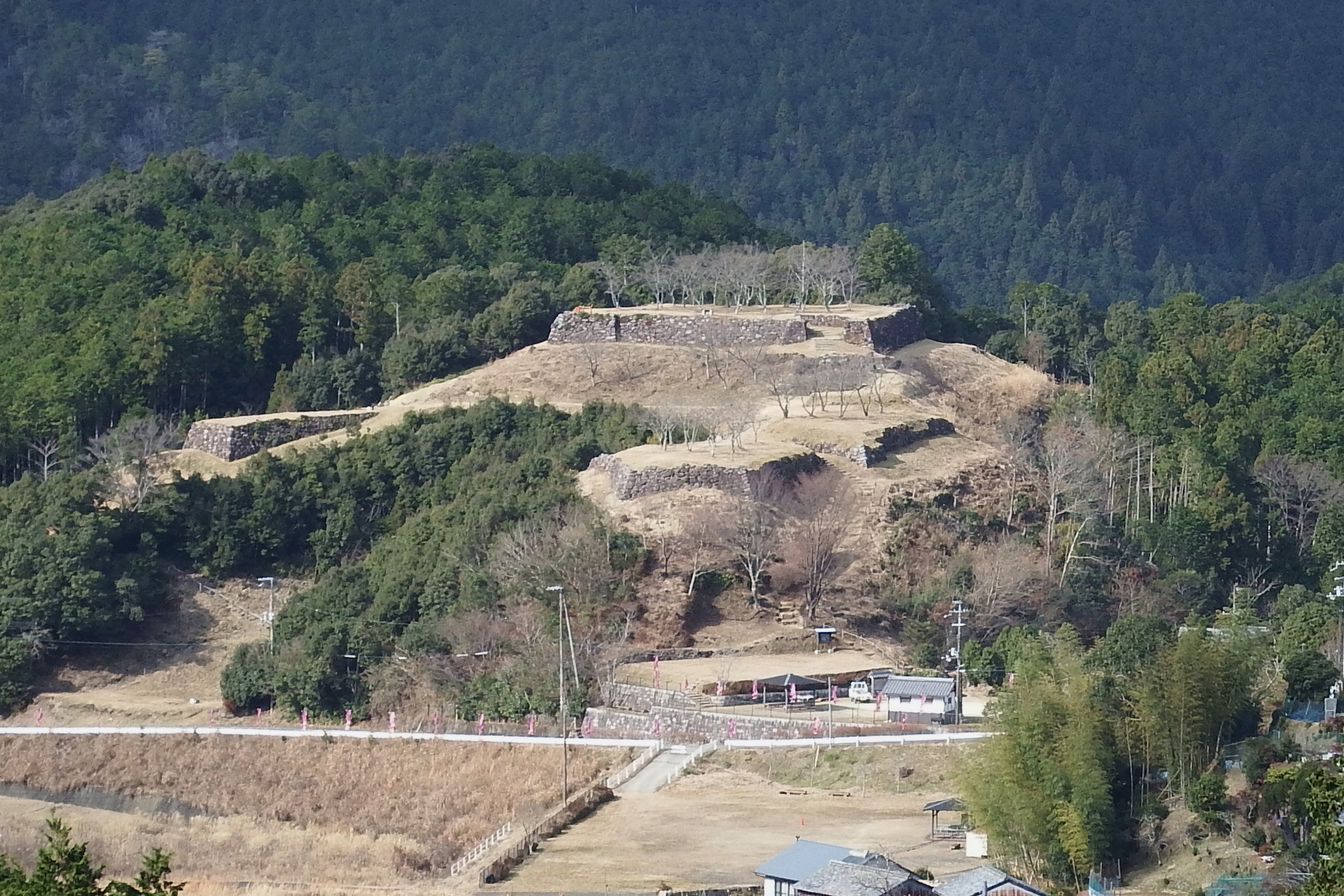
Akagi Castle: Timber, Rebellion, and a Castle in the Clouds
The real reason for the survey was timber. In 1586, when Toyotomi Hidenaga ordered a land census of the remote southern Kii Peninsula, the local warlords and farmers who rose up in armed revolt -- the Kitayama Ikki -- believed they were resisting taxation. They were partly right. But the deeper motive surfaced later, when Hidenaga's general Yoshikawa Heisuke quietly felled over 20,000 trees from the ancient forests of Kumano and sold them in Osaka for enormous profit. The fortress built to suppress the rebellion and enforce this exploitation still stands in ruin on a hillside in the Kiwa district of Kumano City, Mie Prefecture. Its name is Akagi Castle, and the story it tells is one of power, deception, and the price of Japan's finest wood.
A Master Builder's Commission
The man Hidenaga chose to build Akagi Castle was Tōdō Takatora, one of the most accomplished castle architects of the Sengoku period. Takatora constructed the fortress around 1589 on a hilltop at 230 meters elevation in the former Muro District of Kii Province, overlooking a small basin ringed by the Kii Mountains. The site commanded an ancient route connecting the Ise Shrine to the north with the Kumano Shrines to the south -- a pilgrimage corridor that had carried travelers for centuries. Takatora designed the castle as a hirayama-style fortification: three curved embankments encircling an inner bailey at the summit, a layout rooted in medieval mountain castle traditions. But he added innovations that marked the transition to early modern warfare -- stone walls with carefully fitted blocks and fortified gateways that controlled movement through the compound. Takatora remained at Akagi for roughly ten years before Toyotomi Hideyoshi transferred him to Uwajima Castle in 1595.
Blood on the Pilgrimage Road
The Kitayama Ikki of 1586 was no small disturbance. Thousands of local inhabitants joined the revolt against Hidenaga's survey, and although his forces defeated the main resistance quickly, Hidenaga refused to accept the rebels' surrender. He ordered a spring campaign to crush the survivors without mercy, but the plan stalled when most of his army was called away for Hideyoshi's invasion of Kyushu. It was only after Akagi Castle was completed that the reckoning came. In May 1589, a large number of rebellious farmers were beheaded at Tabirako Pass, near the castle. The execution site is still marked today and was included in the National Historic Site designation alongside the castle ruins. History repeated itself decades later: during the Siege of Osaka in the early 1600s, when Asano Nagaakira -- the castle's later lord under Tokugawa Ieyasu -- had sent his forces to fight with the Tokugawa armies, the local population rose again at the urging of Toyotomi Hideyori. Asano returned to suppress the revolt and executed 363 rebels at the same Tabirako Pass. A memorial tower erected in 1968 marks the site.
Stone Walls and the Timber Trade
When Hideyoshi learned that Yoshikawa Heisuke had been logging Kumano's forests for private gain under cover of the land survey, he was furious and ordered Yoshikawa's execution. Hidenaga fell from favor. But Hideyoshi was also a pragmatist. He recognized the immense value of Kumano timber -- the dense, straight-grained cedar and cypress that grew in the deep valleys of the Kii Peninsula -- and Akagi Castle continued to serve as the administrative center for exploiting this resource. The castle's dual role, as both military strongpoint and commercial hub, made it unusual among Sengoku-era fortifications. Its stone walls, painstakingly restored by Kumano City between 1989 and 2004 following the National Historic Site designation, blend medieval and early modern construction techniques in a way that scholars consider especially valuable for understanding the evolution of Japanese castle architecture.
A Castle Floating Above the Valley
On certain autumn and winter mornings, a weather phenomenon called fuden oroshi sends thick white mist cascading down the mountainsides and pooling in the valleys around Kumano City. When the timing is right, Akagi Castle's restored stone walls emerge above this sea of clouds like a fortress suspended in the sky. After the ruins were featured in a Japanese television program in 2015 and photographs of the mist-wrapped walls circulated widely, Akagi became a destination for visitors and photographers chasing the effect. The comparison to a castle in the sky is inescapable, though Akagi's history is far grimmer than any Miyazaki fantasy. The ruins sit quietly on their hilltop for most of the year, surrounded by dense forest and birdsong, the stone walls tracing the outlines of baileys where Takatora's garrison once watched the pilgrimage road below. Kumano City maintains the site as a park, and a live camera streams the view for those hoping to catch the next morning when the clouds cooperate.
From the Air
Located at 33.90N, 135.95E in the Kiwa district of Kumano City, Mie Prefecture, deep in the Kii Mountains of the southern Kii Peninsula. The castle ruins sit at 230 meters elevation on a forested hilltop above a small basin. From altitude, the area is densely mountainous with narrow river valleys running to the coast approximately 10 nautical miles to the southeast. Best viewed at 2,000-4,000 feet AGL, though autumn and winter mornings may produce the fuden oroshi mist effect that obscures the valleys below. Nanki-Shirahama Airport (RJBD) lies approximately 35 nautical miles to the southwest. Chubu Centrair International Airport (RJGG) is approximately 100 nautical miles to the northeast. Terrain is rugged throughout the Kii Peninsula; maintain safe altitude and awareness of mountain weather.