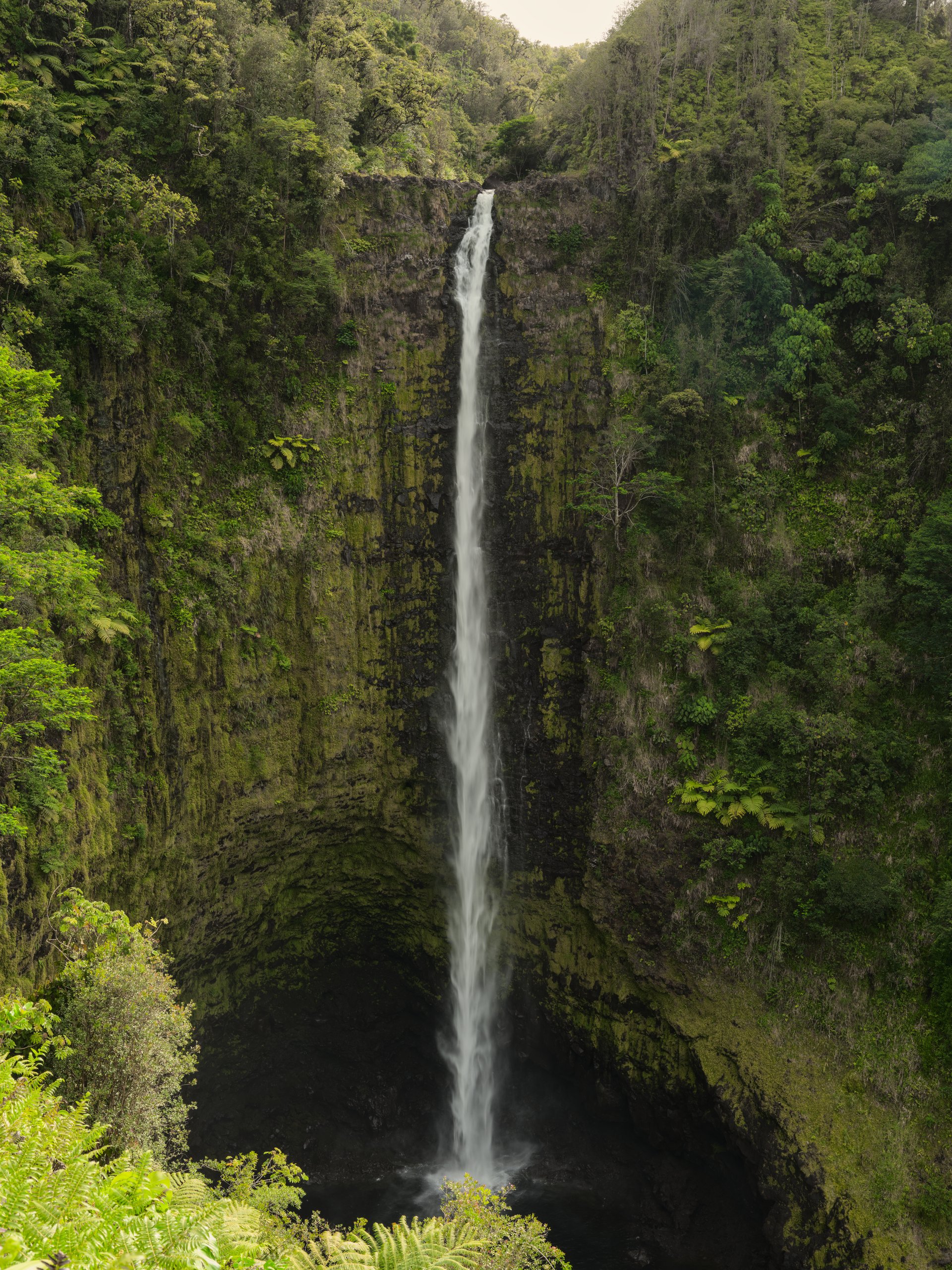
ʻAkaka Falls State Park
There is a stone at ʻAkaka Falls called Pōhaku a Pele. Strike it with a branch of lehua āpane — a dark-red-blossomed variety of the native ʻōhia tree — and, according to Hawaiian folklore, the sky will darken and rain will fall. Given that this stretch of the Hamakua Coast already receives some of the heaviest rainfall in Hawaiʻi, the stone may not need much help. But the story captures something true about this place: water is everything here. It carved the gorge, feeds the falls, and sustains a rainforest so dense that the 442-foot cascade can vanish behind curtains of mist before you even reach the overlook.
A Chief's Namesake
ʻAkaka Falls takes its name from Chief ʻAkaka-o-ka-nīʻau-oiʻo-i-ka-wao, grandson of Kūlanikapele and Kīakalohia. The falls and its surrounding park sit about 11 miles north of Hilo, just west of the small town of Honomū, at the end of Hawaiʻi Route 220. A paved loop trail winds through the park along the right shoulder of the deep gorge, offering multiple vantage points of the main falls and its neighbor, Kahūnā Falls, which drops 300 feet through its own channel of mossy rock. Smaller cascades appear and disappear along the trail depending on recent rainfall, each one threading through layers of tropical vegetation — bamboo groves, giant philodendrons, hanging ferns, and torch ginger with blossoms the color of embers.
The Shrimp That Climbs Waterfalls
The falls plunge into Kolekole Stream, and about 70 feet upstream from the lip sits a large boulder called Pōhaku o Kāloa, one of several named stones that anchor the site in Hawaiian cultural geography. But the stream holds a biological wonder as well. A native freshwater shrimp called the ōpaekalaole has evolved the ability to climb the vertical rock face of ʻAkaka Falls. In a state where nearly every native species arrived by wing, wave, or wind and then adapted to conditions found nowhere else on Earth, this climbing shrimp is a striking example of what isolation and time can produce. The shrimp works its way up the wet basalt against the force of the falling water, a journey of hundreds of vertical feet driven by the same imperative that brought its ancestors to these islands in the first place: the need to reach new habitat.
Rainforest on the Rim
Walking the loop trail at ʻAkaka Falls feels less like visiting a waterfall and more like entering a greenhouse without walls. The park sits in the wet belt of the Hamakua Coast, where moisture-laden trade winds rise against the slopes of Mauna Kea and release their burden as near-constant rain. The result is a rainforest canopy so thick that sunlight reaches the trail in scattered patches, illuminating the red blossoms of ʻōhia lehua and the broad leaves of wild taro. The air is heavy, warm, and fragrant with decomposing vegetation — the smell of a landscape that grows as fast as it falls apart. The trail itself is well maintained, a half-mile loop with paved surfaces and handrails, making this one of the most accessible old-growth rainforest experiences in Hawaiʻi. But accessibility should not be mistaken for tameness. The gorge drops away sharply just beyond the railings, and the roar of the falls below is a constant reminder of the forces that built this landscape.
Water Shapes Everything
Hawaiʻi Island's windward coast is defined by waterfalls, but ʻAkaka stands out for both its height and its setting. At 442 feet, it is among the tallest accessible waterfalls in the state, and the gorge it has carved into the Kohala-age basalt is still actively deepening. Heavy rains can transform the falls from a delicate bridal veil into a thundering brown torrent in a matter of hours. The stream that feeds it drains a catchment area high on the flanks of Mauna Kea, where annual rainfall can exceed 200 inches. This is the engine that powers the falls and everything around them — the dense vegetation, the climbing shrimp, the named stones in the stream. Remove the rain and the whole system collapses. It is a place where geology, biology, and mythology all converge on the same truth: in Hawaiʻi, water is the beginning of every story.
From the Air
Located at 19.85°N, 155.15°W on the Hamakua Coast of Hawaiʻi Island, about 11 miles north of Hilo. The falls are set in a deep gorge that may not be directly visible from altitude, but the lush green belt of the Hamakua Coast and the gorge cut are identifiable from 2,000–3,000 feet AGL. The park is inland from the coast, west of the town of Honomū. Nearest airport: Hilo International Airport (PHTO) approximately 11 nm south-southeast. The Hamakua Coast is frequently cloud-covered due to trade winds; early morning flights offer the best chance of clear views.