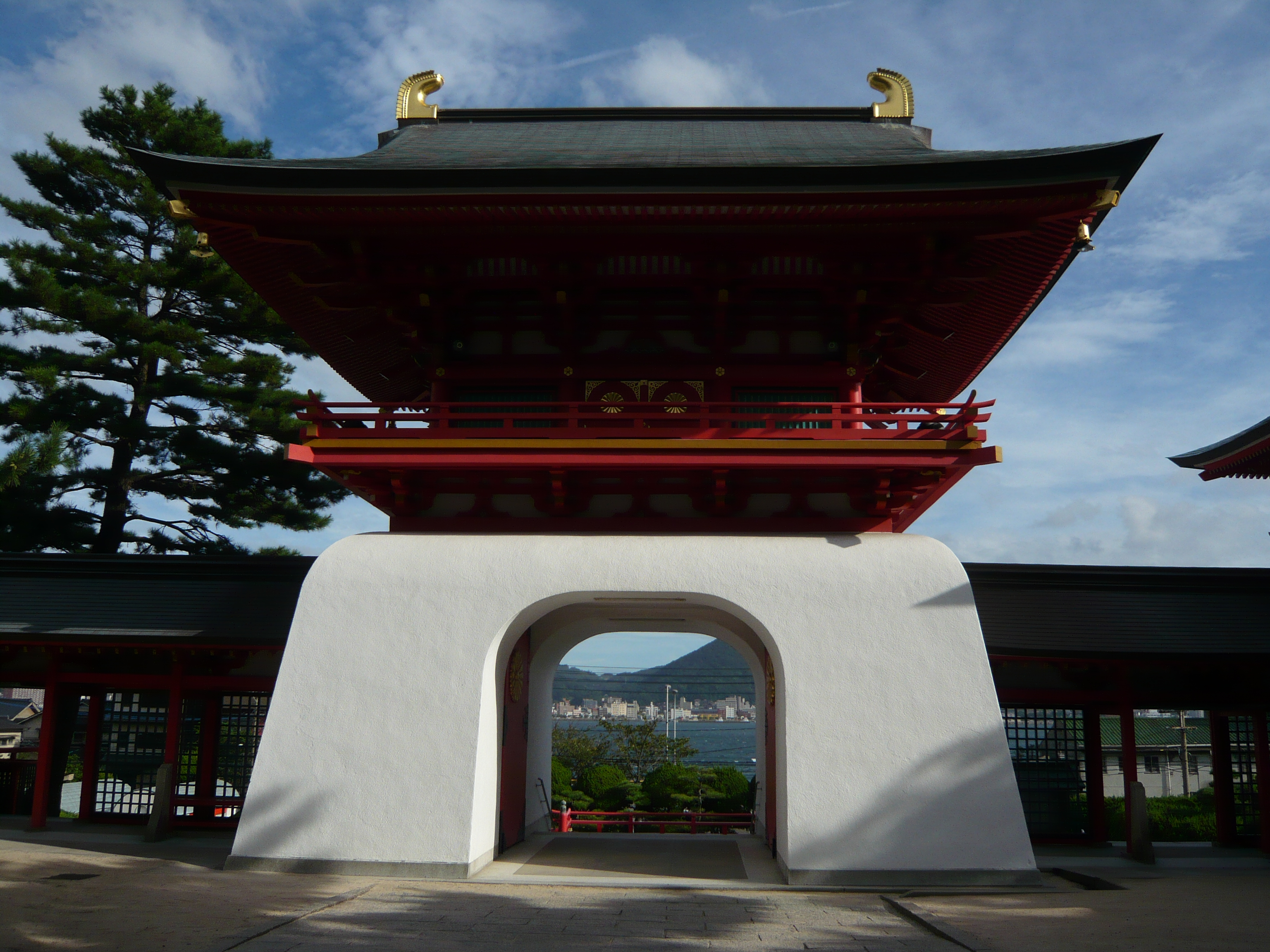
Akama Shrine
The gate is the first thing you notice -- vermillion red, built in the style of Ryugu-jo, the mythical underwater palace of the dragon god of the sea. It stands on the waterfront of the Kanmon Strait in Shimonoseki, facing the water where, in 1185, a six-year-old emperor died. Akama Shrine exists because of that death, and because of the legend that grew around it. When the Taira clan lost the Battle of Dan-no-ura in the strait just offshore, the child Emperor Antoku's grandmother, Nii-no-Ama, gathered him in her arms and leaped into the sea rather than let him be captured by the victorious Minamoto. According to the Tale of Heike, she told him they were going to an underwater palace. The shrine's gate was designed to fulfill that promise.
A Palace Beneath the Waves
The architectural choice is deliberate and haunting. According to the Shimonoseki Tourist Guidebook, the colors and proportions of Akama's main gate reference Ryugu-jo -- the dragon king's undersea palace from Japanese mythology. Nii-no-Ama, Emperor Antoku's grandmother and widow of the powerful Taira no Kiyomori, is said to have wished that their final resting place be created underwater. In the Tale of Heike, she comforted the boy before their plunge by telling him they would find a beautiful palace beneath the waves. Antoku's mother, Taira no Tokuko, later dreamed that they were indeed living in Ryugu-jo. The shrine transforms grief into architecture. What was a drowning becomes an arrival. What was a military defeat becomes a journey to a palace of coral and pearl.
The Earless Monk and the Ghost Warriors
Inside the shrine grounds, the Hoichi Hall houses a statue of Hoichi the Earless -- a figure from one of Japan's most famous ghost stories, brought to Western readers by the writer Lafcadio Hearn. In the tale, Hoichi is a blind biwa player of extraordinary skill who lives at a temple near the strait. Each night, ghostly Taira warriors summon him to perform the story of their defeat at Dan-no-ura. When the temple monks discover what is happening, they cover Hoichi's entire body in Buddhist sutras to make him invisible to the spirits. But they forget his ears. The ghosts, unable to see the rest of him, tear off the exposed ears and carry them away. The story captures something real about this place: the dead of Dan-no-ura do not rest easily here. The shrine grounds also contain the Nanamori-zuka, seven burial mounds honoring the Taira (Heike) warriors who perished in the battle.
From Defeat to Highest Honor
Akama Shrine's history mirrors the strange posthumous rehabilitation of Emperor Antoku. A child placed on the throne as a puppet of the Taira clan, drowned at six in a naval battle he could not have understood, Antoku was later enshrined here and venerated with increasing reverence over the centuries. The shrine's own status climbed the imperial hierarchy in parallel. In 1871, under the Meiji government's system of ranked Shinto shrines, it was classified as a National shrine of the second class, known then as Akama-gu. By 1901, it had risen to the highest rank of National shrine, first class. In 1940, its status was elevated again to Kanpei-taisha -- the pinnacle of imperial shrine ranking -- and its name changed to Akama Jingu. A drowned child emperor, once a symbol of a defeated clan, became one of the most honored figures in the Japanese spiritual landscape. The shrine sits between Shimonoseki's city center and the tourist restaurants of Karato at Kanmon Wharf, its red gate impossible to miss from the waterfront promenade.
From the Air
Akama Shrine (33.96N, 130.95E) sits on the waterfront in Shimonoseki, at the western end of the Kanmon Strait separating Honshu from Kyushu. The strait is one of Japan's busiest shipping channels. Kitakyushu Airport (RJFR) is approximately 15 km to the east across the strait. The Kanmon Bridge and undersea tunnel connect the two islands nearby. The shrine's red gate is visible from low altitude along the Shimonoseki waterfront.