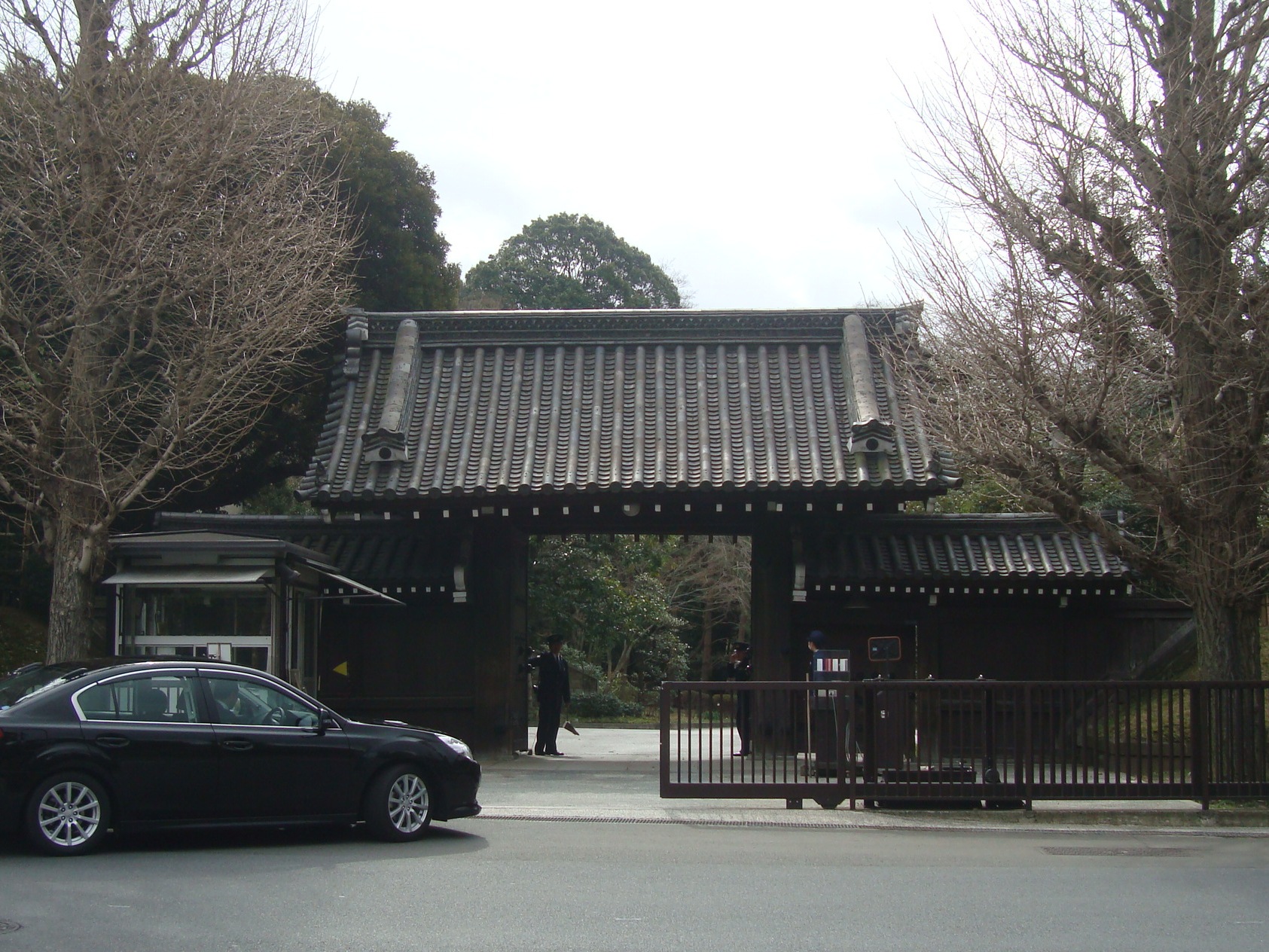
Akasaka Estate
When a fire gutted Nishinomaru Palace inside Edo Castle in 1873, Emperor Meiji needed a roof over his head that same day. Tokugawa Mochitsugu, the former feudal lord whose family had held these grounds since 1632, opened his gates without hesitation. The Emperor moved in and stayed for fifteen years. That act of sudden hospitality transformed what had been one of Edo's largest daimyo estates into the beating heart of Japan's modern Imperial Family -- a role it has never relinquished. Today the Akasaka Estate sits behind stone walls and guarded gates in the Moto-Akasaka district of Minato, Tokyo, invisible to the millions of commuters who pass it daily. Six imperial residences cluster around a central Japanese garden where the Emperor hosts garden parties twice a year for some 2,000 diplomats, politicians, and public figures. The general public, however, never gets inside.
From Shogun's Ground to Emperor's Garden
The estate's story begins in 1632, when the powerful Tokugawa clan of Kii Province received a grant of land that would become one of Edo's most impressive feudal compounds. At 145,381 tsubo -- roughly 48 hectares -- it dwarfed most daimyo residences in the city. The Tokugawa of Kii used it as their secondary Edo residence until 1823, when a fire destroyed their main home in Kojimachi, elevating this estate to primary status. The Meiji Restoration reshuffled everything. Mochitsugu, the last feudal lord, became a Kazoku noble in the new order. When the Emperor arrived in 1873, the estate's feudal chapter closed and its imperial chapter began. Empress Dowager Eisho received a residence on the southwest corner so the Emperor could keep her nearby. The grounds were gradually carved up for crown princes, dowager empresses, and close relatives -- each generation adding palaces and gardens to the compound.
Six Residences Behind the Walls
The estate today is a small village of imperial architecture spanning decades of Japanese design. At its northern edge stands the Akasaka Palace, a 72-room reinforced concrete structure built in 1960 by architect Yoshiro Taniguchi, now serving as the residence of Emperor Emeritus Akihito. To the southeast, the Akishino Residence is a patchwork of buildings dating from 1931 to 2000, home to Crown Prince Akishino, his consort Kiko, Princess Kako, and Prince Hisahito. The complex underwent major renovation from 2019 to 2022, during which the family lived in a purpose-built temporary palace just meters away. The East Mikasa Residence, the Mikasa Residence, and the Takamado Residence line the southern edge -- each carrying the name and memory of its imperial branch. The Takamado Residence, finished in 1986, is an Art Deco-influenced building with 19 rooms and a garden pergola, where Princess Hisako and Princess Tsuguko now live after other family members left the imperial household through marriage to commoners.
The Garden Party You Will Never Attend
At the heart of the compound lies a Japanese garden whose name is known to every politician and diplomat in Tokyo. Twice a year, the Emperor hosts a garden party here, inviting around 2,000 guests from politics, diplomacy, and public life. These events are among the few occasions when outsiders set foot on the grounds. Six gates control access: the main gates along Road 414 on the northern side, eastern-facing gates, one opening onto Aoyama Dori, and another toward Gaien-Higashi Dori on the southwest. Each gate marks a boundary between Tokyo's relentless urban energy and the quiet, wooded calm of imperial grounds that have remained essentially private for nearly four centuries. The contrast is the estate's defining quality -- one of the largest green spaces in central Tokyo, yet one that barely exists on any tourist's itinerary.
Imperial and National, Split by War
The estate's northern section once held the original Akasaka Residence, where Togu Palace was built in 1909. After the Second World War, this section was severed from the rest of the estate. The Togu Palace became the Geihinkan -- Japan's State Guest House -- and was reclassified as national property. The remainder stayed in imperial hands. That postwar division created the curious situation that persists today: two distinct worlds share the same neighborhood, separated by a fence and a legal distinction between national and imperial ownership. Visitors touring the Baroque splendor of the State Guest House are standing on what was once the same continuous estate, yet they cannot walk a few hundred meters south into the grounds where the Imperial Family still lives. The split reflects a broader postwar reality -- the emperor was stripped of political power but kept his home.
From the Air
Located at 35.678N, 139.728E in central Tokyo's Minato ward. The estate appears as a large green rectangle amid dense urban development, immediately south of the Akasaka Palace (State Guest House) complex. Look for the distinctive contrast between the wooded imperial grounds and surrounding high-rises. Nearest airports: Tokyo Haneda (RJTT) approximately 12km south, Narita International (RJAA) approximately 60km east. Chofu Airport (RJTF) lies 20km west. Expect controlled airspace throughout the Tokyo metropolitan area.