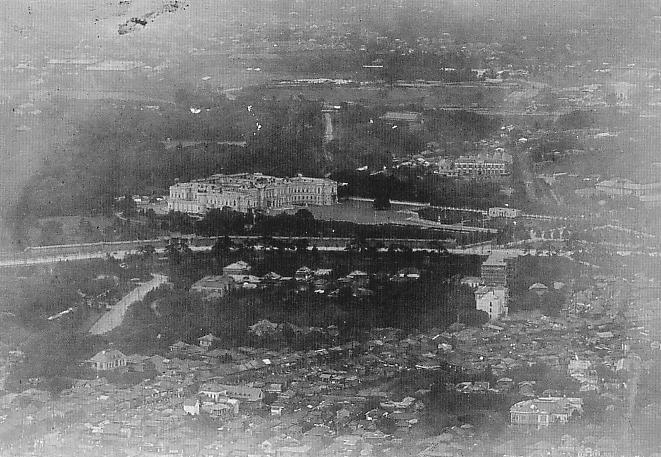
Akasaka Palace
Four days after Emperor Hirohito moved into Akasaka Palace on August 28, 1923, the Great Kanto earthquake leveled much of Tokyo. The move was supposed to be temporary while his regular residence was renovated. It lasted five years. That pattern of unplanned adaptation defines this building's entire existence. Designed in 1909 as the Togu Palace for Japan's crown prince, it was the most ambitious Western-style building of the Meiji era -- a Neo-Baroque confection deliberately modeled on the Hofburg Palace in Vienna and the Palace of Versailles. It was deemed too extravagant for a crown prince and languished for decades as an underused imperial property. After the war, it housed the National Diet Library and the Cabinet Legislation Bureau. Then, in 1974, architect Togo Murano spent five years and 10.8 billion yen transforming it into Japan's official State Guest House, and the building finally found its purpose.
Versailles on the Yamanote Line
The main building is an exercise in confident imitation. Its architects studied European palace design and produced one of the largest structures of the Meiji period, complete with a grand entrance, fountain gardens, and the ornamental vocabulary of French and Austrian royal architecture. The Neo-Baroque facade would not look out of place in Vienna's Hofburg quarter. Inside, the scale matches the ambition -- vast reception halls, ceremonial staircases, and enough gilt to remind any visiting head of state that Japan's imperial aspirations in 1909 were perfectly serious. Alongside the main Western building sits Yushin-tei, a smaller structure in traditional Japanese style that provides a counterpoint of restrained elegance. Together, the two buildings and their gardens occupy a substantial site in Moto-Akasaka, Minato, walled off from the surrounding Tokyo streetscape.
The First President to Visit
When the renovated State Guest House opened in 1974, its first official guest was Gerald Ford -- making him the first incumbent President of the United States to visit Japan. The symbolism was deliberate: a building that once housed Japanese imperial power now welcomed the leader of the nation that had occupied Japan three decades earlier. Since Ford's visit, the palace has hosted three G7 summits -- in 1979, 1986, and 1993 -- and multiple APEC summits. World leaders have dined beneath ceilings originally designed to impress visiting European royalty. The building's transformation from imperial residence to diplomatic venue mirrors Japan's own postwar reinvention, from military empire to economic powerhouse and international partner.
Earthquake, War, and Reinvention
The palace has survived the two great calamities of twentieth-century Tokyo. The 1923 earthquake struck while Hirohito was in residence; the building held. During and after World War II, it served various government functions, including hosting the organizing committee for the 1964 Tokyo Olympics. By the 1960s, Japan needed a proper state guest house. The former residence of Prince Asaka -- now the Tokyo Metropolitan Teien Art Museum -- served briefly but proved too small. The government settled on Akasaka Palace in 1967. Togo Murano, one of Japan's most celebrated architects, led the renovation, preserving the Meiji-era bones while upgrading everything else. The work took more than five years. A second major renovation closed the building from 2006 to 2009.
National Treasure at the City's Core
In December 2009, the main building, the main gate, and the fountain garden received designation as a National Treasure of Japan -- the first post-Meiji Restoration structure to earn the honor. The designation recognized not just architectural merit but historical significance: this is the building where modern Japan learned to present itself to the world in Western architectural language, then spent a century figuring out what to do with that ambition. Today the palace opens periodically for public tours, offering ordinary Tokyoites a rare glimpse behind walls that usually admit only heads of state and their entourages. The contrast between the Baroque grandeur inside and the sleek glass towers visible just beyond the garden walls captures something essential about Tokyo itself -- a city that layers its centuries rather than discarding them.
From the Air
Located at 35.680N, 139.729E in central Tokyo's Minato ward, immediately north of the Akasaka Imperial Estate. The palace grounds appear as a large formal garden with a prominent white Western-style building visible from altitude. The symmetrical layout and fountain garden distinguish it from surrounding structures. Nearest airports: Tokyo Haneda (RJTT) approximately 12km south, Narita International (RJAA) approximately 60km east. The site sits within Tokyo's heavily controlled airspace.