AKI Academy for Art & Design
Enschede's textile barons had a practical problem in 1946. The mills needed fabric designers, the war had wrecked everyone's pipeline, and so the manufacturers founded a school of their own: the Academie voor Kunst en Industrie, the Academy for Art and Industry. The goal was utilitarian. Train people who could draw patterns for cloth. For about fifteen years that is exactly what the school did. Then in 1968, with a new director, the AKI changed course almost completely. It dropped applied arts for free modern art and spent the next several decades earning a reputation as the most rebellious art academy in the Netherlands. The acronym stuck even though the words behind it no longer applied. So did the rebellion.
From Textiles to Free Art
The shift happened under Joop Hardy, appointed director in 1968 at the height of European student upheaval. He took a school designed to feed industry and reoriented it toward whatever students wanted to make. Hardy held the position long enough to set the institutional tone, and was followed by the artist Sipke Huismans, who ran the academy from 1981 until 2001. Through those two long tenures the AKI's reputation hardened. Other Dutch art schools were freer than their counterparts elsewhere in Europe, but the AKI was reportedly freer than them. Students could chase ideas across departments, work in workshops without much supervision, and find the kind of unstructured time that produces both breakthroughs and self-indulgence. The school cultivated that ambiguity deliberately.
Buildings That Tell a Story
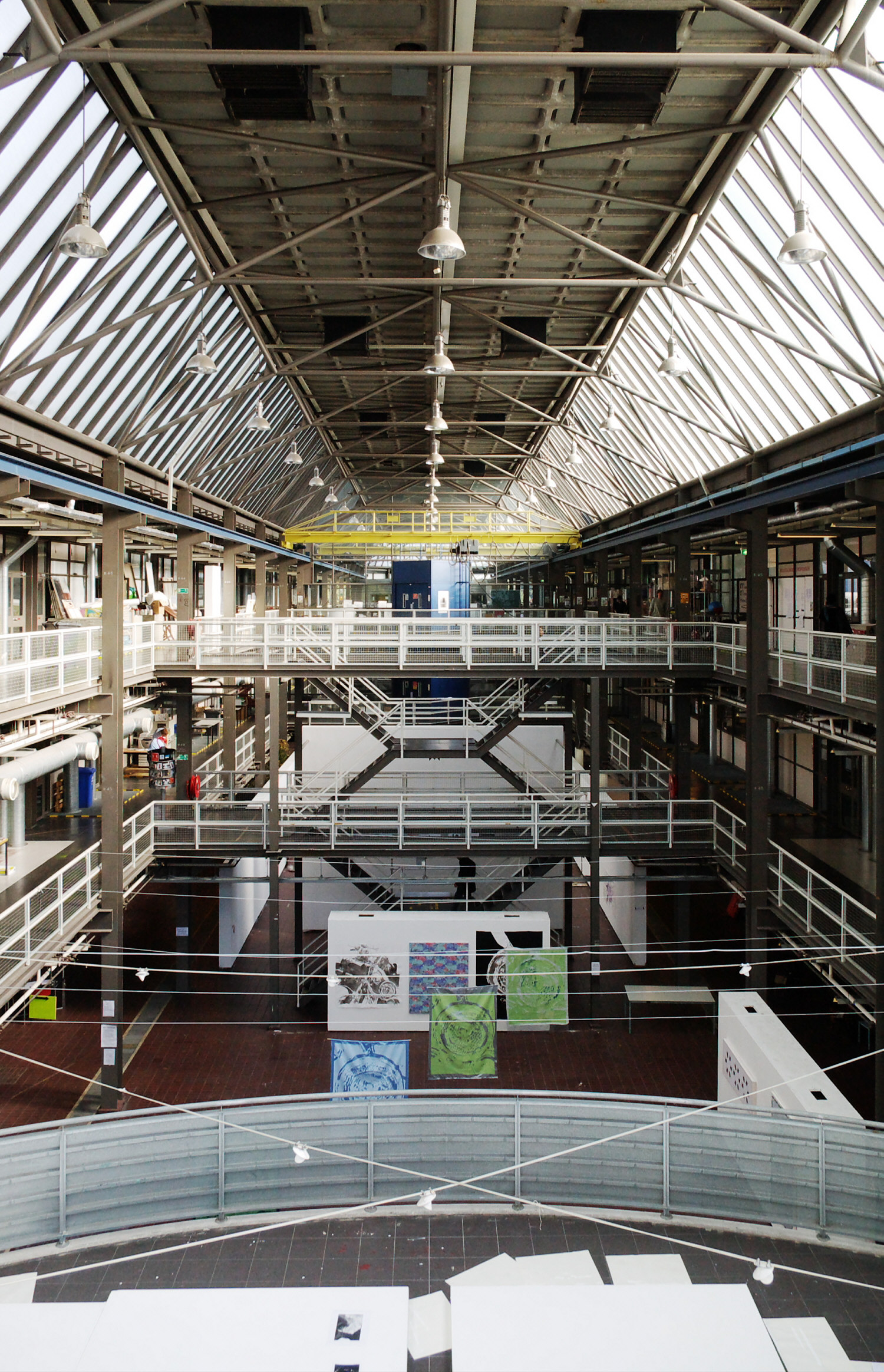
The AKI's addresses trace a small architectural history of post-war Enschede. For decades the school was housed in a modern 1957 building on the Roessinghsbleekweg, designed by Arno Nicolai. Later it moved to the Technohal, a former chemical laboratory on the campus of the University of Twente. The chemistry pedigree was incidental but apt, since by then the school's work was a kind of experimental practice in its own right. In 2013 it moved again, into the TETEM 2 building in the Roombeek district, the neighborhood famously rebuilt after the May 2000 fireworks-factory disaster that killed twenty-three people and flattened part of the city. Until June 2015 the painting students kept an outpost in the former village school of Twekkelo, a separate building that gave them physical distance from the main academy.
Alumni Who Shaped Dutch Design
Look at the alumni list and the AKI's reach becomes concrete. Daan Roosegaarde, the designer behind the Smog Free Tower and the glowing Van Gogh bicycle path, studied here. So did Irma Boom, internationally recognized as one of the most original book designers working today, whose monographs are held in MoMA's collection. Jaap Drupsteen, the graphic designer responsible for some of the most distinctive Dutch postage stamps and television graphics of the late 20th century, came through the school. So did the contemporary sculptors Anne Wenzel and Ronald Ophuis, the street artist Jeroen Jongeleen, and the fashion designer Bas Kosters. For a regional school in the easternmost city in the Netherlands, the export of talent has been disproportionate.
Merger and Reclaimed Name
Dutch educational reforms in the early 2000s forced small institutions to consolidate to meet enrollment thresholds. In 2002 the AKI merged with the art academies in Arnhem and Zwolle to form ArtEZ Hogeschool voor de Kunsten, with the AKI as the Enschede branch. Students protested the loss of identity, and the school eventually reclaimed its old name as a working brand inside the ArtEZ structure. The bachelor programs today are organized around three streams: Fine Art, Crossmedia Design, and Moving Image. Each begins broad and narrows into specialization. The AKI is one of the few academies in the Netherlands that still maintains a working photographic darkroom, a small detail that says a lot about how the school still values craft alongside concept.
Recent Trouble
Reputations for freedom can curdle. In 2017 the then-director, Marc Boumeester, was temporarily suspended after being caught using drugs with students. In September 2022 the school made the news again when a wrongfully suspended student's lawsuit surfaced accounts of what some staff and students described as a culture of fear at the academy. The reports forced an institutional reckoning that has continued since. The AKI's story is not a tidy one; the same disposition that produced Roosegaarde and Boom has at times produced governance failures. The school is still here, still in Roombeek, still graduating people who go on to do interesting things, but the question of what kind of place it should be is open in a way it has not been for a long time.
From the Air
AKI sits at 52.239N, 6.854E in the Roombeek district of Enschede, near the German border in the easternmost corner of the Netherlands. From the air the school is part of the densely rebuilt Roombeek neighborhood, recognizable as the area north of the city center with the unusually planned street grid that followed the May 2000 fireworks disaster reconstruction. The city of Enschede is bounded by green farmland to the west and the German border just east. Closest airport is Enschede Twente (EHTW) a few kilometers north, with Munster Osnabruck (EDDG) just over the border. Best identified at low cruising altitude in clear conditions; the Roombeek street pattern stands out from the surrounding older neighborhoods.