Al Alam Palace
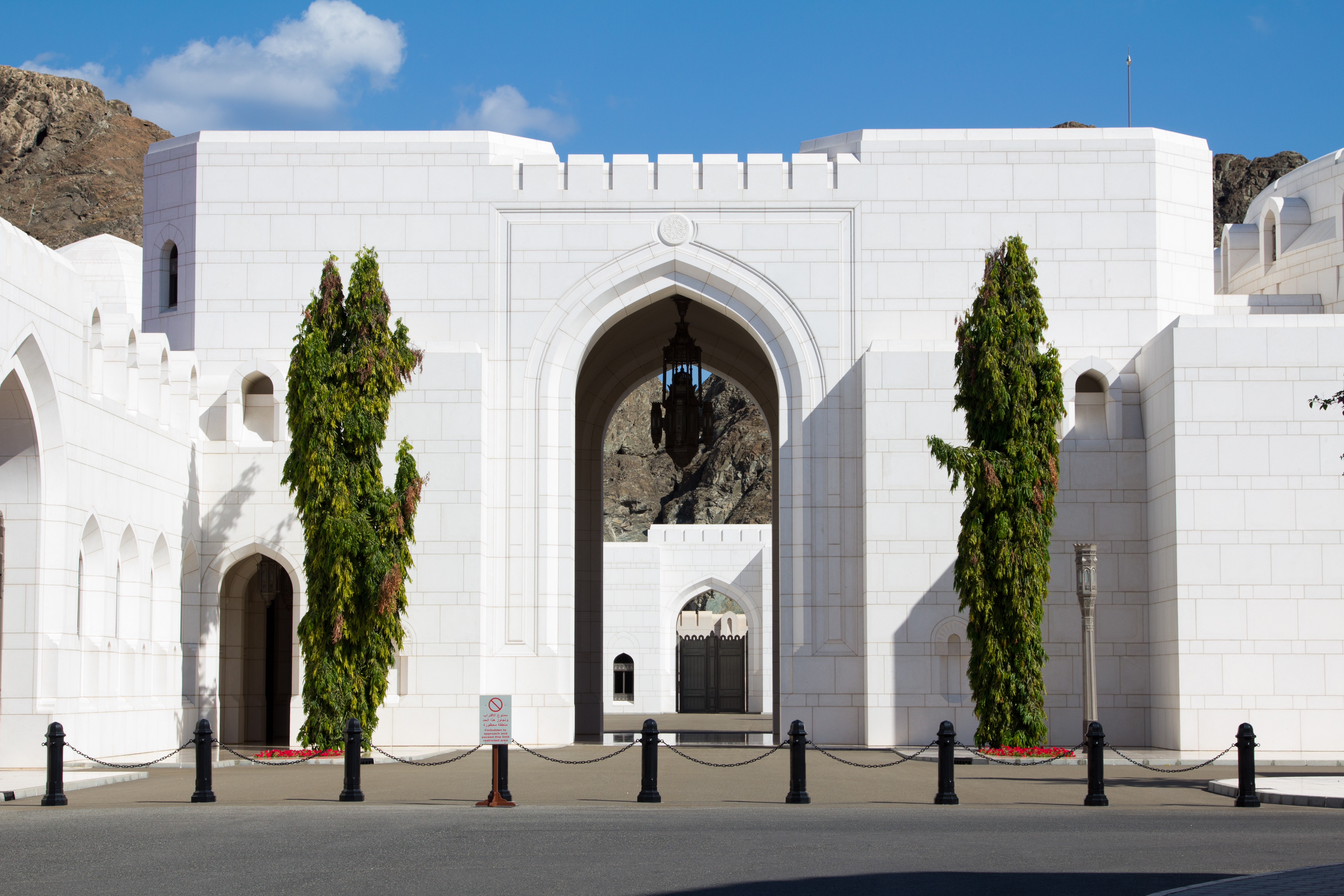
Gold and blue columns rise between two Portuguese forts. Al Alam Palace -- the Palace of the Flag -- occupies one of the most theatrically positioned sites in the Arab world: a narrow strip of reclaimed waterfront in Old Muscat, squeezed between the twin fortresses of Al-Mirani and Al Jalali, with the Gulf of Oman at its back and a 250-meter arcaded plaza stretching before it. Visitors cannot enter the grounds, but they can stand at the gates and photograph a building that manages to be simultaneously flamboyant and inaccessible.
The First Palace
Sultan Said bin Sultan built the original palace, Bayt al-Alam, in the early 1800s on the foundations of the old sea wall between the two Portuguese forts. The location was strategic: flanked by fortifications dating to the 16th century, with the harbor directly accessible. But the palace carried Oman's turbulent politics in its walls. Tribal insurgents damaged it in 1895, and Sultan Faisal bin Turki lacked the funds to repair it. By the 20th century, Sultan Said bin Taimur had largely abandoned Muscat for Salalah in the south, and the palace was locked up and left to deteriorate. It was demolished in 1971, clearing the site for something entirely new.
Qaboos Rebuilds Between the Forts
Sultan Qaboos bin Said, who took power in 1970 by overthrowing his father, commissioned a new palace on the same symbolically charged ground. The Indian architectural firm Shapoorji Pallonji designed the replacement in what observers have called a flamboyant style -- a deliberate departure from the austere military architecture surrounding it. Completed in 1972, the new Qasr al-Alam features the gold and blue columned facade that has become its signature. The palace functions as a ceremonial venue for receiving foreign dignitaries and heads of state rather than as a royal residence, giving it the character of a stage set for state occasions.
Framed by History
The palace derives much of its visual power from context. Al-Mirani Fort stands on a rocky outcrop to the west; Al Jalali Fort mirrors it to the east. Both were built by the Portuguese in the 1580s and have served variously as military strongholds, prisons, and museums. Between them, the palace sits like a jewel in a setting designed by centuries of conflict. The surrounding government buildings maintain the architectural discipline of Old Muscat -- white walls, crenellated rooftops, wooden balconies in traditional Omani style. The plaza facing the palace leads directly to the National Museum of Oman, creating a ceremonial axis that connects the country's political present to its cultural past.
Seen but Not Entered
Al Alam Palace is one of those landmarks that belongs more to the viewer than to the visited. The inner grounds remain off limits, and the palace has no public tour program. Visitors photograph the facade from beyond the gates or view it from boats in the harbor, where the building appears framed by cliffs and fortifications. This distance is part of the design: the palace communicates sovereignty through visibility rather than accessibility. The gold and blue columns are meant to be seen, from the plaza, from the water, from the mountainous roads that wind above Old Muscat. What happens behind those columns remains the private business of the state.
From the Air
Al Alam Palace is at 23.616N, 58.595E in Old Muscat, flanked by twin forts on rocky outcrops visible from the air. Best viewed at low altitude approaching from the Gulf of Oman side, where the palace, forts, and harbor form a compact tableau. Muscat International Airport (OOMS) is the nearest major airport. The Muttrah Corniche runs along the coast to the west.