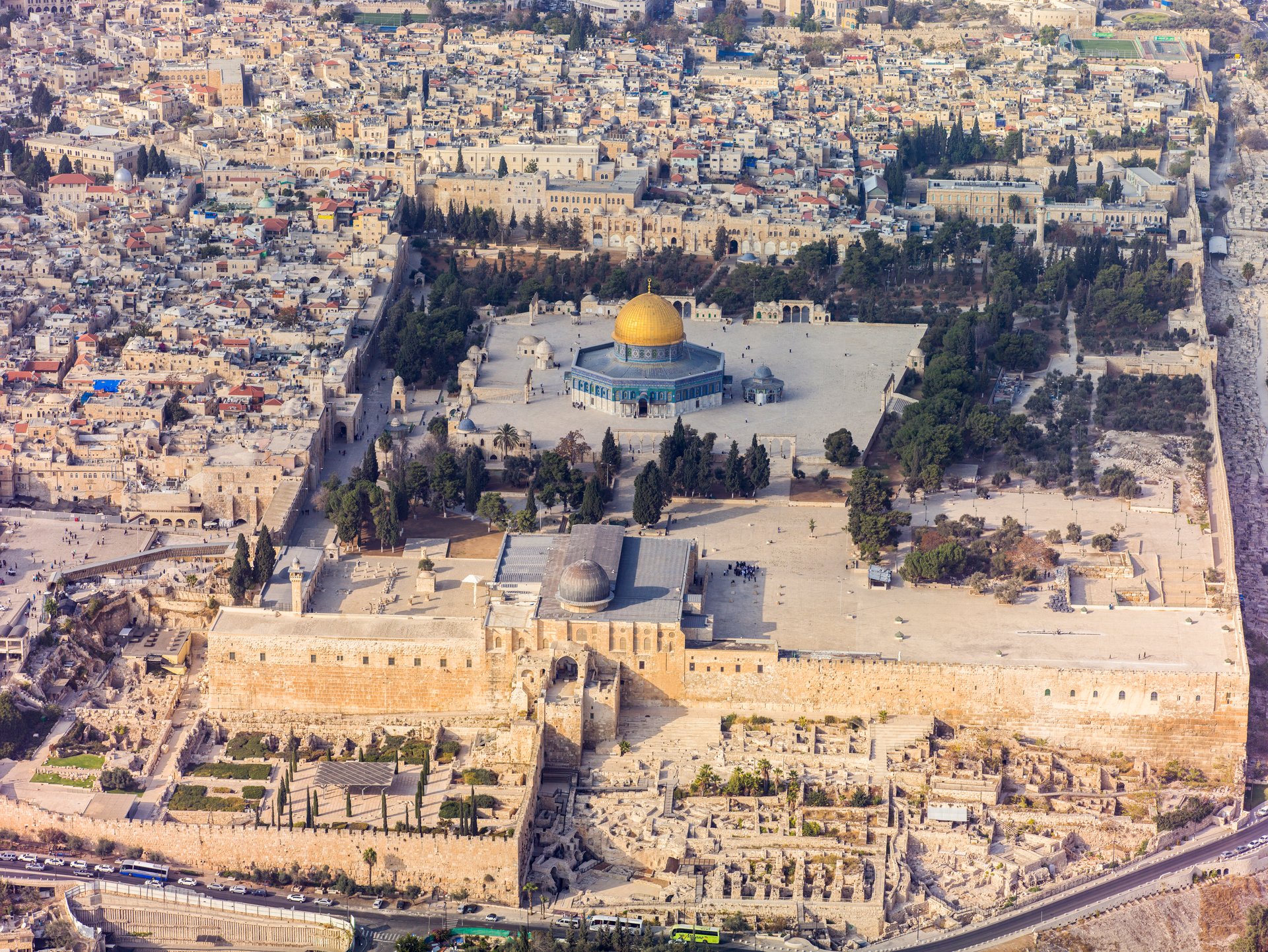
Al-Aqsa Mosque
The silver dome catches the light differently than its golden neighbor. Where the Dome of the Rock gleams and announces itself across the Jerusalem skyline, the Al-Aqsa Mosque sits lower, darker, more restrained -- a place built not for spectacle but for prayer. It is the main congregational mosque on the Haram al-Sharif, the Noble Sanctuary, known in Jewish tradition as the Temple Mount. For Muslims, it marks the site of the Prophet Muhammad's Night Journey. For everyone who lives in or claims Jerusalem, it is ground where politics, faith, and history press against each other with a weight that fourteen centuries of rebuilding have not eased.
Layers Beneath the Prayer Hall
The mosque stands on the southern edge of a platform that King Herod the Great expanded beginning in 20 BCE during his reconstruction of the Second Jewish Temple. Herod's engineers built the arches that still support the artificial terrace, overcoming the steep drop of the Tyropoeon and Kidron valleys as they pushed the enclosure southward. During the late Second Temple period, the present site of the mosque was occupied by the Royal Stoa, a grand basilica running along the southern wall. When the Romans destroyed the Temple in 70 CE, the platform survived. It was on this Herodian foundation that the first Muslim structures would rise. Analysis of wooden beams removed during renovations in the 1930s revealed Lebanese cedar and cypress, with radiocarbon dating suggesting some timbers may predate the Islamic construction -- materials possibly reused from earlier structures on this endlessly repurposed ground.
Built, Destroyed, and Built Again
Islamic tradition holds that the caliph Umar built a small prayer hall on the Haram al-Sharif after the Muslim conquest of Jerusalem in 637 CE. By the time of the Umayyad dynasty, the structure had grown into a substantial mosque, built by the caliph Abd al-Malik or his successor al-Walid I in the early eighth century, positioned on the same north-south axis as the Dome of the Rock. An earthquake in 746 brought it down. The Abbasid caliph al-Mansur rebuilt it in 758, and his successor al-Mahdi expanded it further in 780. Another earthquake in 1033 caused severe damage; the Fatimid caliph az-Zahir rebuilt the mosque largely in its current form. The Crusaders captured Jerusalem in 1099 and converted the mosque into a headquarters for the Knights Templar, adding structures and renaming it the Templum Solomonis. When Saladin retook the city in 1187, he restored it to Islamic worship, installing the elaborate minbar that stood in the mosque until it was destroyed by arson in 1969.
The 1969 Fire and Its Aftermath
On August 21, 1969, an Australian tourist named Denis Michael Rohan set fire to the Al-Aqsa Mosque, destroying the medieval wooden minbar that Saladin had installed nearly eight hundred years earlier. The fourteenth-century painted decorations inside the dome were severely damaged. Rohan, later found to be suffering from a psychiatric disorder, believed he was acting on divine instructions to hasten the Second Coming by clearing the way for a new Jewish Temple. The fire galvanized the Muslim world and contributed to the founding of the Organisation of Islamic Cooperation. Restoration took years. The dome's interior paintings were reconstructed using the tratteggio technique, in which fine vertical lines distinguish restored areas from original ones -- a method that preserves honesty about what is old and what is new. The minbar was eventually replaced with a replica, completed in 2007 by Jordanian craftsmen following the original Ayyubid design.
Contested Ground
Since Israel captured the Old City in 1967, the Haram al-Sharif has been administered under a complex arrangement: Israel controls security access while the Jordanian-backed Islamic Waqf manages the religious sites. This arrangement satisfies no one completely. Muslims who are Israeli residents or Palestinians living in East Jerusalem can generally pray at the mosque, though access restrictions tighten during periods of tension, falling most heavily on Gazans and West Bank Palestinians. Non-Muslim visitors were once admitted through Waqf-issued tickets, but that ended with the Second Intifada in 2000 and has not resumed. In April 2021, during a rare overlap of Passover and Ramadan, Israeli police entered the compound and cut speaker wires to mosque minarets, silencing the call to prayer during an event by the Israeli president at the nearby Western Wall. Clashes followed, with hundreds of Palestinians injured. The mosque is a place of worship, but the worship is never separable from the politics that surround it.
Prayer at the Farthest Mosque
The name itself carries theological weight. Al-Aqsa means "the farthest" in Arabic, a reference to the Quran's account of the Isra, the Prophet Muhammad's miraculous Night Journey from Mecca to "the farthest mosque" and then to heaven. For the world's nearly two billion Muslims, this connection places the mosque among Islam's three holiest sites, alongside the Masjid al-Haram in Mecca and the Prophet's Mosque in Medina. The current building, with its lead-sheeted concrete dome, its facade of fourteen stone arches in a Romanesque style borrowed from Crusader-era structures, and its interior columns donated by Mussolini, is not a single act of creation but a palimpsest. Every earthquake, every conquest, every fire has added a layer. Seventy thousand worshippers gathered here for Ramadan prayers in 2021, the largest congregation since the start of the COVID pandemic. They prayed in a building that has been destroyed and rebuilt so many times that its persistence has become its own form of testimony.
From the Air
Located at 31.776N, 35.236E on the Temple Mount / Haram al-Sharif in the Old City of Jerusalem. The silver-domed mosque is visible adjacent to the golden Dome of the Rock -- together they are among the most recognizable landmarks in the Middle East. Best observed from 3,000-5,000 feet AGL. The Old City walls provide useful orientation. Note: This is extremely sensitive airspace. Nearest airports: LLJR (Jerusalem/Atarot, currently closed), LLBG (Ben Gurion International) approximately 30 nm west-northwest. Expect restricted airspace over Jerusalem.