Al-Attarine Madrasa
Step through the L-shaped bent entrance off Tala'a Kebira street and the noise of Fez drops away. The Al-Attarine Madrasa is not large -- its courtyard could fit inside a tennis court -- but the density of its decoration makes the space feel immense. Every surface speaks. Geometric zellij tiles climb the lower walls in patterns that seem to multiply the longer you look. Above them, carved stucco erupts in arabesques, calligraphy, and honeycomb muqarnas niches. Higher still, carved cedar wood takes over, projecting in richly sculpted eaves that cast thin shadows across the courtyard below. The building takes its name from the Souk al-Attarine, the spice and perfume market just outside, and something of that sensory saturation has seeped into the architecture itself.
A Sultan's Gift to Scholars
The Marinid sultan Uthman II Abu Said commissioned the madrasa between 1323 and 1325, part of a dynasty-wide campaign to build theological schools across Morocco. The Marinids were prolific madrasa builders, adopting an institution that had originated in northeastern Iran by the early 11th century and migrated steadily westward. Their madrasas served a specific purpose: supporting the great Qarawiyyin Mosque and university nearby. Unlike the mosque, which held classes but offered no lodging, the madrasas provided accommodations for students traveling from distant towns -- many of them poor young men seeking enough education to secure a better position back home. The schools gave them bread, a bed, and proximity to one of the medieval world's most important centers of Islamic learning.
Three Crafts in Conversation
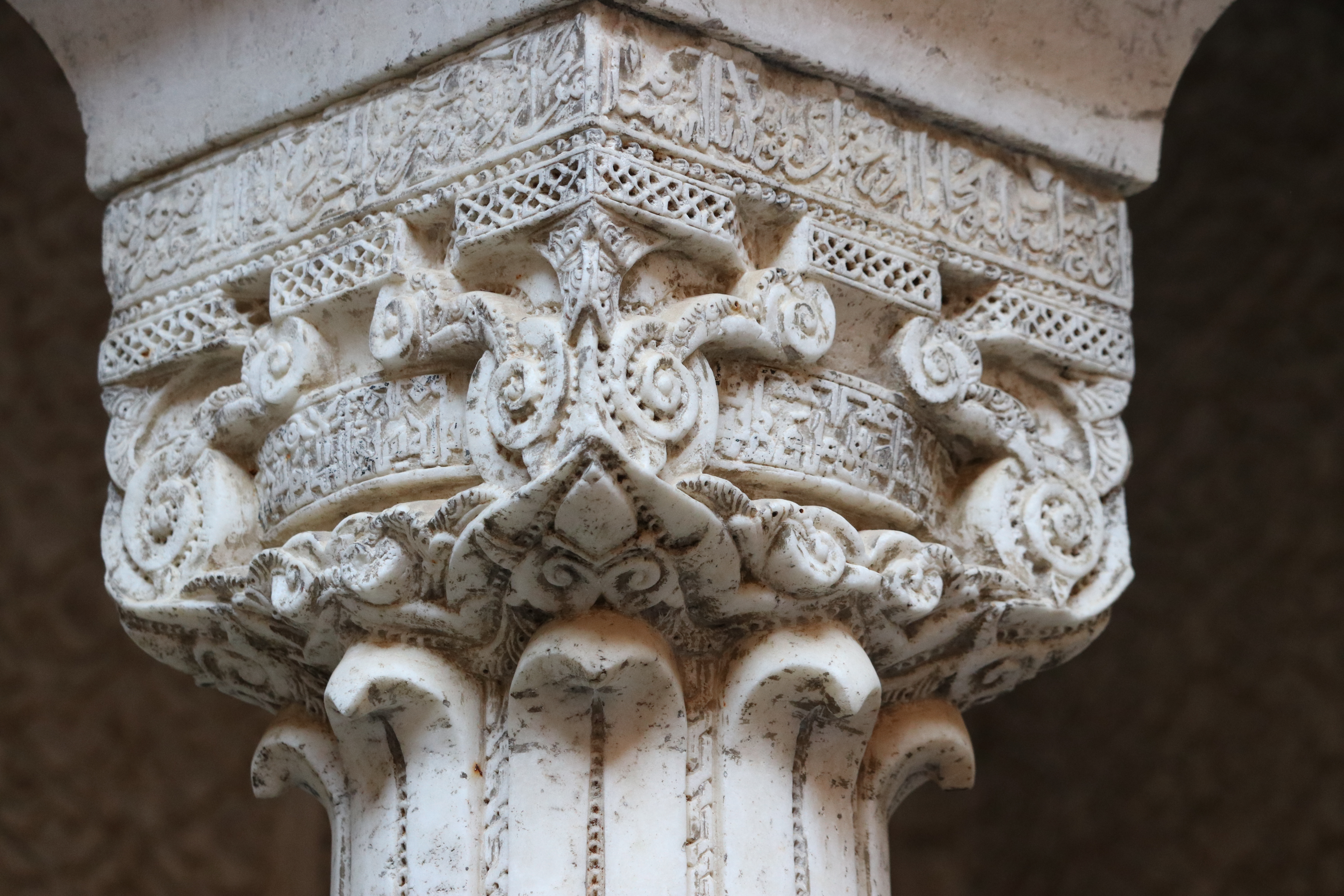
What makes the Al-Attarine exceptional is not any single decorative element but the harmony among three distinct craft traditions layered on top of each other. The lowest register features zellij -- mosaic tilework assembled from small hand-cut pieces into complex geometric patterns, with a band of calligraphy running above. The middle zone explodes in carved stucco: arabesques, vegetal patterns, muqarnas arches, and Arabic inscriptions carved with such depth that they cast their own shadows. The upper zone transitions to carved cedar wood, its surfaces worked with geometric star patterns that culminate in a pyramidal wooden cupola over the prayer hall. The marble and onyx columns supporting the courtyard galleries have carved capitals so elegant they are considered among the finest of the Marinid period. Each material demands different tools, different skills, different traditions of training -- yet together they create a single unified effect.
Bronze and Light
The madrasa's entrance doors are made of cedar but sheathed in decorative bronze plating -- the originals are now kept at the Dar Batha Museum, with replicas in their place. The plating is assembled from many pieces forming an interlacing geometric pattern, each piece chiseled with arabesque backgrounds and small Kufic script compositions inside octagonal stars. This bronze work represents an evolution of the earlier Almoravid-era decoration on the nearby Qarawiyyin Mosque's doors, refining a tradition that was already centuries old. Inside the prayer hall, the original Marinid bronze chandelier still hangs from the cupola, bearing an inscription praising Sultan Uthman II. The prayer hall's upper walls hold an unusual feature: colored glass windows set into lead grilles rather than the stucco grilles typical of the period, forming geometric and floral patterns that filter light into shifting colors across the carved surfaces below.
Seven Centuries Standing
The madrasa has been restored many times since the 14th century, but always in a manner consistent with its original style -- a rare continuity in a city where earthquakes, floods, and political upheaval have reshaped much of the built environment. Students no longer sleep in the upper-floor chambers, but the building endures as a monument to what concentrated artistic skill could achieve within a small footprint. Seen from the air, the madrasa is a tiny rectangle in the dense fabric of Fes el Bali, barely distinguishable from the thousands of other rooftops packed into the medina. Its power lies entirely within -- in the courtyard where seven centuries of light have fallen on the same carved surfaces, where the proportions still work, and where the three layers of decoration still speak to each other exactly as the Marinid craftsmen intended.
From the Air
Coordinates: 34.065N, 4.974W. Located deep within Fes el Bali, the oldest medina quarter of Fez, near the Qarawiyyin Mosque. The madrasa is not individually visible from altitude but sits within the UNESCO-listed medina. Nearest airport: Fes-Saiss (GMFF), approximately 15 km south. The dense, car-free medina with its distinctive tannery vats and mosque minarets is identifiable from 3,000 ft AGL.