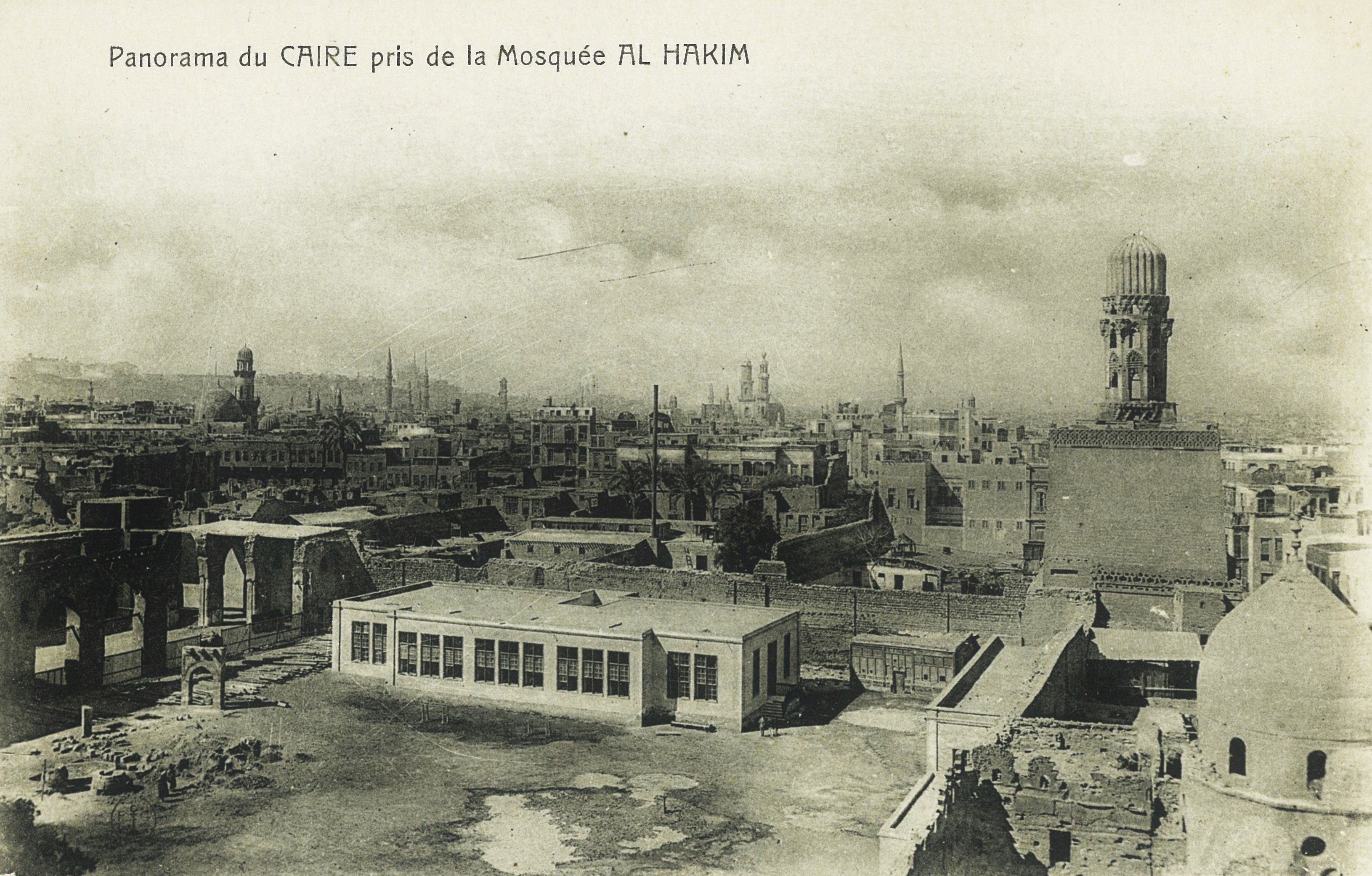
Al-Hakim Mosque
Two minarets of unequal height guard the northern end of al-Muizz Street, just inside Bab al-Futuh, the great gate of medieval Cairo. They have stood there since 1003, though the massive stone bastions encasing their bases were added seven years later for reasons no one has satisfactorily explained. The mosque between them -- named al-Anwar, "the Illuminated" -- was once more than double the size of nearby al-Azhar. Its patron, the Fatimid caliph al-Hakim bi-Amr Allah, spent 45,000 dinars on its construction and furnishings. What he built would endure a millennium of earthquake, neglect, and repurposing before finding its way back to prayer.
Father, Son, and Stone
Construction began in 990 CE under Caliph al-Aziz, who intended it as a second great congregational mosque for Cairo. He died before it was finished, and the project passed to his son, al-Hakim bi-Amr Allah, the sixth Fatimid caliph and sixteenth Ismaili Imam, who completed it in 1013. The inauguration fell during Ramadan. At 120 meters in length, the new mosque dwarfed al-Azhar and announced the Fatimid dynasty's ambition in stone. Like al-Azhar, it received the epithet "the Illuminated" -- a naming convention the Fatimids favored, linking their buildings to the concept of divine light central to Ismaili theology. A walled outer enclosure, or ziyada, was later added, begun by Caliph al-Zahir and completed only under the Ayyubid and Mamluk rulers who followed.
The Asymmetric Minarets
The minarets are the mosque's most striking feature, and their deliberate asymmetry is part of the puzzle. The northern minaret rises 33.7 meters with a square base and cylindrical shaft above; the southern stands 24.7 meters on a taller square base topped by an octagonal shaft. Both were built in 1003, but in 1010 enormous bastion towers -- called arkan in Arabic sources -- were added around their bases. Scholars have proposed military defense, structural reinforcement, and symbolic display as motives, but none fully explains the unusual configuration. The effect, seen from the street or from the air, is of two sentinels that belong together precisely because they do not match.
A Thousand Years of Other Uses
A devastating earthquake in 1303 severely damaged the mosque, and Sultan Baybars II al-Jashankir undertook repairs during the Mamluk period. By then al-Hakim's mosque had already been repurposed as a teaching institution for the four Sunni schools of law -- a pointed transformation for a building raised by Ismaili rulers. In later centuries it served as a warehouse, a stable, and eventually a ruin. Napoleon's forces used it during the French occupation of Egypt. The building's Fatimid identity was all but erased by the accumulation of centuries.
Restoration from an Unexpected Quarter
In 1980, a major restoration was completed by the Dawoodi Bohras, an Ismaili Muslim community based primarily in India. They saw the mosque as a direct link to their spiritual heritage -- the Fatimid caliphs are venerated as Imams within the Ismaili tradition. The restoration was extensive and controversial. Scholars and conservationists criticized the use of materials and methods they considered inconsistent with the Venice Charter's standards for historic preservation. The prayer hall was largely reconstructed, and a new portal was built based on earlier descriptions by the British architectural historian K. A. C. Creswell, since the original Fatimid entrance had not survived. The mosque reopened for religious use, and in February 2023, after further restorations, it was reopened again. Indian Prime Minister Narendra Modi visited in June 2023.
Standing at the Gate
Al-Hakim Mosque occupies a threshold -- literally, at the gate of Bab al-Futuh, and figuratively, between the Fatimid past and the Sunni present. Its stone facades and brick interior follow the pattern of Cairo's older mosques, linking it to the Ibn Tulun Mosque and al-Azhar. Its minarets, encased in their mysterious bastions, remain among the most unusual in Islamic architecture. The building is both a monument to a caliph whose reign was marked by eccentricity and cruelty and a living place of worship restored by a community that reveres his memory. That contradiction -- destruction and devotion occupying the same walls -- is what makes it one of Cairo's most compelling structures.
From the Air
Al-Hakim Mosque sits at 30.054N, 31.264E on the east side of al-Muizz Street near Bab al-Futuh, the northern gate of medieval Cairo. The two asymmetric minarets are identifiable from the air. Cairo International Airport (HECA) lies approximately 20 km northeast. Best viewed at 2,000-3,000 feet to distinguish the mosque's footprint within the dense Islamic quarter. The Citadel to the south and the Northern Cemetery to the east provide orientation.