Al-Hallaniyah
In 1998, divers exploring the shallow waters off a barren Omani island found the scattered remains of a ship that had been missing for nearly five centuries. The vessel was the Esmeralda, part of Vasco da Gama's second armada to India, lost in a storm in 1503. Among the 2,800 artifacts eventually recovered was a copper disc etched with navigational markings -- confirmed by Guinness World Records in 2019 as the oldest known marine astrolabe. The island where it all came to rest is Al-Hallaniyah, the largest of the Khuriya Muriya archipelago, a place so remote that fewer than 150 people call it home.
Granite Teeth and Vertical Cliffs
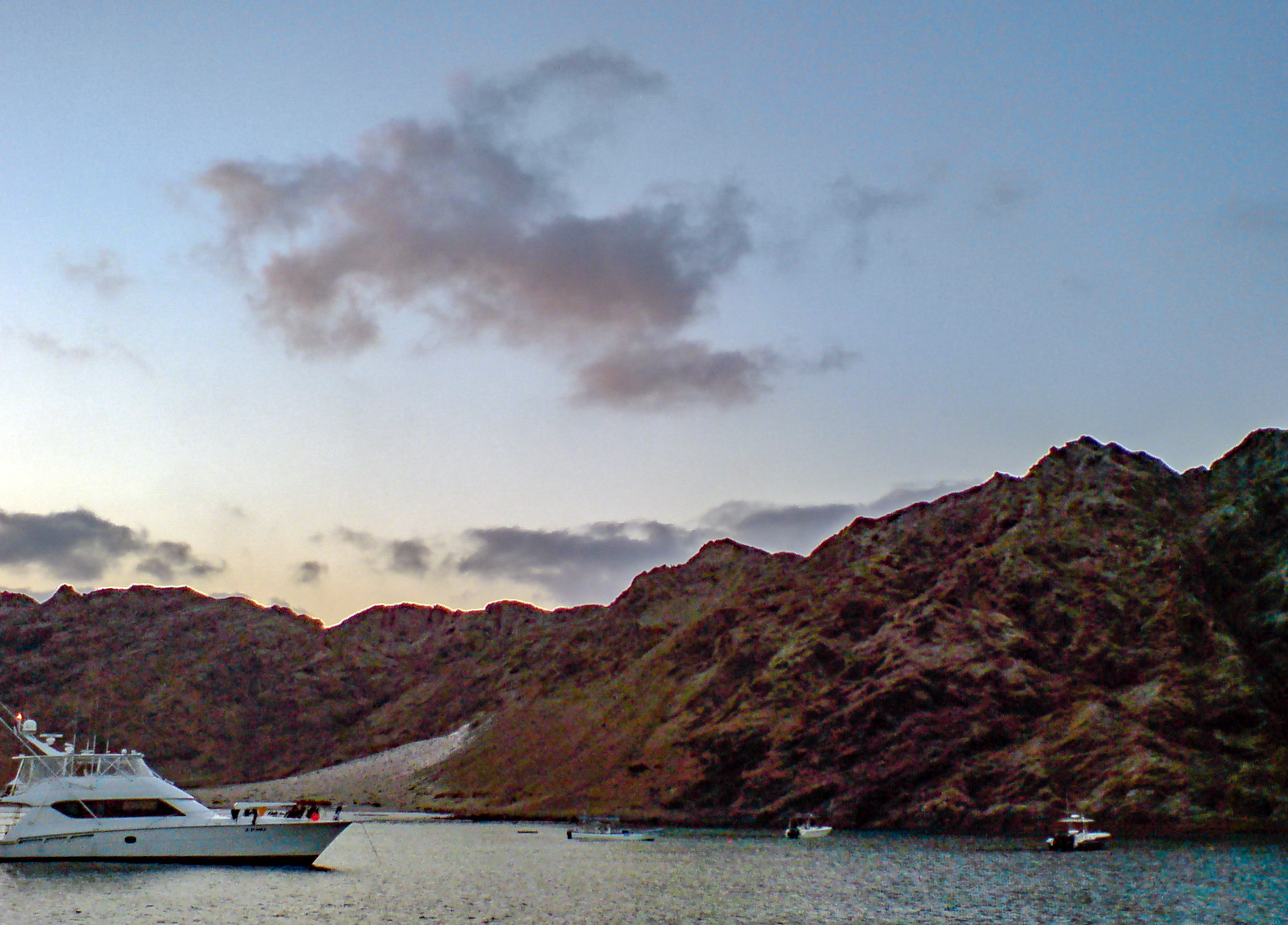
Al-Hallaniyah rises from the Arabian Sea like a fortress. Its central spine climbs to a cluster of granite chimney peaks, the tallest reaching 495 meters. The northern headland, Ras al Hallaniyah, is a sheer bluff standing 501 meters above the waterline, with Muschelkalk cliffs dropping almost vertically into the surf for a mile on either side. The island's 56 square kilometers are mostly rugged and bare -- tamarix trees and patches of grass cling to the eastern slopes, but the rest is exposed rock and wind. The only village sits on the flat western end, a small settlement reachable by boat or by a modest airstrip nearby. From the air, the island reads as a dark wedge of stone set in turquoise water, eight kilometers east of its nearest neighbor, Al-Sawda.
A Language Older Than the Trade Routes
The islanders speak Shehri, also called Jibbali, a Modern South Arabian language unrelated to the Arabic spoken across the Omani mainland. Shehri belongs to a linguistic family that predates the Arab migrations, a living remnant of the languages spoken along the southern Arabian coast for millennia. On Al-Hallaniyah, this small community of fishermen preserves not just the language but the rhythms of a life shaped entirely by the sea. When weather permits, they row to neighboring islands to catch birds and collect eggs. Their primary livelihood is fishing, and the sea rewards them generously -- during the Khareef monsoon season from mid-May to mid-September, deep upwelling currents bring nutrient-rich cold water to the surface, creating an abundance of marine life. The tradeoff is fierce: the sea turns rough, fog rolls in, and the wind does not relent for months.
The Esmeralda's Long Silence
Vicente Sodre, the maternal uncle of Vasco da Gama, captained the Esmeralda as part of a squadron left behind to protect Portuguese trading interests along the Indian Ocean coast. In 1503, Sodre anchored his ships near the Khuriya Muriya Islands despite warnings from local sailors about the coming monsoon. The storm destroyed his vessel and killed him. For centuries, the wreck's location remained unknown. When a team led by marine archaeologist David Mearns identified the site in 1998, the shallow water that had broken the ship apart had also preserved its cargo in the sand. Excavations between 2013 and 2015 uncovered an extraordinary collection: an extremely rare indio silver coin minted specifically for trade with India, a dozen gold coins, a copper alloy ship's bell, stone cannonballs, and the fragments of the astrolabe that would make headlines worldwide. The disc, likely used by Sodre himself to measure the altitude of celestial bodies for navigation, dates to between 1496 and 1501.
Where Monsoons Rule the Calendar
Life on Al-Hallaniyah divides cleanly into two seasons. Outside the Khareef, the sea is calm enough for the islanders to fish and move between the five islands of the archipelago. During the monsoon months, everything changes. Cold upwelling transforms the waters into a rich feeding ground, but the swells and fog make open-water travel dangerous. The island becomes more isolated than usual, its inhabitants waiting out the wind in a settlement that has no significant fresh water source and depends on supply runs from the Omani mainland. This seasonal rhythm -- abundance and confinement -- has shaped Al-Hallaniyah's character for generations. The island does not accommodate casual visitors. It rewards those willing to meet it on its own terms: a place where the Indian Ocean's deep currents surface alongside the artifacts of its oldest trade routes.
From the Air
Al-Hallaniyah sits at 17.51N, 56.02E in the Khuriya Muriya Islands, approximately 40 km off the Omani coast. The island is visible as a rugged, dark landmass rising sharply from turquoise water. A small airstrip serves the western village. Best viewed at 3,000-5,000 ft to appreciate the granite peaks and vertical cliffs. Nearest significant airport is Salalah (OOSA), about 300 km to the west. During Khareef season (May-September), expect reduced visibility due to fog and rough seas.