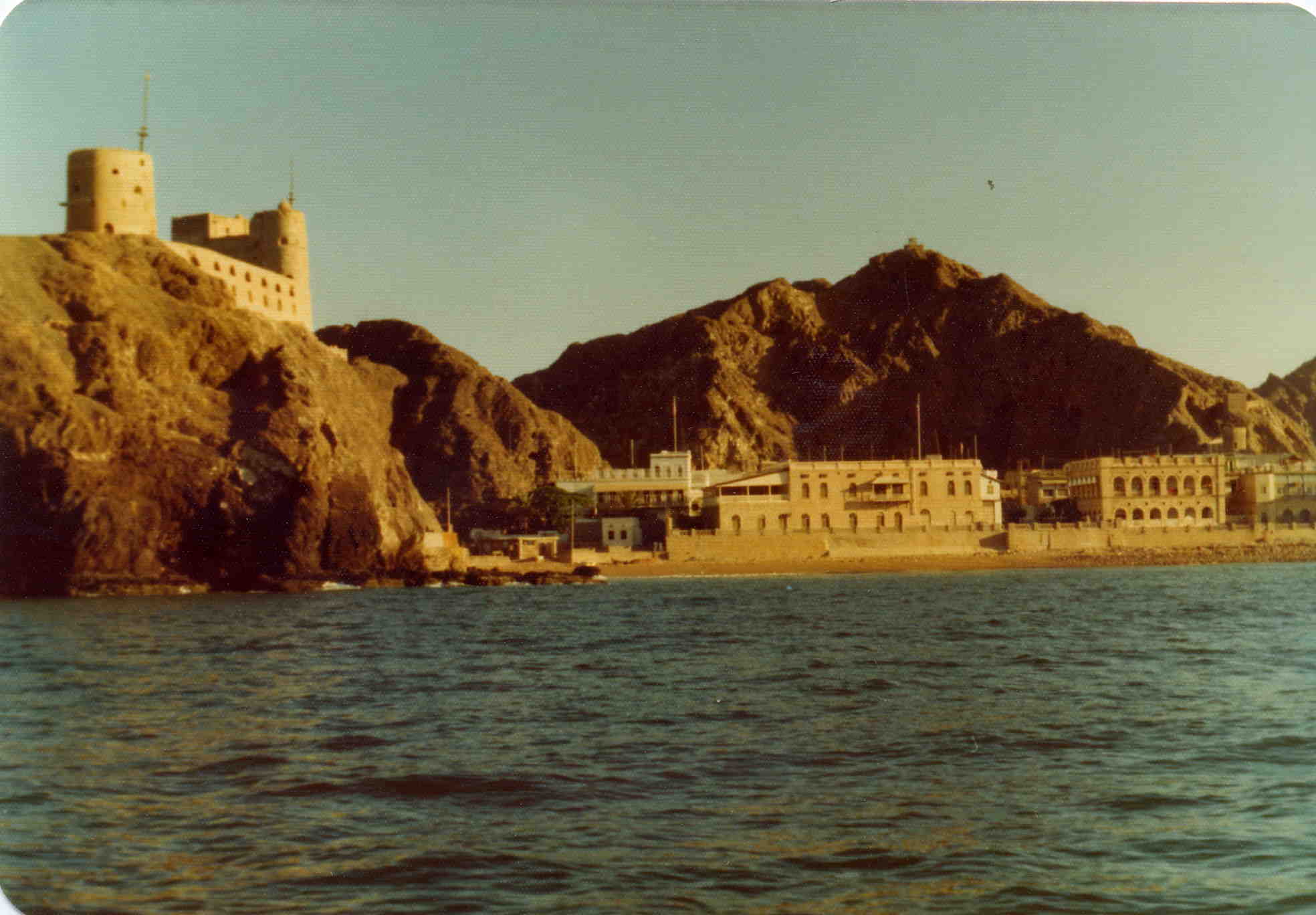
Al Jalali Fort
In 1743, a Persian commander named Mirza Taki invited the deposed Omani imam Saif bin Sultan II aboard his ship for a banquet. Wine flowed. Saif grew stupefied. His seal was taken from his finger and pressed onto forged orders commanding the garrisons of Al Jalali and Al Mirani forts to surrender. They did. It is one of dozens of stories that cling to this rocky outcrop on the eastern side of Muscat harbor, where a fort has stood in some form since before the Portuguese arrived and will likely stand long after the last of its cannons rusts.
The Concealed Harbor
The word Muscat means anchorage, and the name fits. Old Muscat sits on a bay roughly 700 meters long, hemmed by mountains on the landward side, sheltered from open sea by rock. The geographer Ptolemy may have described it in the 2nd century as a concealed harbor. Al Jalali Fort commands the eastern headland of this bay; its twin, Fort Al-Mirani, guards the western approach. Between them, any ship entering the harbor passed under crossfire. Additional fortifications crowned the ridges above, and Muttrah fort watched the western approach further along the coast. Until recently, the only way to reach Al Jalali was a steep flight of stone steps from the harbor side. A funicular railway now supplements the climb, and land reclamation on the seaward side has created space for a heliport.
Portuguese Blood and Stone
When Afonso de Albuquerque sailed along Oman's coast in 1507 with seven ships and 500 men, Muscat was the principal trading port of the Kingdom of Hormuz. Albuquerque's forces had already massacred the populations of Qurayyat and Qalhat. Muscat surrendered, then withdrew its submission when reinforcements arrived. Albuquerque sacked the city. The Portuguese held Muscat for nearly 150 years, building the first fort on the western headland around 1550. After Ottoman raids in 1552 and 1582 destroyed earlier defenses, Captain Belchior Calaca was sent in 1587 to build Forte de Sao Joao -- today's Al Jalali. He leveled the rocky prominence, scarped the cliffs, built a cistern, and mounted cannon overlooking the harbor. The gun deck remains the fort's most distinctly Portuguese contribution.
Centuries of Siege and Treachery
Imam Nasir bin Murshid unified Oman's tribes against the Portuguese starting in 1624. His cousin Sultan bin Saif captured Muscat in December 1649, and about 600 Portuguese fled by sea while others surrendered at Al Mirani on January 23, 1650. That victory launched Oman's maritime expansion across the Indian Ocean. But peace did not follow. Civil wars after 1718 brought Persian armies twice into Muscat -- once by invitation. Ahmad bin Said al-Busaidi, founder of the dynasty that still rules Oman, took the forts in 1749 and renovated Al Jalali extensively, adding the round towers and central buildings visible today. In 1803, a nephew of the ruler tried to smuggle himself into the fort inside a large box but was detected by a Hindu trader. In 1895, when tribes sacked Muscat, Sultan Faisal bin Turki sheltered inside Al Jalali until his brother retook the town from Al Mirani.
From Hellhole to Museum
For most of the 20th century, Al Jalali served as Oman's main prison, holding some 200 inmates in conditions that Colonel David Smiley, commander of the Sultan's armed forces, called a veritable hellhole. Prisoners included Omanis captured during the Jebel Akhdar War of 1954-59 and the Dhofar Rebellion of 1962-76. In 1963, 44 prisoners staged a well-planned escape, but most were quickly recaptured -- their weakened condition from imprisonment working against them. The prison closed in the 1970s after Sultan Qaboos took power. The fort was restored in 1983 and converted into a private museum of Omani cultural history, accessible only to visiting dignitaries. Behind massive doors studded with iron spikes, rooms display cannons, muskets, maps, pottery, jewelry, and incense holders. The interior is now landscaped with fountains, pools, and gardens. During state occasions, the royal dhow sails through the harbor below while bagpipers play on the battlements.
From the Air
Al Jalali Fort sits at 23.617N, 58.598E on the eastern headland of Old Muscat harbor. Its twin, Fort Al-Mirani, is directly across the harbor mouth to the west. Best viewed from low altitude approaching from the Gulf of Oman, where the twin forts framing the harbor entrance create a dramatic visual. Al Alam Palace sits between them. Nearest airport is Muscat International (OOMS). The fort's rocky prominence is clearly visible against the surrounding mountains.