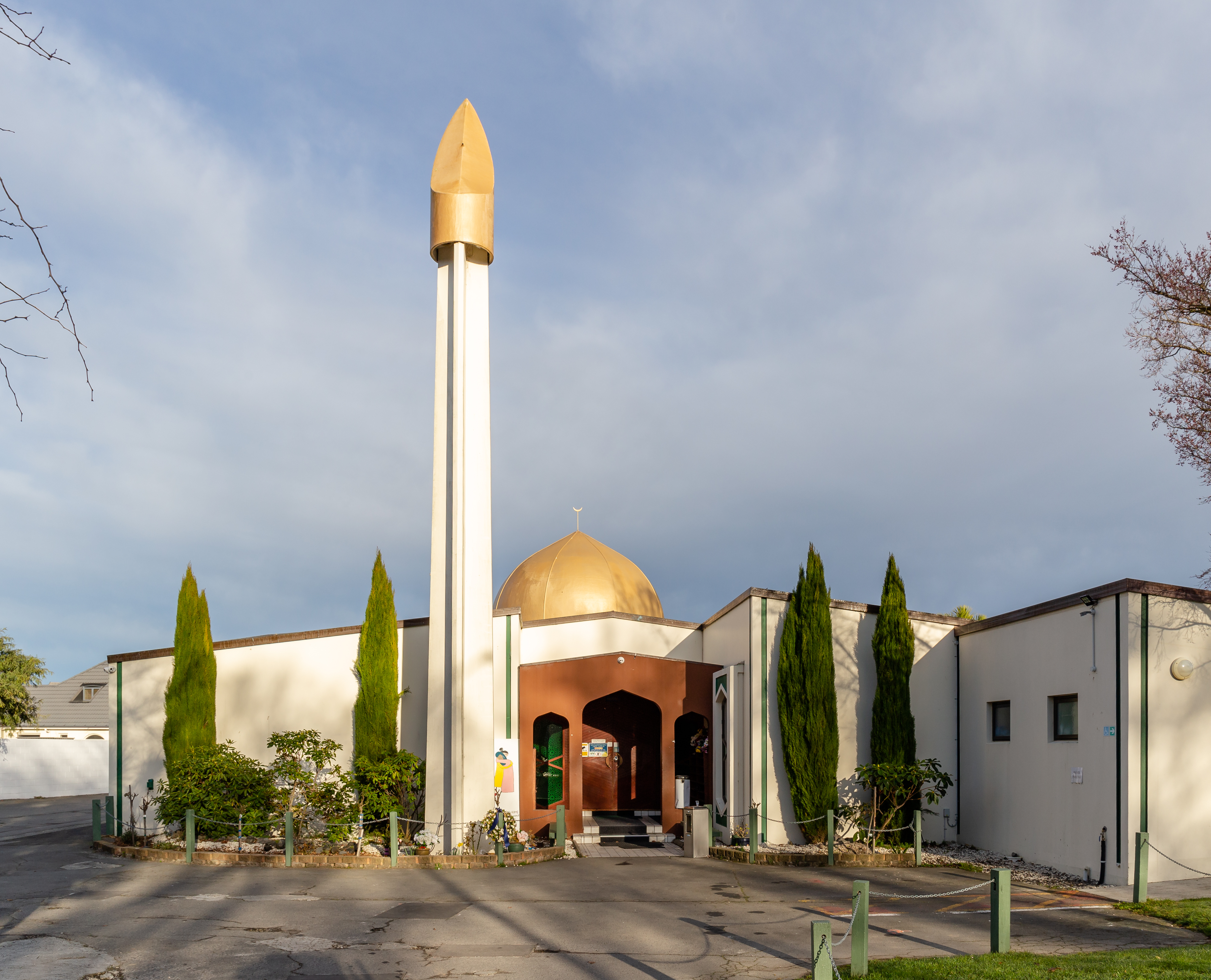
Al Noor Mosque, Christchurch
For thirty-four years, the Al Noor Mosque sat quietly in the Christchurch suburb of Riccarton, a modest building where families gathered for Friday prayers and children learned to recite the Quran. Most New Zealanders had never heard of it. Then, on March 15, 2019, a lone gunman walked through its doors and turned it into the site of the deadliest mass shooting in the country's modern history. Fifty-one people died that day across two mosques, forty-four of them at Al Noor. The attack shattered New Zealand's sense of safety, but what followed -- the outpouring of grief, the swift legislative response, the community's insistence on love over hate -- reshaped the national conversation about who belongs in this country and what it means to protect them.
A Community Built from Scratch
Canterbury's Muslim community was small in the late 1970s -- a handful of families, mostly South Asian academics and professionals, gathering in living rooms for prayer. In 1977, they formalized as the Muslim Association of Canterbury, and by 1983 they had broken ground on a purpose-built mosque, only the second in New Zealand. Agricultural scientist Hanif Quazi, then working for the Department of Scientific and Industrial Research in nearby Lincoln, was among the driving forces. The Saudi Arabian government donated $460,000 toward the NZ$500,000 construction cost, and the mosque opened in 1985. It was, by any measure, a quiet achievement -- a small community putting down roots in a city better known for its Anglican cathedral and English gardens. By 2015, the congregation had grown to 550 members, a mix of South Asian, Arab, Somali, and other backgrounds reflecting the changing face of New Zealand immigration.
Fifteen Minutes That Changed a Nation
The attack came during Friday prayers, the busiest time of the week. At 1:40 p.m., the gunman entered the mosque and opened fire. In the minutes that followed, forty-four people were killed and thirty-five others wounded at Al Noor alone. The victims ranged in age from three to seventy-seven. They were fathers, engineers, students, refugees who had fled violence in their home countries only to find it here. Seven more people were killed at the Linwood Islamic Centre across the city. The attacker was apprehended by police thirty-six minutes after the first emergency call. He was convicted of fifty-one counts of murder, forty counts of attempted murder, and one charge of terrorism on June 2, 2020, and sentenced to life imprisonment without the possibility of parole -- the first time such a sentence had been imposed in New Zealand.
The Response That Defined a Country
What happened in the days after the shooting became as much a part of the story as the attack itself. Prime Minister Jacinda Ardern donned a headscarf and embraced grieving families, telling them simply, "They are us." Within weeks, New Zealand's parliament passed sweeping gun reform, banning military-style semi-automatic weapons in a near-unanimous vote. Tens of thousands gathered at vigils across the country. In Christchurch, flowers were laid along the fence outside Al Noor until they formed a wall. The mosque itself reopened just eight days later, on March 23, an act of defiance and faith that moved the country. The national call to prayer, broadcast live on television and radio, brought two-minute silences to streets and offices throughout New Zealand. Ardern's refusal to name the attacker publicly -- choosing instead to center the victims -- set a tone that many other nations studied in the aftermath.
Lives Remembered, Not Statistics
The roll of the dead tells the story of global migration converging on one small city. Haji-Daoud Nabi, seventy-one, had fled Afghanistan in 1979 and was greeting worshippers at the door when he was shot. Mucad Ibrahim, three years old, was the youngest victim. Husna Ahmed ran back into the mosque to help her wheelchair-bound husband escape and was killed in the attempt. Naeem Rashid, a teacher from Pakistan, charged the attacker and was fatally shot while trying to wrestle the weapon away. Each of the fifty-one people killed had a story that stretched across continents -- from Bangladesh, Egypt, Fiji, India, Iraq, Jordan, Malaysia, Pakistan, Palestine, Saudi Arabia, Somalia, and Turkey. They had come to Christchurch for safety, for education, for opportunity. They had found a community at Al Noor.
What Endures
The Al Noor Mosque still stands on Deans Avenue in Riccarton, still holds Friday prayers, still welcomes families. The building itself is unremarkable from the air -- a low structure with a small minaret in a residential neighborhood, easy to miss among the surrounding houses and playing fields. But its meaning has grown far beyond its walls. The annual March 15 remembrance draws thousands, and the site has become a place of pilgrimage for people from around the world. Inside, the congregation carries on -- praying, teaching, debating, living. The community that Hanif Quazi and others built from nothing in the 1970s endured the worst that hatred could deliver and chose, deliberately and publicly, to remain open.
From the Air
Located at 43.53S, 172.61E in the Riccarton suburb of Christchurch, on the South Island of New Zealand. The mosque sits near Hagley Park, the large green space visible from altitude in central Christchurch. Christchurch International Airport (NZCH) is approximately 8 km to the northwest. The Canterbury Plains stretch flat to the west and south, with the Banks Peninsula hills visible to the southeast.