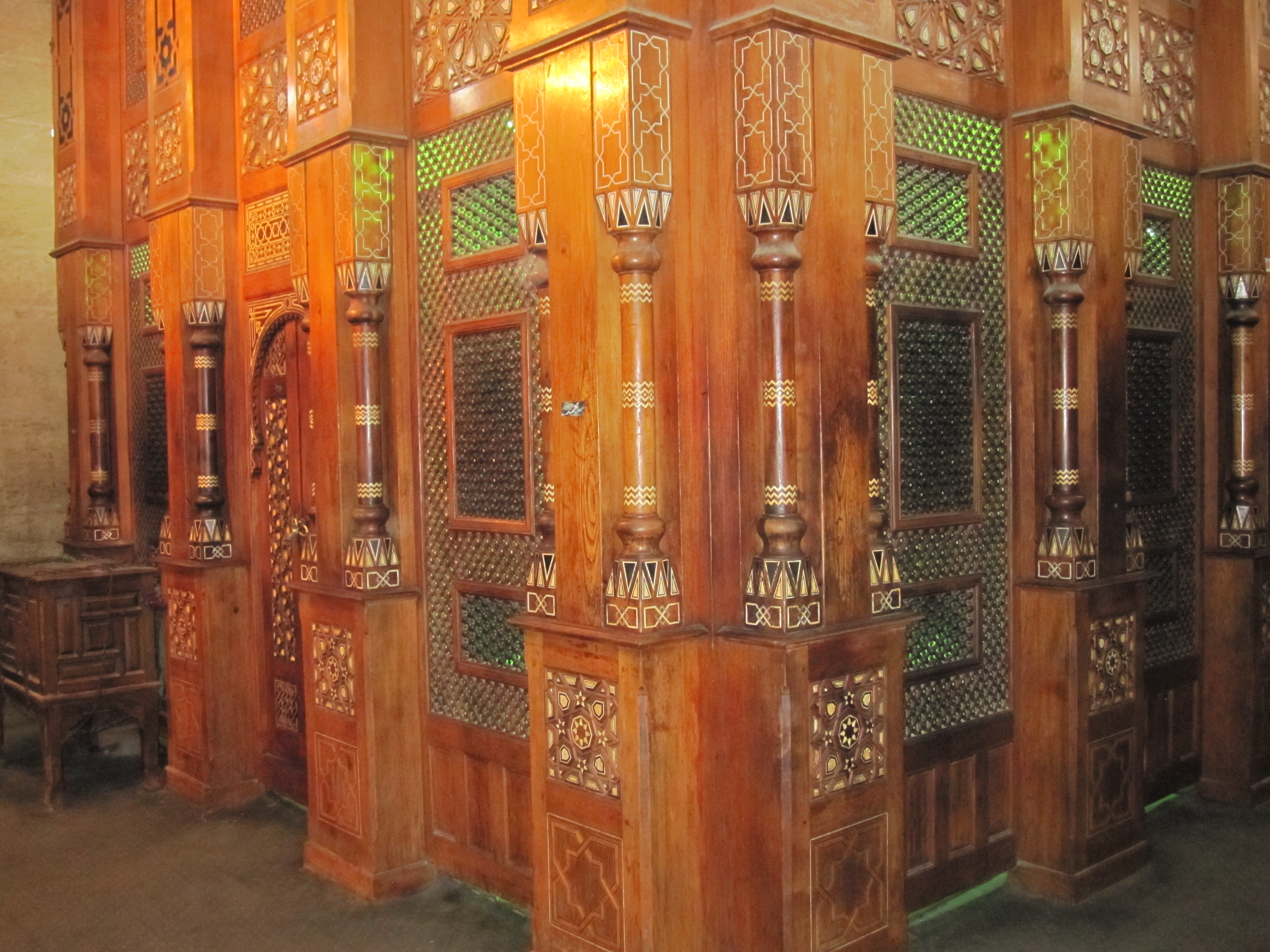
Al-Rifa'i Mosque
Stand in Citadel Square and you see two mosques facing each other like bookends across five centuries. On one side, the Mosque-Madrasa of Sultan Hassan, built around 1361, one of the masterworks of Mamluk architecture. On the other, Al-Rifa'i, completed in 1912, a deliberate echo designed to make the nineteenth-century rulers of Egypt look like the natural heirs of medieval glory. The architectural gambit worked well enough. But what makes Al-Rifa'i truly strange is not its facade -- it is the collection of occupants buried inside.
A Sufi Shrine Becomes a Royal Stage
The original structure on the site was a modest twelfth-century Fatimid mosque called Al-Dakhirah. When Ali Abu Shubbak al-Rifa'i -- grandson of the Sufi saint Ahmad al-Rifa'i -- was buried within it, the building was converted into a zawiya, a lodge for the Rifa'i Sufi order. Yahya al-Ansari, regarded as the patron saint of Cairo, also rests here. The transformation from humble Sufi shrine to monumental royal mausoleum began when Egypt's ruling dynasty decided they needed a burial place that projected power. The architects were tasked with matching Sultan Hassan's mosque in height and grandeur, a challenge that drew criticism from archaeologists and required the intervention of the Hungarian architect Max Herz to resolve structural difficulties.
The Khedive's Family Vault
Al-Rifa'i became the mausoleum of Muhammad Ali's dynasty, the family that ruled Egypt from 1805 until the 1952 revolution. Hoshiyar Qadin and her son Khedive Ismail Pasha lie here, along with Sultan Hussein Kamel, King Fuad I, and King Farouk -- the last monarch, who died in exile in Rome in 1965 but was returned to Cairo for burial. The mosque thus contains the arc of modern Egyptian royalty, from the ambitious modernizer Ismail, who bankrupted Egypt building the Suez Canal and reshaping Cairo, to Farouk, whose extravagance and political failures invited the military coup that ended the dynasty. Two notable family members are buried elsewhere: Khedive Tewfik and Khedive Abbas II rest at Qubbat Afandina in Cairo's Eastern Cemetery.
An Exiled Shah Finds Cairo
The most unexpected resident arrived from Iran. Reza Shah Pahlavi, founder of the Pahlavi dynasty, died in exile in South Africa in 1944. His body was brought to Al-Rifa'i, where it rested until 1950, when it was returned to Iran for reburial. His son, Mohammad Reza Pahlavi -- the last Shah of Iran -- followed a darker path to the same mosque. Overthrown in the 1979 Iranian Revolution led by Ayatollah Ruhollah Khomeini, the Shah wandered in exile from country to country before Egypt's President Anwar Sadat offered refuge. He died in Cairo in July 1980 and was buried at Al-Rifa'i with full state honors. His tomb remains here, a reminder that Cairo has long served as a place of last resort for deposed rulers.
Two Mosques, One Square
The architectural relationship between Al-Rifa'i and Sultan Hassan is a study in calculated imitation. Sultan Hassan's mosque, built with the ransom money of Crusader captives, is raw Mamluk power -- massive stone walls, a soaring iwan, austere geometry. Al-Rifa'i borrows that vocabulary -- the scale, the stone, the pointed arches -- but applies it with the polish of a Neo-Mamluk revival style that aims to impress rather than overwhelm. The result is a kind of architectural conversation across Citadel Square, one voice medieval and uncompromising, the other modern and calculated. Together, they frame one of Cairo's most dramatic public spaces, with the Citadel of Saladin rising behind them.
Sufi Saints and Fallen Kings
Al-Rifa'i is a building where the layers refuse to settle into a single story. A Sufi mystic's bones share the ground with a dynasty's worth of kings. An Iranian Shah lies in a mosque built to glorify Egyptian rulers. The architectural shell imitates a medieval original across the square while housing thoroughly modern political dramas. Visitors come for different reasons -- some to pay respects at the royal tombs, others to visit the Sufi shrines, and many simply to see the audacious pairing with Sultan Hassan. What unites these threads is Cairo's recurring role as a crossroads where power, faith, and exile converge in unexpected combinations.
From the Air
Al-Rifa'i Mosque is located at 30.033N, 31.257E in Citadel Square, immediately opposite the Mosque-Madrasa of Sultan Hassan and below the Cairo Citadel. The paired mosques are highly visible from the air as two large symmetrical structures flanking a plaza. Cairo International Airport (HECA) is approximately 18 km northeast. Best viewed at 2,000-4,000 feet. The Citadel of Saladin on the hill directly behind provides an unmistakable landmark.