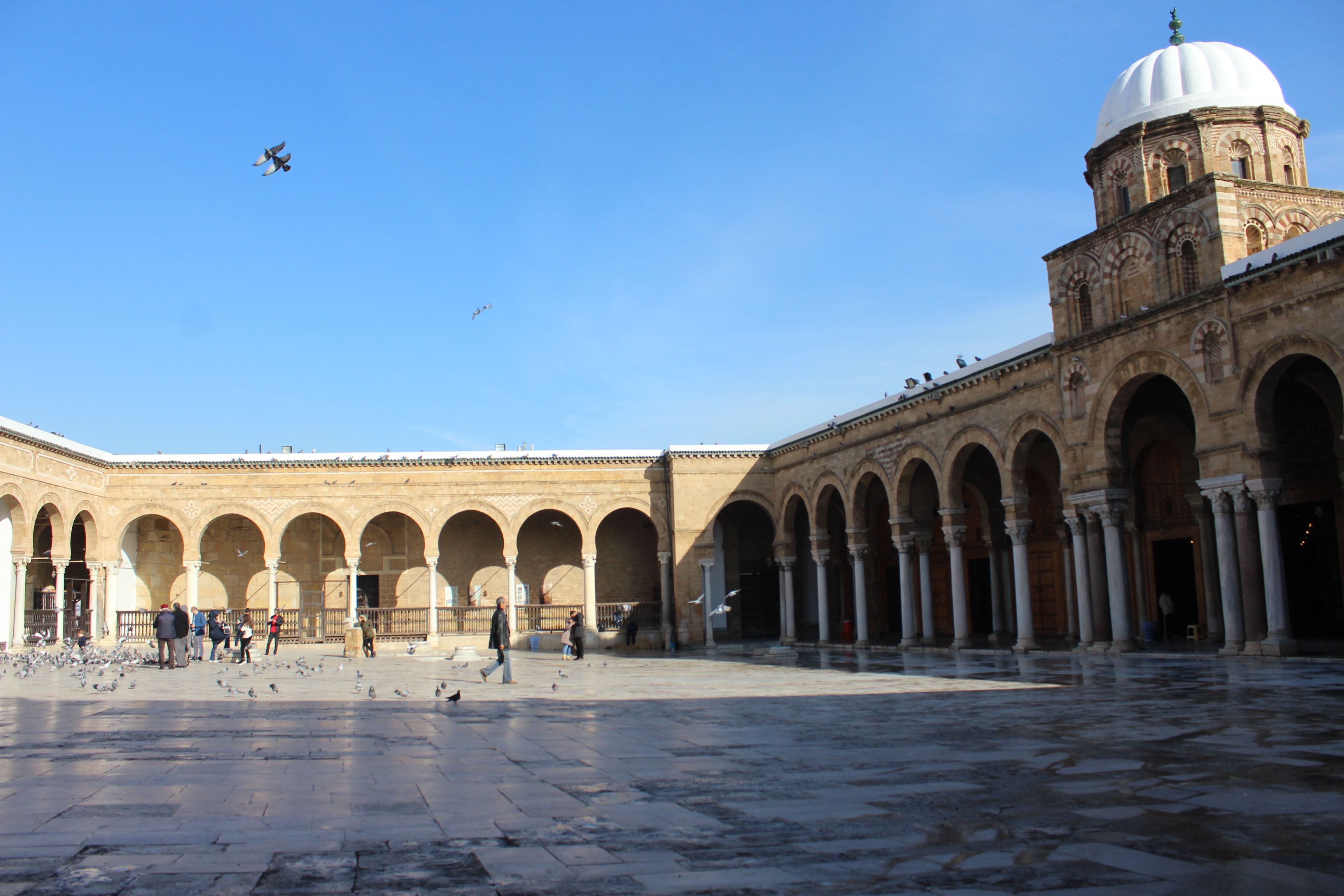
Al-Zaytuna Mosque
The columns came from Carthage. When the Aghlabid rulers rebuilt Al-Zaytuna Mosque in the ninth century, they carried ancient Roman and Byzantine columns across the landscape and set them in rows inside the prayer hall, giving the oldest mosque in Tunis a foundation literally rooted in the civilizations that preceded it. Al-Zaytuna -- the Mosque of the Olive -- stands at the heart of the Medina of Tunis, where it has functioned continuously as a place of worship and learning since at least the early eighth century. Its name, according to one legend, recalls an olive tree that grew on the site of an older place of worship. Another tradition connects it to the relics of a saint. Either way, the mosque predates the city that grew around it.
Layers of Foundation
Al-Zaytuna was the second mosque built in Ifriqiya and the Maghreb, after the great Mosque of Uqba in Kairouan. The exact date remains debated among historians. The eleventh-century writer Al-Bakri attributed the construction of a Friday mosque in Tunis to the Umayyad governor Ubayd Allah ibn al-Habhab, though other scholars assign it to an earlier builder. What is certain is that the mosque's current form dates from a major reconstruction completed in 864-865 under the Aghlabid emir Abu Ibrahim Ahmad, who ruled Ifriqiya on behalf of the Abbasid caliphs in Baghdad. The resulting layout closely mirrors the Mosque of Uqba in Kairouan, which the Aghlabids had rebuilt earlier in the same century -- a family resemblance across 150 kilometers of Tunisian geography.
Where Prayer Meets Knowledge
For centuries, Al-Zaytuna was more than a mosque. It was a university. Though organized teaching may not have begun until the fourteenth century, by its peak the institution attracted students and scholars from across the known world. The curriculum ranged from Quranic exegesis and Islamic jurisprudence to Arabic grammar, history, science, and medicine. The al-Abdaliyah library housed rare manuscripts that drew researchers from abroad. The university's influence shaped generations of North African intellectual life. After Tunisian independence, the educational functions were absorbed into the national university system, but in 2012, following the Tunisian Revolution, a court petition by citizens led to the mosque's former educational offices being reopened and Al-Zaytuna being declared an independent educational institution once again.
Stone, Gold, and Geometry
The mosque covers 5,000 square meters and has nine entrances, but its treasures concentrate around the mihrab and minbar. The mihrab -- the niche indicating the direction of Mecca -- contains a marble plaque covered in gold leaf and carved with Aghlabid Kufic script, its religious formulas including the shahada. The stucco decoration surrounding it dates largely from 1638, with later additions from 1820. The minbar, or pulpit, ranks among the oldest surviving examples after that of Kairouan. Some of its carved wooden side panels are original Aghlabid work from the ninth century; others date from later renovations, with the most recent pieces from 1583 in the early Ottoman period. Measuring 2.53 by 3.30 meters, the minbar is smaller than its Kairouan counterpart, but its panels display an intricate vocabulary of geometric and stylized vegetal motifs that speaks to a millennium of craftsmanship.
An Olive Tree's Persistence
What makes Al-Zaytuna remarkable is not any single feature but its continuity. Empires have risen and crumbled around it -- Aghlabid, Fatimid, Zirid, Almohad, Hafsid, Ottoman, French. Each left some mark on the building, a layer of stucco here, a restored panel there, the accumulated repairs and embellishments of rulers who understood that legitimacy requires visible piety. The antique columns from Carthage still stand in the prayer hall, Phoenician and Roman stone repurposed for Islamic worship, carrying weight in every sense. Through it all, the mosque has remained what it was built to be: the spiritual center of a city, the place where Tunis begins. In 1402, King Martin I of Sicily requested the return of relics associated with the site from the Berber Caliph Abu Faris Abd al-Aziz II. The caliph refused. Some things, once rooted, do not move.
From the Air
Located at 36.80N, 10.17E in the heart of the Medina of Tunis, visible from above as a large rectangular complex with a distinctive minaret amid the dense urban fabric. Best viewed at 2,000-3,000 feet. The mosque sits near the junction of the Medina's main axes. Nearest airport is Tunis-Carthage International (DTTA), approximately 8 km to the northeast.