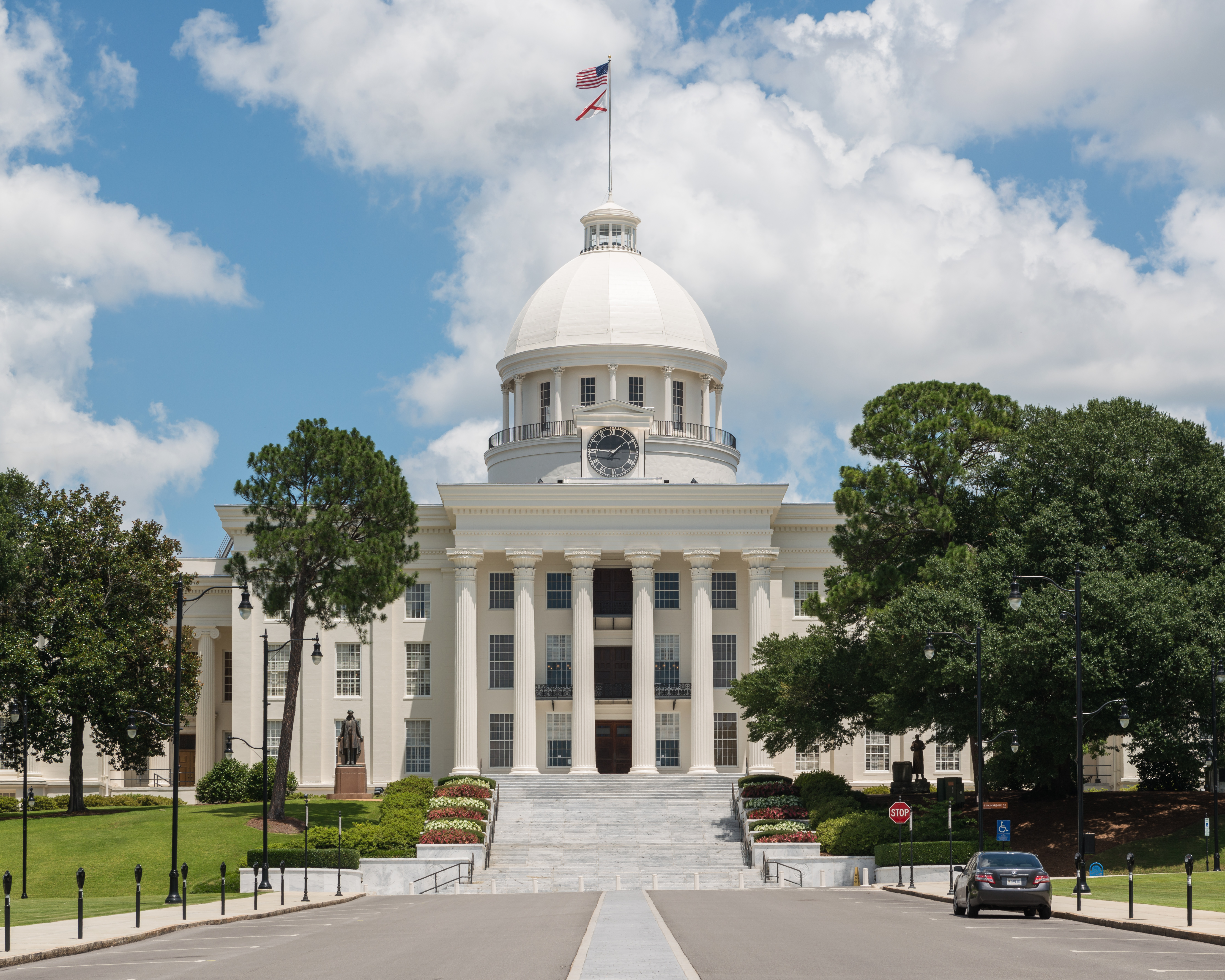
Alabama State Capitol
The twin spiral staircases in the entrance hall of the Alabama State Capitol were built by Horace King, a man born into slavery on a South Carolina plantation in 1807. King designed and constructed the cantilevered staircases when the current building was completed in 1851 on a Montgomery hilltop still known as Goat Hill, named for the animals that once pastured there. Two decades later, during Reconstruction, King won election to the Alabama House of Representatives and took his seat in the very building his hands had shaped. That layering of contradictions defines the Capitol: a Greek Revival temple to democracy built partly by enslaved labor, where secession was voted and civil rights marchers would one day arrive.
Five Capitals, Four Buildings, One Hill
Alabama has had five political capitals since territorial days. The first territorial capital sat at St. Stephens in 1817; the organizing convention met in Huntsville in 1819; the first permanent capital was Cahaba, designated in 1820. The legislature moved to Tuscaloosa in 1826, housing itself in a new three-story building. Finally, in 1846, lawmakers chose Montgomery. Andrew Dexter Jr., one of the town's founders, had kept a prime hilltop property vacant for years, anticipating exactly this move. Philadelphia architect Stephen Decatur Button designed the first Montgomery capitol, a stuccoed brick building with a domed portico modeled on the Choragic Monument of Lysicrates. It burned on December 14, 1849, barely two years after completion. The replacement, designed by Barachias Holt and finished in 1851, is the building that still stands today, expanded by wings added in 1885, 1906, and 1912.
Where the Confederacy Drew Its Constitution
When Montgomery briefly served as the first capital of the Confederate States of America in 1861, the Capitol's Senate Chamber became the room where secession took legal form. Delegates convening as the Montgomery Convention drafted the Provisional Constitution of the Confederate States on February 4, 1861, and adopted the Permanent Constitution on March 11. Jefferson Davis took the oath of office as Confederate president on the building's front steps. The Confederate capital moved to Richmond, Virginia within months, but Montgomery's Capitol had already been cemented in history. A century later, the building became a flashpoint again: in 1965, Martin Luther King Jr. delivered an impassioned speech at the base of those same steps after leading 25,000 marchers 54 miles from Selma. The delegation attempted to present Governor George Wallace with a petition demanding an end to racial discrimination, but state police surrounded the grounds and refused them entry.
The Art Beneath the Dome
Inside the dome, eight painted murals by Roderick MacKenzie illustrate the history of Alabama as the London-born artist interpreted it. MacKenzie, who had relocated from London, England, to the American South as a child, worked on the canvases from 1926 to 1930 in his Mobile studio. The finished panels were shipped to Montgomery by railroad and installed in July 1930. Below the murals, the original 1851 legislative chambers survive with their Corinthian columns supporting mezzanine galleries. In the old Senate Chamber, the columns are gilded; in the larger House Chamber, they are simply painted. Neither chamber has a computerized voting system, a fact that became relevant in May 2009 when flooding at the nearby Alabama State House forced the legislature to reconvene in the Capitol for the first time since 1985, using replica desks from 1861.
A Capitol Without Its Legislature
The Alabama Legislature moved out in 1985 for a renovation completed in 1992 by Holmes and Holmes architects. The move was officially temporary; the Alabama Constitution requires the legislature to meet in the capitol. A 1984 constitutional amendment allowed the exception during renovation. But when the restored building reopened, the governor and state offices moved back in while the legislature stayed at the State House. Today the Capitol functions primarily as a museum and the governor's office. Tourists walk through the entry stairhall, the old Governor's Office, the Supreme Court Chamber with its concave entry wall and Ionic columns, the rotunda, and both legislative chambers. Outside, the Avenue of Flags arranges the flags of all 50 states in a semi-circle, each with a native stone from its state engraved at the base, dedicated in 1968.
Contested Ground
The Capitol steps have served as a stage for Alabama's unresolved arguments. The Confederate battle flag flew over the dome for decades until African American legislators and NAACP members were arrested in 1988 for attempting to remove it. The flag came down during dome renovations in 1992, and a 1993 court ruling barred its return, citing an 1895 statute permitting only the national and state flags. LGBT advocacy groups have held vigils on the steps, and hundreds of protesters gathered in 2011 against the state's strict immigration law, Alabama HB 56. The building endures as a place where the present keeps arguing with the past, its Greek columns and gilded chambers bearing witness to every chapter.
From the Air
Located at 32.378°N, 86.301°W on Capitol Hill (Goat Hill) in downtown Montgomery. The white dome is visible from altitude above the dense grid of central Montgomery, near the bend of the Alabama River. Nearby airports include Montgomery Regional Airport (KMGM, ~9 nm southwest). Best viewed at 2,000-3,000 ft AGL in clear conditions. Dexter Avenue runs straight from the Capitol steps toward the river, a visual axis connecting to the Dexter Avenue King Memorial Baptist Church.
Sources
- Alabama State Capitol
- Builder Horace King left an elegant legacy in Alabama
- History of the Alabama State Capitol
- Selma to Montgomery marches - Wikipedia
- Provisional Congress of the Confederate States - Wikipedia
- MacKenzie, John Roderick Dempster - Encyclopedia of Alabama
- History of Confederate flag on Alabama Capitol grounds - WSFA