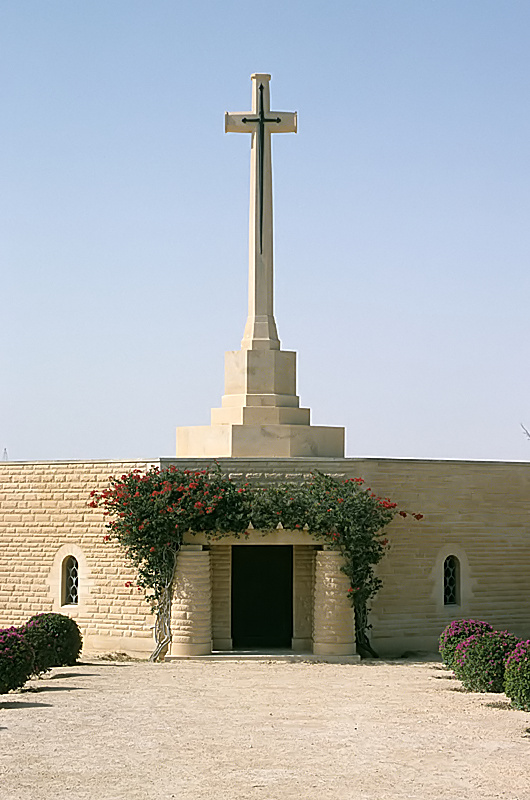
Alamein Memorial
The names are carved into stone in long, orderly columns, but the deaths they represent were anything but orderly. Eleven thousand eight hundred and sixty-six of them, stretching across the cloisters of the Alamein Memorial in Egypt. Each name belongs to a Commonwealth soldier or airman who died during the Second World War and whose body was never recovered, or never identified, or was buried in a grave that the desert swallowed. The memorial stands in the El Alamein War Cemetery, where the North African coast meets the silence of the Western Desert.
Where Two Continents Meet
The Alamein Memorial commemorates a sprawling geography of loss. For land forces, it records the names of those who died during the Western Desert campaign and in operations across Syria, Lebanon, Iraq, and Iran, all of whom have no known grave. For airmen, the reach extends further still: Egypt, Libya, Syria, Lebanon, Iraq, Greece, Crete, the Aegean, Ethiopia, Eritrea, the Somalilands, Sudan, East Africa, Aden, and Madagascar, plus those who died in service of the Rhodesian and South African Air Training Scheme. The memorial does not distinguish between a tank commander lost in the sand at El Alamein and a pilot who went down over the mountains of Crete. It gathers them all into one place, at the hinge point where Africa meets Asia.
Worthington's Cloister
Architect Hubert Worthington designed the memorial as a series of cloisters, an enclosed walkway where visitors move through the names in a progression that feels more like reading a book than scanning a wall. The design imposes a kind of intimacy; the columns of names are close enough to touch, and the shade of the cloister roof creates a coolness that contrasts with the glare beyond. Worthington understood that a memorial for nearly twelve thousand people could easily become abstract, a number too large to feel. The cloister form forces the visitor to slow down, to pass name after name at walking pace, to understand that each carved line represents a particular person who left home and did not return.
Montgomery Returns
On 24 October 1954, exactly twelve years after he had launched the barrage that opened the Second Battle of El Alamein, Viscount Montgomery of Alamein returned to unveil the memorial. It was Montgomery who had commanded the Eighth Army to its victory here, the battle that Churchill later said marked the moment when the tide of the war turned. For Montgomery, the ceremony was personal. He had sent many of these men into battle, had planned the operations that killed them, had watched the casualty lists grow through thirteen days of fighting. The date was not coincidental. October 24th was chosen deliberately, linking the unveiling to the anniversary of the offensive that gave the memorial its reason to exist.
The Inscription
At the entrance to the cloister, an inscription addresses visitors directly. It speaks of soldiers and airmen "who died fighting on land or in the air where two continents meet and to whom the fortune of war denied a known and honoured grave." The language is formal, measured, and deliberately collective: these dead are joined with their fellows who rest in the cemetery, with comrades-in-arms of the Royal Navy, and with seamen of the Merchant Navy. Together, the inscription says, "they preserved for the West the link with the East and turned the tide of war." It is a statement of strategic significance wrapped in the language of memorial, a reminder that El Alamein was not merely a battle but a pivot point in the twentieth century's largest conflict.
From the Air
Located at 30.84N, 28.95E on Egypt's Mediterranean coast at El Alamein, approximately 106 km west of Alexandria. The El Alamein War Cemetery and memorial complex are visible from the air as a manicured green rectangle against the surrounding desert, situated just south of the coastal highway. El Alamein International Airport (HEAL) is approximately 20 km to the west. The German and Italian war memorials are also in the vicinity. Best viewed at 2,000-4,000 ft AGL. The Mediterranean coastline runs east-west, with the Qattara Depression visible to the south.