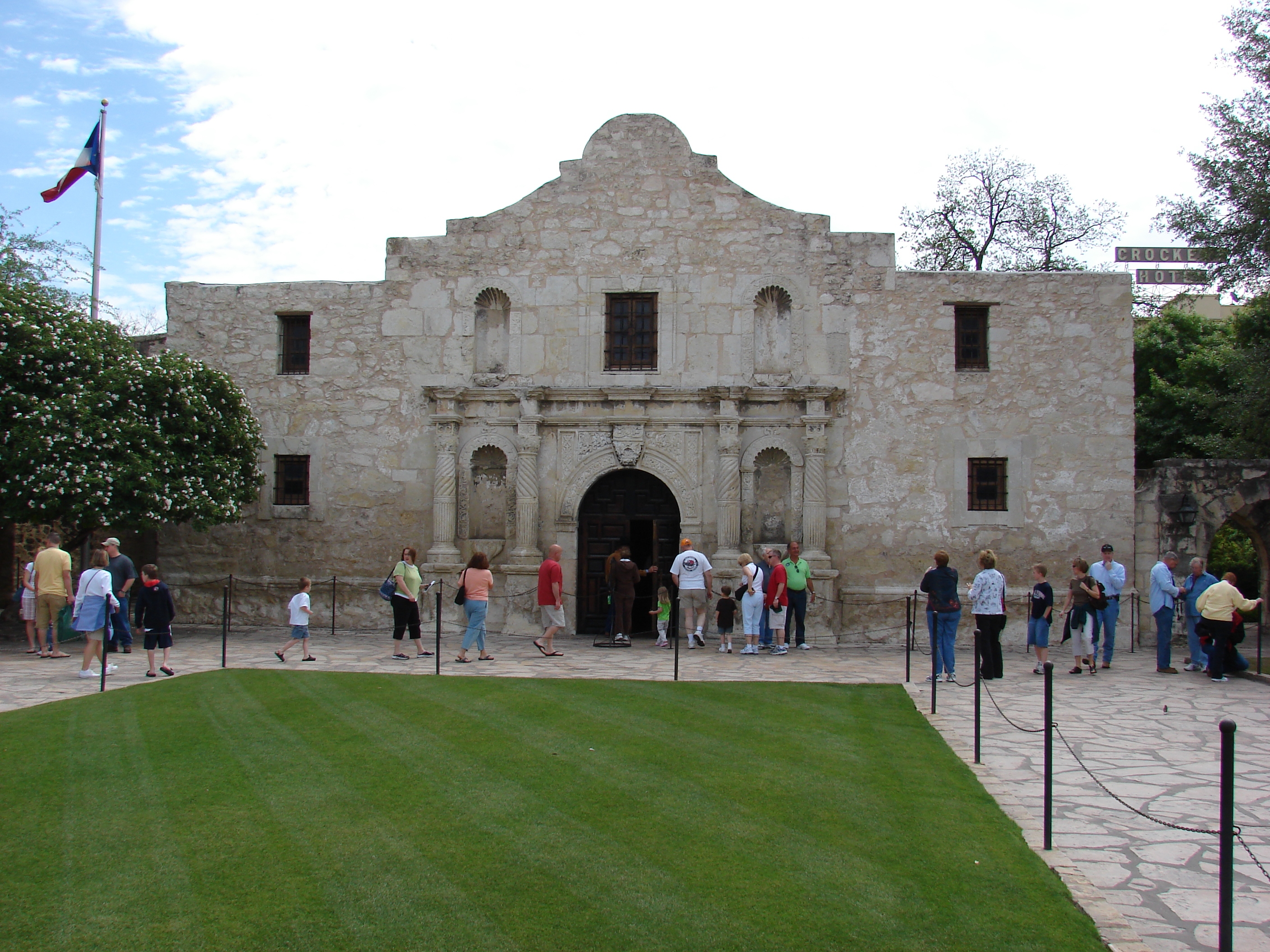
Alamo Mission
In 1828, French naturalist Jean Louis Berlandier stood among the ruins and called the Alamo chapel one of 'the loveliest monuments of the area, even if its architecture is overloaded with ornamentation like all the ecclesiastical buildings of the Spanish colonies.' By 1845, bats had colonized the abandoned complex and weeds covered the walls. By the 1880s, the long barracks had been converted into a wholesale grocery store. The building that Texas now treats as a sacred shrine spent more years as a warehouse than as either a church or a fort.
Cottonwood Trees and Cattle Herds
Founded in April 1718 as Mision San Antonio de Valero, the mission was established by Spanish Governor Martin de Alarcon as a waystation between Rio Grande settlements and East Texas missions. It was initially populated by three to five Indian converts from Mission San Francisco Solano. One mile north, Alarcon built the Presidio San Antonio de Bexar and founded the first civilian community in Texas, which grew into present-day San Antonio. By 1744, over 300 Indian converts lived at the mission, which was largely self-sufficient with 2,000 head of cattle, 1,300 sheep, and farmland producing up to 2,000 bushels of corn and 100 bushels of beans each year. The chapel's first permanent stones were laid in 1744, intended to rise three stories with a dome and bell towers. The dome was never built. The church was never completed. It is unlikely it was ever used for religious services.
Thirteen Days in March
After Mexican General Martin Perfecto de Cos surrendered the fort in December 1835 following the Siege of Bexar, a small garrison of Texian soldiers occupied the compound. William Travis and James Bowie agreed to share command. On February 23, 1836, President-General Antonio Lopez de Santa Anna arrived with 1,500 Mexican soldiers. For thirteen days the Mexican Army laid siege. On March 6, the siege ended in a fierce battle. As Mexican soldiers overran the walls, Texians fell back to the long barracks and chapel, where they had carved firing holes through walls and dug trenches into the floors. The 18-pounder cannon destroyed barricades, and room by room the defenders were overwhelmed. Almost all of the Texian defenders were killed, with historians estimating 400 to 600 Mexican casualties -- roughly one-third of the soldiers involved in the final assault. As the Mexican Army retreated months later, they tore down walls and set fires, leaving the chapel in ruins.
The Savior and the Granddaughter
Preservation of the Alamo became a decades-long battle of its own. Adina Emilia De Zavala, granddaughter of Republic of Texas Vice-President Lorenzo de Zavala, convinced the owner of the convent building to give the Daughters of the Republic of Texas first option to buy. When the $75,000 asking price proved far beyond the group's reach, De Zavala found an ally in Clara Driscoll, a wealthy heiress passionate about Texas history. Driscoll paid the initial deposit of $500, then covered $4,500 when fundraising raised only $1,021.75, and eventually committed to paying the remaining $50,000 herself. Texas newspapers dubbed her the 'Savior of the Alamo.' The two women then turned on each other in a bitter dispute over the site's future, forming rival chapters of the DRT and dragging the governor into the conflict. The political infighting became known as the Second Battle of the Alamo.
Shrine, Landmark, World Heritage
During the Great Depression, the Works Progress Administration and the National Youth Administration funded a wall around the Alamo and a museum. The Alamo Cenotaph, designed by Pompeo Coppini, was completed in 1940. The Alamo was designated a National Historic Landmark on December 19, 1960, and became an inaugural listing on the National Register of Historic Places in 1966. For over a century, the Daughters of the Republic of Texas served as custodians, until 2015 when Texas Land Commissioner George P. Bush transferred control to the Texas General Land Office. On July 5, 2015, the Alamo and four other missions in the San Antonio Missions National Historical Park were designated a UNESCO World Heritage Site. The limestone walls, quarried from the banks of the San Antonio River, still expand with moisture and contract with cold -- shedding small pieces of stone with each cycle, slowly wearing away the same surfaces that Berlandier admired nearly two centuries ago.
From the Air
Located at 29.426N, 98.486W in downtown San Antonio, Texas. The Alamo chapel sits in Alamo Plaza near the center of the city. Best viewed at 2,000-4,000 ft AGL. The compound is small but recognizable by its distinctive chapel facade amid the surrounding urban grid. Nearest airports: KSAT (San Antonio International, 7 nm N), KSSF (Stinson Municipal, 6 nm S). The San Antonio River and the Riverwalk are visible nearby. Fort Sam Houston lies approximately 3 nm to the northeast.