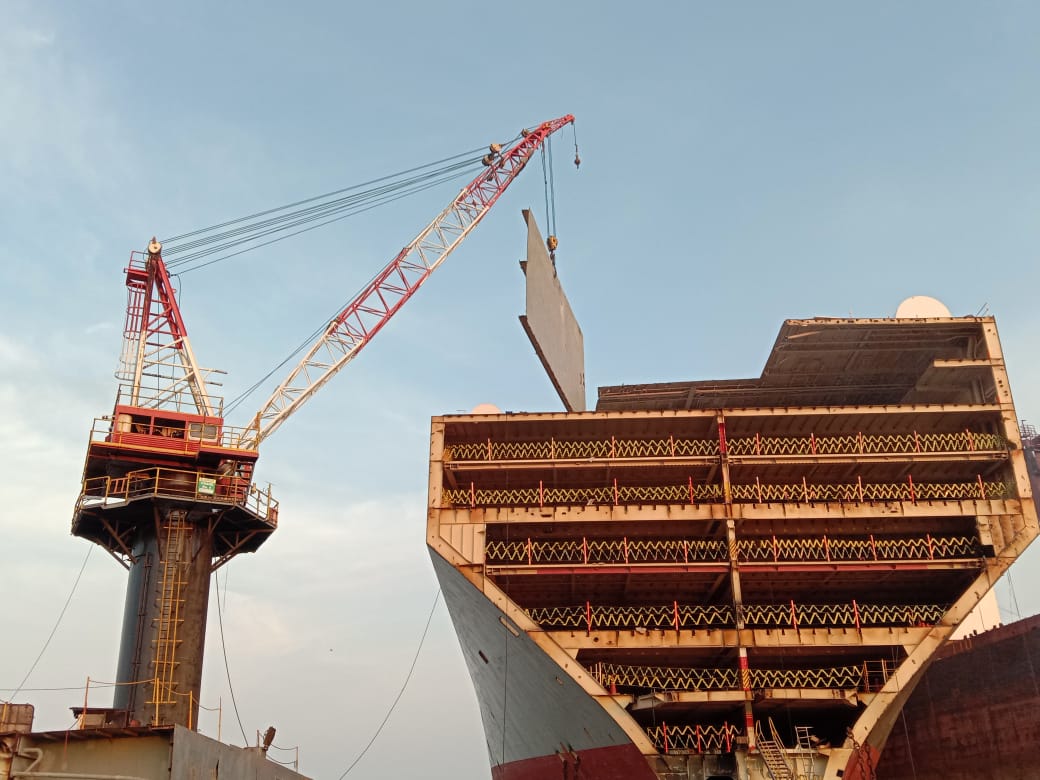
Alang Ship Breaking Yard
At high tide, they beach the ships. Supertankers, container vessels, car ferries, ocean liners - driven at full speed onto the mud flats of the Gulf of Khambhat until they ground themselves on the shore near the town of Alang. Then the tide goes out, and thousands of workers walk onto the exposed beach to begin taking the ships apart by hand. This is the Alang Ship Breaking Yard, the largest such facility on Earth, where more than a third of the world's retired freight and cargo ships come to die. The first vessel beached here - the MV Kota Tenjong - arrived on February 13, 1983. What followed transformed a quiet stretch of Gujarat coastline into an industrial operation of staggering scale and troubling human cost.
Anatomy of a Graveyard
The numbers convey the scale. One hundred eighty-three individual breaking yards stretch along 14 kilometers of coast, with a combined capacity of 4.5 million Light Displacement Tonnage. At its peak between 2011 and 2012, Alang processed 415 vessels in a single year. The process is elemental in its simplicity and brutal in its execution: ships are driven onto the tidal flats at high water, and as the sea retreats, laborers move in with cutting torches and muscle. Steel plates are stripped away by cranes and hauled to scrap dealers. Engines, wiring, fittings, furniture - everything salvageable is removed and sold. Founded by N. Sundaresan in 1983, the yard's growth eventually prompted its extension northeast toward Sosiya, and the complex is now commonly known as the Alang-Sosiya Yard. By 2020, though, the throughput had fallen to 196 ships per year, less than half the peak volume.
Where Famous Ships End
The vessels that arrive at Alang carry their own histories. In 2004, the Regal V was broken up here - the same ship that, under the name Scandinavian Star, was the site of a deadly arson fire in 1990 that killed 159 people. The French aircraft carrier Clemenceau became an international incident in 2005 when it left Toulon bound for Alang, sparking protests over toxic waste. India's Supreme Court temporarily barred the ship from entering port, and France's Conseil d'Etat ultimately ordered it to return to French waters. The Clemenceau was eventually scrapped in Britain by Able UK at the Graythorp yard near Hartlepool, with disassembly beginning in November 2009. These stories illustrate Alang's uncomfortable position in the global maritime economy: the place where the developed world sends its problems, along with its ships.
The Human Toll
Between January 2009 and October 2012, at least 54 workers died in work-related accidents at Alang, according to a local workers' union. The figure almost certainly understates the reality. Workers dismantle ships containing asbestos, heavy metals, toxic paints, and residual fuels, often with minimal protective equipment. The recycling activities pollute the beach and surrounding waters with heavy metal contamination. For years, the nearest full-service hospital was 50 kilometers away in Bhavnagar - an unacceptable distance when a cutting torch hits a fuel pocket or a steel plate gives way. In March 2019, the Gujarat Maritime Board and the Indian Red Cross Society opened the Alang Hospital, a multi-specialty facility providing immediate medical services on-site. The IndustriALL Global Union and the European Union have both scrutinized conditions at the yard. Workers here are not abstractions in an industrial process. They are people whose bodies absorb the cost of the world's appetite for cheap recycling.
Turning the Tide
Efforts to modernize Alang have been underway for years. In 2010, Japan and Gujarat signed a Memorandum of Understanding focused on technology transfer and financial assistance to bring the yard's operations up to International Maritime Organization standards. The Japanese International Cooperation Agency provided a soft loan of $76 million in 2017, supplemented by $35 million from the Gujarat Maritime Board. The goal is to transform Alang into the world's largest IMO-compliant ship recycling facility, integrated into the broader Delhi-Mumbai Industrial Corridor development. Alang now competes with major yards in Aliaga, Turkey; Chittagong, Bangladesh; and Gadani, Pakistan - the last of which was once the world's largest but now produces less than a fifth of its 1980s output, in part because Alang took its business. Whether the upgrades can reconcile the yard's economic importance with the safety and environmental standards its workers deserve remains the defining question of Alang's next chapter.
From the Air
Located at 21.41°N, 72.20°E on the eastern shore of the Gulf of Khambhat in Gujarat. From the air, Alang is unmistakable: a 14-kilometer stretch of coastline lined with the hulls of ships in various stages of dismantlement, visible as dark shapes on the tidal mudflats. The scale is striking - dozens of vessels are typically visible beached nose-first onto the shore. Nearest airport is Bhavnagar Airport (BHU/VABV), approximately 50 km to the northeast. At low altitude, individual ships and cutting operations may be visible. Recommended viewing altitude: 2,000-5,000 feet AGL for the full industrial panorama.