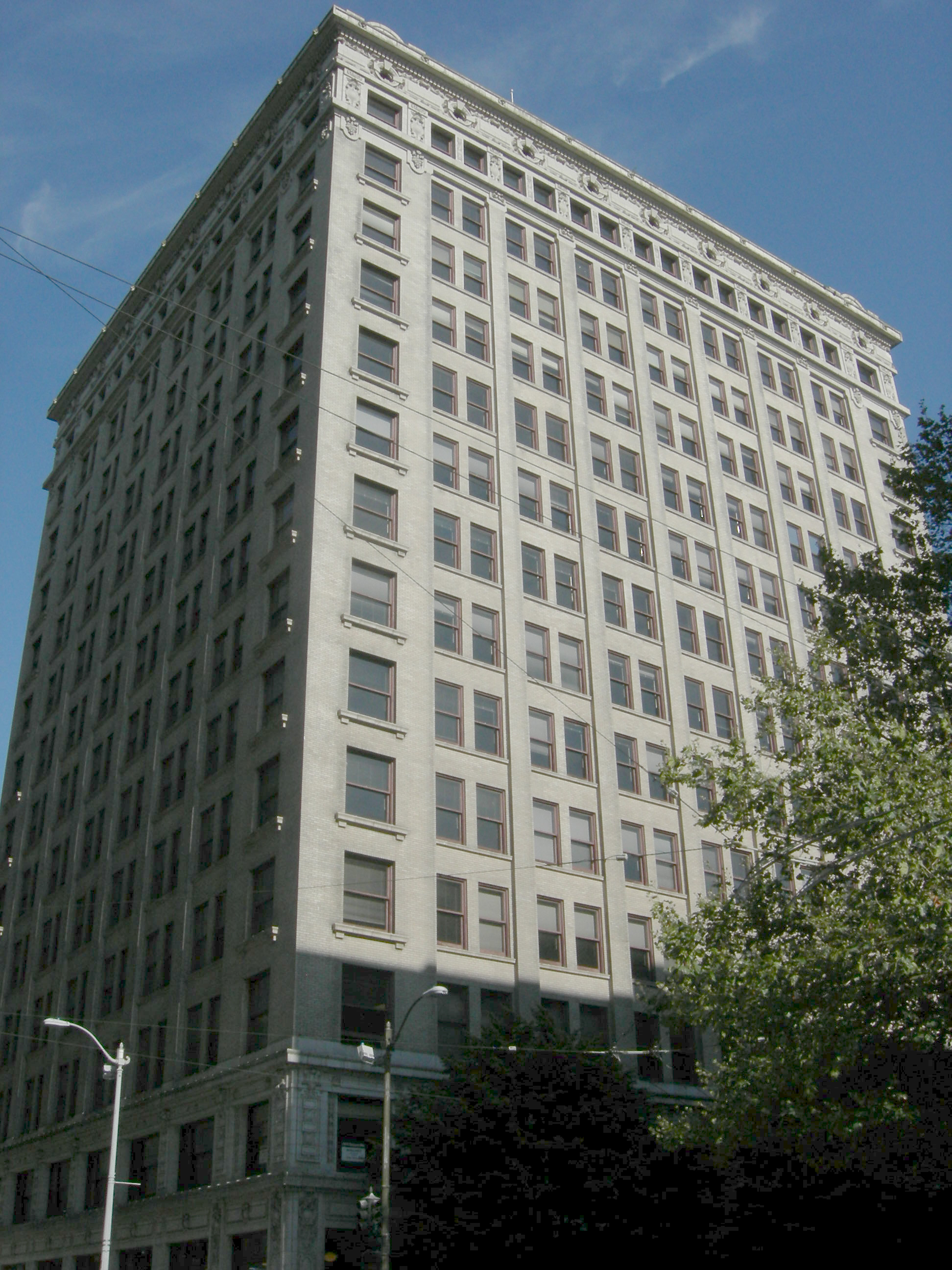
Alaska Building
For years, a gold nugget was embedded in the front door of the Alaska Building, a reminder to every person who entered of the stampede that made this fourteen-story tower possible. In 1897, Alaskan prospectors stepped off a ship at a Seattle wharf carrying what newspapers described as a "ton of gold," and the city seized the moment, branding itself the "Gateway to the Klondike." The marketing campaign worked beyond anyone's expectations. Money, people, and ambition poured into Seattle, and within seven years the boomtown spirit had produced something no one in the Pacific Northwest had seen before: a steel-frame skyscraper rising fourteen stories above the corner of Second Avenue and Cherry Street.
A Skyscraper Built on a Stampede
The Alaska Building began with a land deal in 1903. Seattle's Scandinavian-American Bank, directed by Jafet Lindeberg -- one of the three "Lucky Swedes" who struck gold in Nome in 1898 -- along with John Edward Chilberg and other shareholders, purchased the southeast corner of Second Avenue and Cherry Street from the Amos Brown estate. The original plan was a modest bank building, but J.C. Marmaduke of St. Louis proposed a far more ambitious partnership. Caught up in the boomtown fever, the bank's shareholders endorsed the project without hesitation. They hired the St. Louis architectural firm Eames and Young, with local architects Saunders and Lawton supervising construction, and contractor James Black Masonry Construction broke ground. Eleven months later, the building was finished -- Seattle's first steel-frame structure of any height, and the tallest building in the state of Washington.
Beaux Arts on the Second Avenue Canyon
The Alaska Building's terra cotta exterior and Beaux Arts ornamentation set it apart from everything else in early twentieth-century Seattle. The style was a rarity in the city, with the nearby Frye Hotel being one of the few other Beaux Arts examples in the Pioneer Square-Skid Road Historic District. Porthole windows lined the top floor, looking out over the waterfront and providing views of the shipbuilding, shipping, and rail industries that the gold rush had encouraged. When the building opened, the Alaska Club -- a commercial organization of entrepreneurs and residents with ties to the Far North -- occupied the penthouse, maintaining a reading room stocked with Alaska newspapers and mineral exhibits. The Scandinavian-American banking hall filled the main floor. The building heralded a wave of imposing structures along Second Avenue, which soon earned the nickname "Second Avenue canyon" as towers rose on both sides of the street.
From Tallest Tower to Hotel Lobby
The Alaska Building held the title of Seattle's tallest building for nearly a decade, losing it only in 1911. It held the broader distinction of Washington state's tallest until 1910, when Spokane's Old National Bank Building surpassed it. As Seattle's skyline grew around it, the Alaska Building settled into a quieter role on the northern edge of the Pioneer Square Historic District, which was established by city ordinance in 1970 and listed on the National Register of Historic Places that same year. In 1982, architects Stickney and Murphy rehabilitated the building, preserving its historic character. Then, in December 2007, American Life, Inc. purchased the property for $38.7 million and began converting it into a hotel. When the Courtyard by Marriott opened in June 2010, the renovation preserved the original exterior, the marble lobby, the crown molding, the window framing, and the wood pillars -- physical links to the gold rush era that built the tower.
Gold Rush, Still Standing
Lisa Mighetto and Marcia Babcock Montgomery captured the building's significance in their book Hard Drive to the Klondike: "This fourteen-story structure symbolized the significance of the gold rush in Seattle. The porthole windows along the top floor looked out over the waterfront, providing a view of the shipbuilding, shipping and rail industries that the gold rush encouraged." The Alaska Building remains a dominant presence at the northern cusp of Pioneer Square, a district where the brick and stone buildings of the 1890s and 1900s still define the streetscape. Today's hotel guests sleep in rooms shaped by Klondike ambitions, and the building's Beaux Arts facade still anchors a block that has witnessed Seattle's transformation from boomtown to metropolis. The gold nugget is gone from the front door, but the tower it adorned still stands as one of the most tangible monuments to the fever that made Seattle a city.
From the Air
The Alaska Building is located at 47.603N, 122.333W on the corner of Second Avenue and Cherry Street in Seattle's Pioneer Square district. From the air, Pioneer Square is identifiable as the cluster of older, lower-rise brick and stone buildings at the southern end of downtown Seattle, bordered by the waterfront to the west and the sports stadiums (T-Mobile Park and Lumen Field) to the south. The Alaska Building's terra cotta facade and porthole-windowed top floor distinguish it from surrounding structures at lower altitudes. Nearest airports: Boeing Field/King County International (KBFI) 4nm south, Seattle-Tacoma International (KSEA) 11nm south, Renton Municipal (KRNT) 9nm southeast.