Alaska-Yukon-Pacific Exposition
William Boeing walked through the fairgrounds in 1909 and saw a manned flying machine for the first time. He left fascinated with aircraft, and within a decade he would found the company that bears his name. The Alaska-Yukon-Pacific Exposition did that to people -- it showed them possibilities. Held on the largely undeveloped campus of the University of Washington, the A-Y-P was Seattle's bid to prove it belonged on the world stage, a city barely fifty years old throwing open its doors and declaring itself the gateway to Alaska, the Yukon, and the entire Pacific Rim. Over four and a half months, from June 1 to October 16, more than 3.7 million people walked through its gates.
A Gold Rush Dream, Delayed
The idea belonged to Godfrey Chealander, Grand Secretary of the Arctic Brotherhood, who had helped organize Alaska Territory's exhibit at the 1905 Lewis and Clark Exposition in Portland. He pitched Seattle Times city editor James A. Wood and Alaska Club member William Sheffield on a permanent Alaska exhibit in Seattle. Wood had bigger ambitions -- an exposition to rival Portland's. They soon gained the backing of Times publisher Alden J. Blethen, and remarkably for the era, even the rival Seattle Post-Intelligencer declined to oppose the plan. Originally scheduled for 1907 to mark the tenth anniversary of the Klondike Gold Rush, the fair was postponed when organizers learned of the Jamestown Exposition that same year. The delay proved fortunate: 1907 brought an economic downturn that would have doomed the venture. By 1909, the economy had recovered and Seattle was ready.
The Mountain as Centerpiece
Edmond S. Meany proposed holding the fair on the University of Washington campus, which in 1905 had exactly three buildings and thick stands of second-growth forest. The location seemed impossibly far from downtown, but Meany argued the forest itself would attract visitors and the trolley ride would not deter them. He was right, and he knew something else: whatever the fair built would remain long after the crowds left. The Olmsted Brothers, already designing Seattle's park system, were hired to plan the grounds. When John C. Olmsted visited in October 1906, Mount Rainier dominated the southeastern horizon. He seized on it, aligning the exposition's central axis directly toward the volcano. That axis became Rainier Vista, still the defining sight line of the university campus. The principal landscape architect, James Frederick Dawson, designed a long reflecting pool with cascading waterfalls along the vista -- a composition of water, symmetry, and mountain that anchored the entire fair.
Opening Day Fireworks
At 8:30 on the morning of June 1, 1909, the gates opened and crowds poured in. By 9:30, military bands from the Army and Navy were performing in the amphitheater. The real spectacle came at noon Seattle time, when President William Howard Taft, seated in the East Room of the White House, pressed a gold telegraph key studded with nuggets from the first Klondike mine. The telegraphic spark traveled three thousand miles. When it arrived, a gong struck five times, a massive American flag unfurled, and a 21-gun salute thundered across campus. Opening Day was declared a city holiday; 80,000 people attended. Seattle Day drew 117,013. Japan and Canada were the only foreign nations to erect entire buildings, but their presence -- along with exhibits from Hawaii and the Philippines -- validated the 'Pacific' theme the Seattle Chamber of Commerce had insisted on adding to the fair's name.
Shadows on the Midway
Not everything at the A-Y-P reflected well on its era. The fair included human exhibits that displayed Igorot people from the Philippines, presenting them as curiosities for paying crowds. Over one hundred Filipino merchant marines signed a letter of protest to the Seattle Post-Intelligencer. A Chinese village exhibit depicted opium dens and referenced the Boxer Rebellion. In one of the fair's most troubling episodes, a month-old orphaned boy named Ernest was raffled away as a prize; a winning ticket was drawn, but nobody claimed the child. His fate was still being investigated a century later. Labor unions protested the use of non-union workers to build the exposition, organizing a march on Labor Day. The Seattle Socialist called the fair "a great fantastic monument to the brutal avarice of the capitalist class." These were real people caught in the machinery of spectacle, and the fair's legacy is incomplete without acknowledging what the celebration cost them.
What the Fair Left Behind
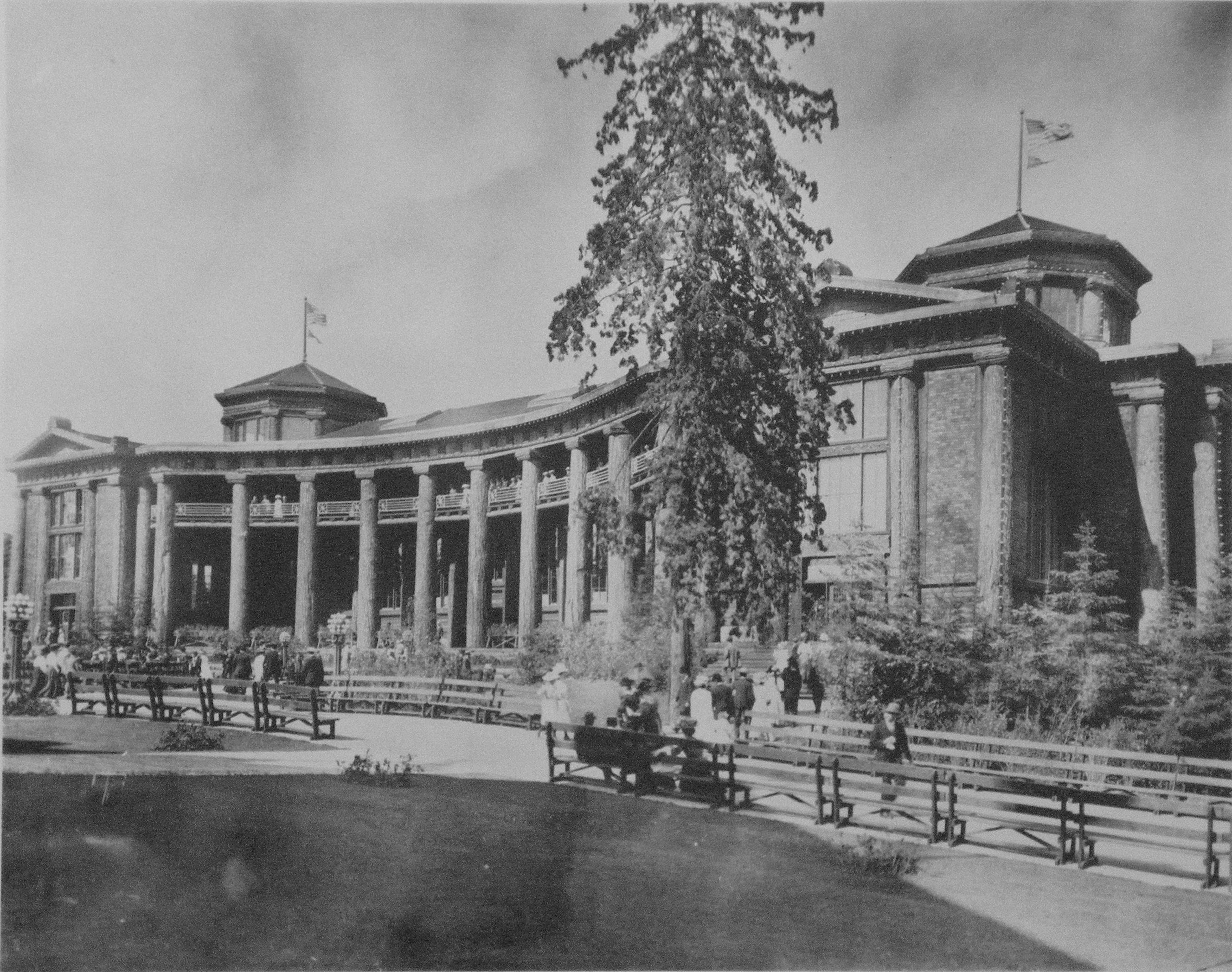
Most A-Y-P buildings were designed as temporary structures, but several survived to shape the university that grew around them. The Fine Arts Palace, built by Howard and Galloway as a future chemistry building, served that purpose for decades as Bagley Hall before becoming Architecture Hall, which still stands. The Women's Building, once clad in stucco, is now wood-sided Cunningham Hall, named for photographer Imogen Cunningham and one of the few campus buildings honoring a woman. The Forestry Building -- once the largest log cabin ever built, funded by $300,000 from King County -- proved impossible to maintain and was demolished mid-century; the Husky Union Building now occupies its site. Rainier Vista and Drumheller Fountain remain the campus's emotional center. The fair also elevated exposition president J. E. Chilberg from respected banker to social royalty, a man who found himself dining with relatives of the Emperor of Japan and hosting French ambassadors. But the deepest legacy may be Boeing's: a young man's glimpse of a flying machine at a world's fair in the Pacific Northwest, and everything that followed.
From the Air
Located at 47.654N, 122.308W on the University of Washington campus. The former fairgrounds are clearly visible from the air: Rainier Vista runs southeast from the central campus as a broad green corridor aimed directly at Mount Rainier, with Drumheller Fountain (the original Geyser Basin) at its center. The campus is bordered by Portage Bay to the south, Union Bay to the east, and the University District neighborhood to the north and west. Nearest airports: Boeing Field (KBFI) 8nm south, Renton Municipal (KRNT) 9nm southeast, Kenmore Air Harbor (S60) 6nm north. Best appreciated at 3,000-5,000 feet on a clear day when Mount Rainier is visible along the same axis the Olmsted Brothers chose in 1906.