Albanian Riviera
The Albanian Riviera remained hidden while the rest of the Mediterranean developed, locked behind Enver Hoxha's paranoid isolation until 1991. While tourists packed the Greek islands visible from its shores, Albania's southwestern coast sat empty except for concrete bunkers built against imaginary invasions. That history of enforced preservation created an unlikely gift: some of Europe's most beautiful and least developed coastline, now slowly opening to visitors who discover what the Adriatic and Ionian looked like before mass tourism transformed them. The Riviera stretches from Palase in the north, where legend says Julius Caesar threw his wine cup into the sea, to Lukove in the south, where black-dressed village women still invite strangers in for meals. Between them lie turquoise coves accessible only by boat, stone villages clinging to mountainsides, Byzantine churches, Ottoman fortresses, and beach bars playing electronic music for backpackers who've found Europe's last budget destination.
The Coastline
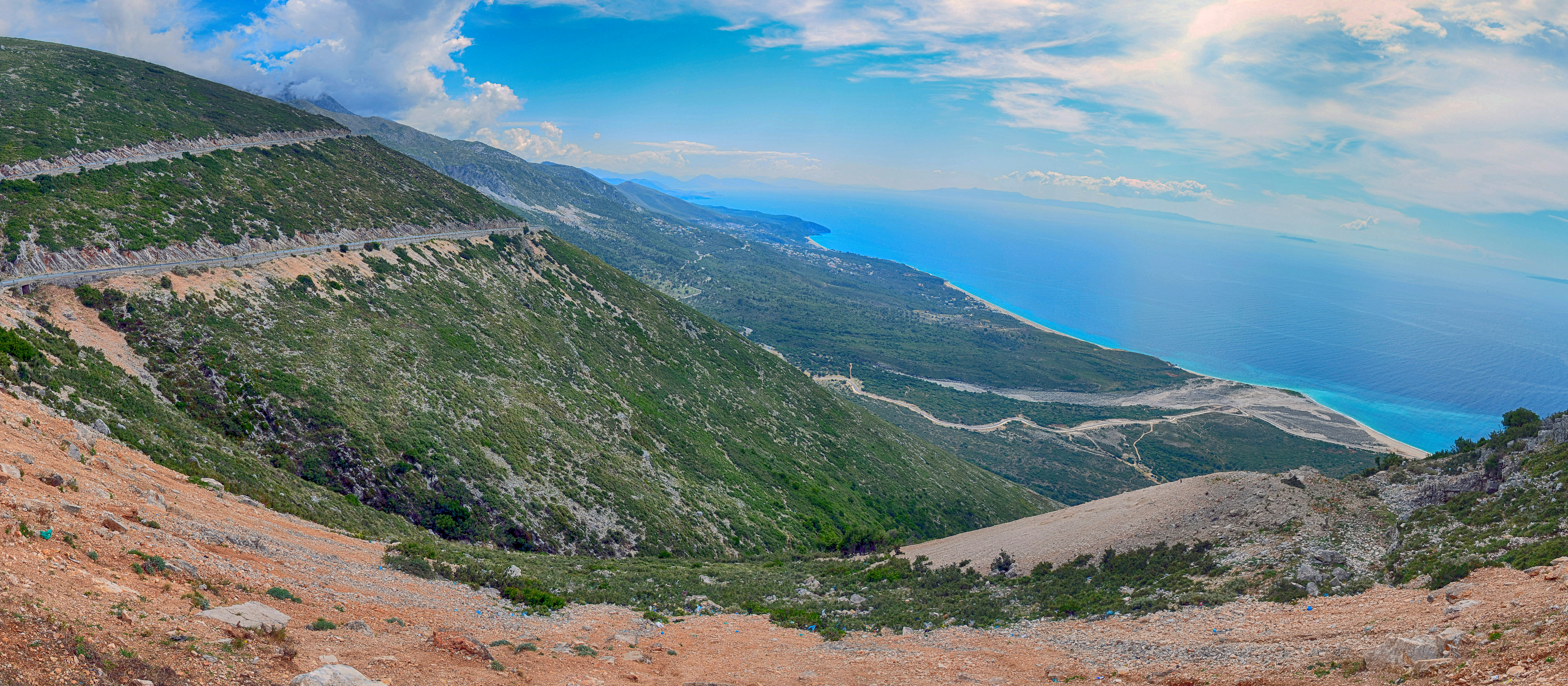
Dramatic topography defines the Riviera. Mountains rise directly from the sea, their slopes terraced with olive groves and dotted with stone villages built for defense rather than convenience. The road from Vlore crosses Llogara Pass at over a thousand meters, offering views that encompass the entire coastline spread below - then descends through hairpin curves to beaches that remain remarkably empty compared to neighboring Greece or Croatia. Each village claims its own beach: Dhermi draws the party crowd with trendy beach clubs; Jale offers multiple coves including one called the Aquarium for its clarity; Porto Palermo features a fortress built by Ali Pasha on a near-island overlooking turquoise water; Borsh stretches for kilometers along shores lined with orange and lemon groves. The water clarity throughout rivals the Caribbean, the result of minimal development and strong currents through the Strait of Corfu.
Historical Layers
History has accumulated here like sediment in the coves. The ancient Greeks established colonies along this coast; their archaeological remains dot the landscape, particularly at Butrint, a UNESCO site south of Sarande. Romans followed - Caesar himself passed through Llogara during his pursuit of Pompey, giving Caesar's Pass its name. Byzantine Christianity left churches throughout the mountains; some date to the 12th century and remain in active use. Ottoman rule built the castles that crown strategic points, including Porto Palermo's pentagonal fortress and the ruins overlooking Himara, rebuilt by Justinian in the 6th century. Then came communism's concrete bunkers - over 170,000 scattered across Albania, many still visible on beaches and hillsides, bizarre mushroom shapes now serving as informal changing rooms or simply conversation pieces about a history few visitors expected to encounter on a beach holiday.
Village Life
The villages above the beaches preserve a way of life increasingly rare in Europe. Stone houses cluster around Orthodox churches whose bells mark the passing hours. Elderly women in traditional black tend vegetable gardens and keep goats; their hospitality extends to strangers who wander up the decorated footpaths. Many villagers are bilingual, speaking Albanian and Greek - a legacy of the large Greek minority in this region. The accent of tradition grows stronger as you move south: Piqeras sits on a hilltop with views to Corfu; Nivice keeps a 300-year-old olive tree in its village square; Shen Vasil's 200-year-old tree anchors a community where a candle-lighting post marks where a church stood before communist destruction. These villages offer something the beach clubs cannot: connection to a culture that survived isolation and now welcomes those who make the climb from the coast.
Changing Fast
The secret is out, and the Riviera is changing. Each summer brings more visitors; each winter brings more construction. Beach clubs multiply; prices rise; what cost five euros three years ago now costs fifteen. The new Vlora International Airport, expected to open soon, will bring the first direct international flights to the region, potentially transforming access and development patterns. The Tren Maya of Albania - improved roads from Tirana - already make the journey easier each year. Music festivals like Soundwave Albania draw thousands to beaches that once saw only locals. Long-term visitors debate whether to mourn the changes or celebrate their own good timing. The Mediterranean's development pattern - from fishing villages to tourist destinations to overdeveloped strips - has repeated so often that predicting the Riviera's future requires little imagination. For now, empty coves still exist for those willing to hike or take boats; village grandmothers still offer homemade raki; prices remain fraction of neighboring Greece.
Practical Matters
Most visitors arrive via Tirana airport, then drive south through improving roads - about four hours to the northern Riviera, longer for the southern stretches. Ferries from Corfu connect to Sarande in the south, offering a scenic alternative. The coastal road SH8 is dramatically beautiful but demanding: narrow sections, tight curves, minimal barriers, and occasional livestock require attention. July and August bring the largest crowds and highest prices; June and September offer better balance. Accommodation ranges from campsites in olive groves to boutique hotels in renovated stone houses to simple guesthouses where families rent spare rooms. Cash remains essential - ATMs exist but often empty in high season. Local specialties include fresh fish, lamb roasted over open fires, locally pressed olive oil, and whatever fruit ripens on the terraces above. The beaches require no fee; the beauty costs nothing but the journey to reach it.
From the Air
Located at 40.07°N, 19.76°E along Albania's Ionian coast. The Riviera appears from altitude as a steep mountainous coastline with villages visible on terraced slopes above small coves. The distinctive Llogara Pass crossing is visible as a gap in the coastal mountains. Vlora lies to the north, Sarande to the south. The island of Corfu (Greece) is visible across the strait to the southwest. Karaburun Peninsula extends into the sea west of Vlora. Tirana International Airport (TIA) lies 150km northeast. The new Vlora International Airport (VLO) is under development.