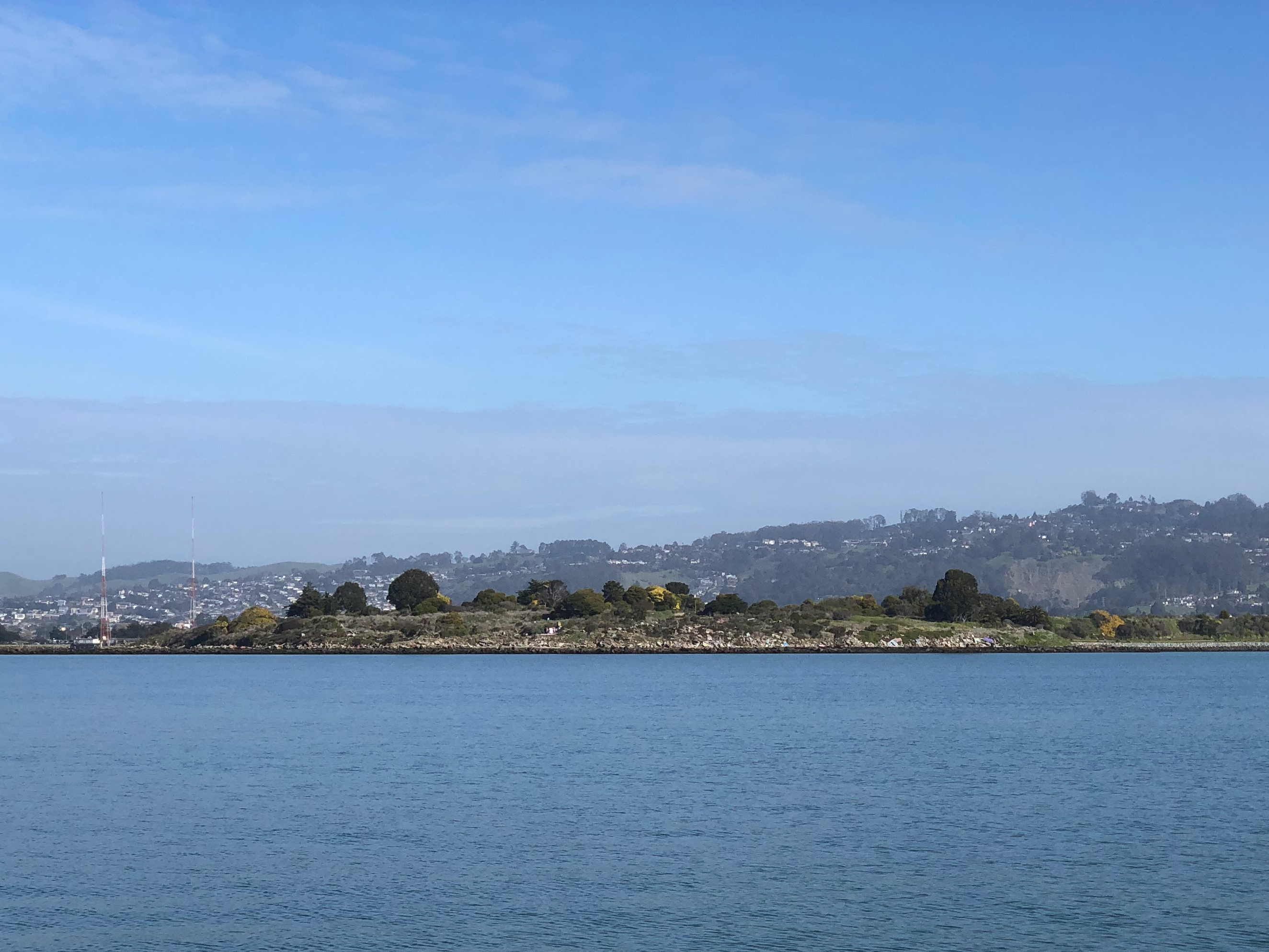
Albany Bulb
Somewhere on the southwest corner of a peninsula made entirely of construction debris, a concrete and plaster castle faces the Golden Gate Bridge. Its builder, a long-time resident known as Mad Marc, constructed it from the same rebar and rubble that forms the ground beneath it. The Albany Bulb is that kind of place -- a landscape that refuses to behave like what it technically is. On paper, it is a former landfill, a round-topped hill of concrete chunks and twisted metal pushed into San Francisco Bay by decades of dumping. In practice, it became one of the Bay Area's strangest and most contested public spaces: part art gallery, part wildlife refuge, part homeless encampment, part dog park, and entirely unlike anywhere else on the shoreline.
Built from Dynamite and Debris
The Bulb's origin story begins with an explosion. In 1939, the Santa Fe Railroad dynamited El Cerrito del Sur, a low hill on Fleming Point southwest of Albany Hill, to clear ground for Golden Gate Fields race track. The rubble was shoved into the bay to create parking lots. Albany extended Buchanan Street westward on fill, and a lagoon formed between the new road and the racetrack's northern edge. Dumping continued for decades, extending the peninsula farther into the bay. The round hill at the tip -- the Bulb proper -- was created in 1963 after Albany signed a disposal contract with Santa Fe Railroad. The method was blunt: enclose a section of shallow bay with rock and concrete riprap, fill the lagoon with garbage and debris, and cap it with clay. Save the Bay fought this filling from the 1960s onward. Lawsuits finally halted the dumping in 1983, but by then the peninsula existed, a stub of human refuse jutting into one of the world's most beautiful estuaries.
The Gallery Nobody Curated
Nature abhors a vacuum, and so does art. As the dumping stopped and the Bulb was left alone, artists began arriving. The Sniff collective -- Scott Hewitt, Scott Meadows, and David Ryan -- painted enormous murals on salvaged wood and erected sculptures on the peninsula's northwest corner during the 1990s. Sculptor and activist lawyer Osha Neumann, often collaborating with his son-in-law Jason DeAntonis, created some of the largest works on site, including a towering female figure assembled from scrap wood and metal that locals call the Beseeching Woman or Water Lady. The medium was always the landscape itself: driftwood, rebar, concrete, whatever the tide and the landfill offered up. In 2006, the Bay Area theater company We Players staged Shakespeare's The Tempest in an amphitheater built from landfill materials -- a play about a sorcerer stranded on a strange island, performed on a strange island made of garbage. The casting was perfect.
Residents Without Addresses
Starting in the early 1990s, people without housing began settling on the Bulb. The Albany Police Department had standing orders not to enforce the camping ban, and a community grew -- loosely organized, self-governing in the way that places without governance tend to be. By 1999, the population reached fifty or sixty people, and the city carried out a mass eviction. Residents filtered back. By 2013, more than forty people were living on the Bulb again. That May, the Albany City Council voted to evict them, eventually offering thirty residents three thousand dollars each to leave as part of a legal settlement with the East Bay Community Law Center. Twenty-eight accepted. Two -- Amber Whitson and her partner Phyl Lewis -- refused. On May 29, 2014, at four in the morning, Albany police arrived at the Bulb with assault rifles and arrested Whitson, Lewis, and a supporter named Erik Eisenberg on lodging charges. The story of the Bulb's homeless community is not a simple one. These were people who built shelters, made art, and formed a neighborhood in a place no one else wanted. Their removal was documented in two films: Bum's Paradise in 2003 and Where Do YOU Go When It Rains? in 2013.
Falcons on the Landfill
The debris peninsula altered San Francisco Bay's currents, pushing tidal mudflats westward at the mouths of Codornices, Village, and Marin Creeks. These Albany Mudflats became important habitat for shorebirds and waterfowl. Peregrine falcons and ospreys perch on wooden posts to eat their catches. Burrowing owls winter on the Plateau, a flat area once popular for flying model airplanes that has been partly fenced to protect them. The ecology is complicated by invasion: pampas grass, English ivy, French broom, and iceplant have damaged habitat for species like the Townsend's warbler and the white-tailed kite, both considered threatened. Regular inspections by CalRecycle have found no significant contamination, which is why the site remains uncapped -- the rebar and rubble simply persist as topography, slowly being claimed by soil and roots.
Whose Bulb Is It?
In 2002, after seventeen years of effort by Citizens for Eastshore State Park, the Plateau and lower Neck became part of Eastshore State Park. The Bulb itself remains under Albany's ownership, though the city has tried to transfer it to State Parks or the East Bay Regional Park District. Neither entity is eager to accept liability for a landscape bristling with exposed concrete and rebar. Meanwhile, the Bulb has become one of the most heavily used outdoor recreation sites on the bay. In 2016, the nonprofit Love the Bulb formed to protect the site's artistic identity and environmental value, hosting the Bulbfest arts festival in 2018 and 2019 and planting a native species garden. A 2010 community study found that sixty-two percent of Albany residents wanted to expand waterfront open space by at least seventy-five acres, though half also wanted enough development to maintain the $1.7 million in annual tax revenue that Golden Gate Fields generates. The Bulb exists in that tension: a place everyone values and no one quite knows how to manage, built from what people threw away.
From the Air
Located at 37.89N, 122.325W, the Albany Bulb is a distinctive peninsula shape clearly visible on the East Bay shoreline. It juts westward into San Francisco Bay just north of Golden Gate Fields race track, which is identifiable by its oval track shape. Best viewed below 2,500 feet. The Bulb's round tip and narrow neck are easy to spot from the air. Point Isabel lies to the north; the Berkeley Marina extends to the south. Metropolitan Oakland International Airport (KOAK) is approximately 12 nm to the south-southeast. The Golden Gate Bridge is visible to the west-southwest across the bay.