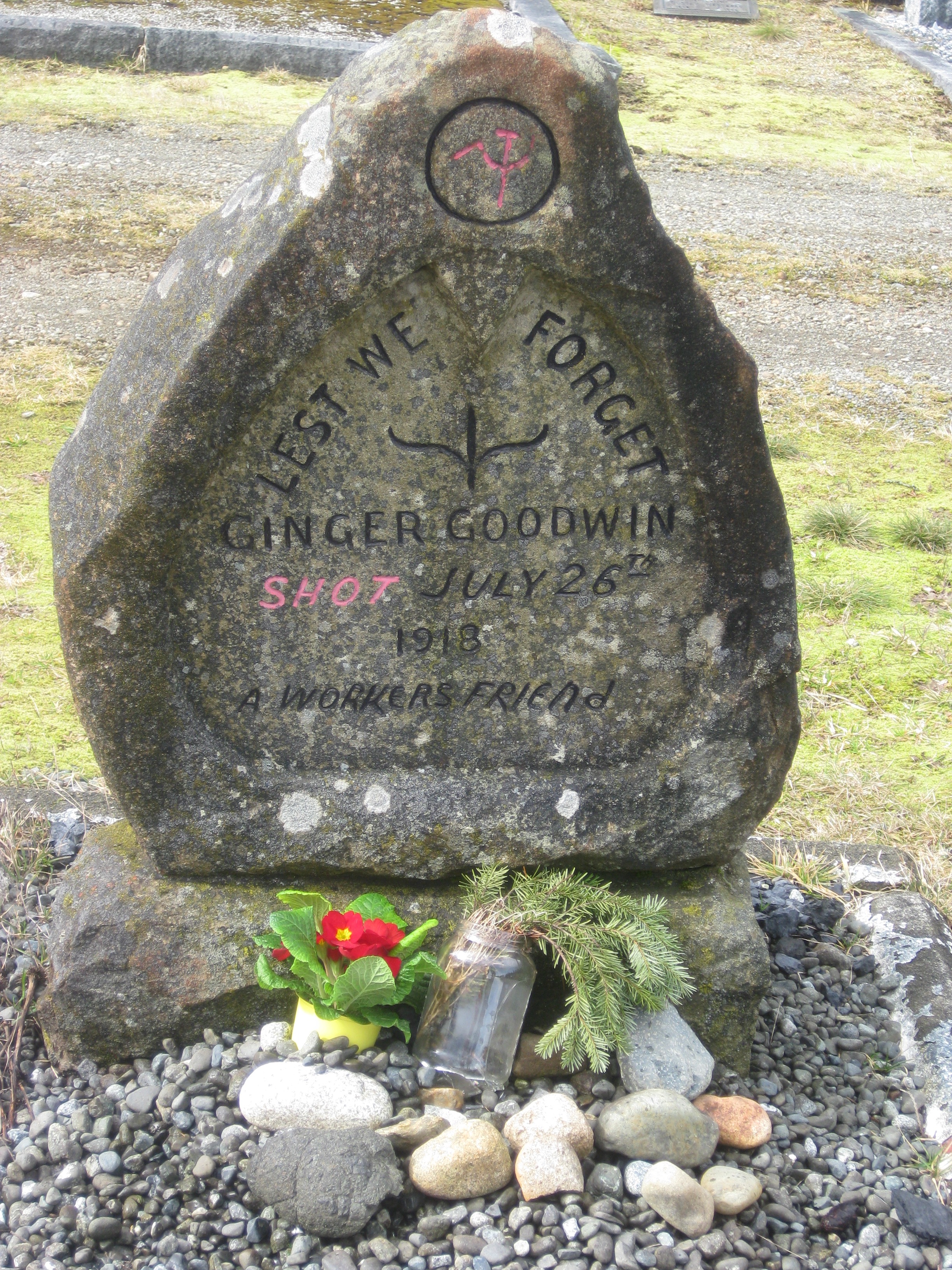
Albert Goodwin
They called him Ginger for his bright red hair, and he burned with a conviction that matched it. Albert "Ginger" Goodwin was born on May 10, 1887, and by the time a police officer's bullet killed him in the forests near Cumberland, British Columbia, on July 27, 1918, he had organized strikes, served as a delegate for the British Columbia Federation of Labour, run for provincial office with the Socialist Party of Canada, and become one of the most visible opponents of military conscription during World War I. He was 31 years old.
From English Pit to Canadian Coalface
Goodwin emigrated from England to the coal mines of British Columbia, bringing with him a firsthand understanding of the exploitation that powered industrial capitalism. The conditions in British Columbia's mines were brutal: long hours underground, inadequate safety, wages that barely covered subsistence, and companies that treated any attempt at organization as an act of war. Goodwin threw himself into the labor movement with an intensity that alarmed both employers and government officials. He participated in and led multiple strikes, fighting for higher wages and safer conditions, and served as an organizer for the Socialist Party of Canada. In the 1916 provincial election, he ran as the party's candidate in Trail, a smelting town in the Kootenays.
Unfit to Serve, Fit to Die
When military conscription was imposed during World War I, Goodwin was initially exempted after a medical examination found him unfit for service. But as his political activity intensified, his draft classification was mysteriously revised, making him eligible for conscription. Whether this reclassification was a deliberate attempt to silence a troublesome labor organizer or a routine administrative review remains debated by historians. Goodwin refused to report. He fled into the bush near Cumberland on Vancouver Island, where sympathizers supplied him with food and information. On July 27, 1918, Dominion Police officer Dan Campbell tracked Goodwin down and shot him. Campbell claimed self-defense. Others believed he was acting under special military orders to eliminate an agitator.
The Day Vancouver Stopped
Goodwin's death ignited a fury that swept far beyond the coal towns of Vancouver Island. On August 2, 1918, workers in Vancouver walked off their jobs in what is widely considered Canada's first general strike, a one-day action that shut down the city and signaled the depth of anger over conscription, labor repression, and the circumstances of Goodwin's killing. The strike was brief but its symbolic weight was enormous, demonstrating that the labor movement could mobilize across industries and regions in response to an injustice perpetrated against one of its own. Goodwin, who had spent his life arguing that workers must "organize as a class and fight them as class against class," had become in death the catalyst for exactly the kind of collective action he had advocated.
A Name on the Highway, Flowers on the Grave
Ginger Goodwin's legacy has been contested ever since his death. In 1996, a section of Highway 19 passing through Cumberland was named Ginger Goodwin Way, but the province's Liberal government removed the signs in 2001. The NDP government reinstalled them in 2018. That same year, on the centennial of his death, the BC government proclaimed July 27 as Ginger Goodwin Day. Every year during Miners' Memorial weekend, people gather at his grave in the Cumberland cemetery to lay flowers and remember. In 2016, filmmaker Neil Vokey released Goodwin's Way, a documentary following the town of Cumberland as it resisted the opening of a new mine while resurrecting the legacy of the man who had fought the mine owners a century earlier. The red-haired miner from England is still stirring things up.
From the Air
Located at 49.637N, 125.007W near Cumberland, British Columbia, on Vancouver Island. Cumberland is a small town visible inland from the Comox Valley, surrounded by forest. Goodwin's grave is in the Cumberland cemetery. Nearest airport is Comox Valley Airport (CYQQ), approximately 10 km to the east. Highway 19 (Ginger Goodwin Way) passes through the town. Recommended viewing altitude 3,000-5,000 ft AGL for context of the town within the forested Comox Valley landscape.